Your cart is currently empty!
Category: Ranger News
General News from Arbor Rangers. Announcements, Events, Activities etc.
-
MULCH Around Trees – Why?
[Last update: November 2025]
Quick Links to Topics Covered in This Article:
INTRODUCTION • Mulching Can Be a Hassle, So WHY Do It?
Mulch – What Is It and Why Beneficial? • Properly Applied Mulch
AVOID Volcanic Mulching!
INTRODUCTION: MULCH: The Ugly, The Bad, and The Good
Most property owners are conscientious about the appearance of their landscapes. They will spend hundreds, even thousands of dollars to enhance their property’s “curb appeal.” This is particularly the case if they want to build equity in their property and perhaps sell their home in the future. A properly maintained property with a healthy-looking lawn and a complement of aesthetically pleasing trees, shrubs, and flowers can do wonders for it’s value!

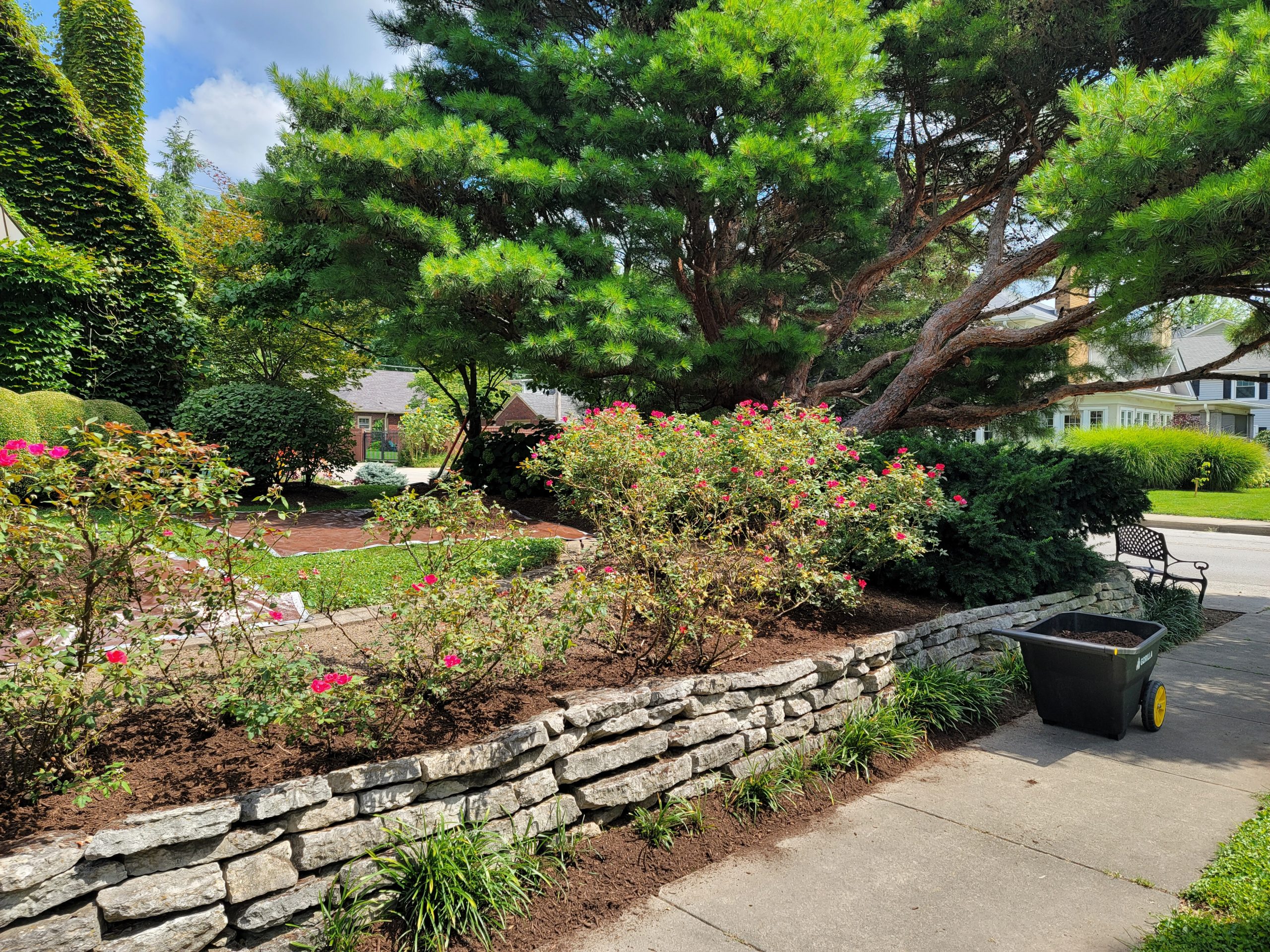
Properly applied mulch in the landscape can produce environmental benefits and add value and aesthetics to your property! In many landscapes, mulch plays an important role in adding balance and beauty to the landscape, but not everyone views mulch from the same perspective. Instead of being a happy marriage that joins aesthetics with functionality, aesthetics appears to take top priority, but in many cases is not applied properly! This is primarily where some major plant health care (PHC) problems develop in the landscape. This article will discuss a few common types of mulch used (the ugly, the bad, and the good), the benefits of properly applied mulch from a practical scientific viewpoint, and how improperly applied mulch can cause irreparable harm to your trees and shrubs.
Mulching Can Be a Hassle, So WHY Do it?
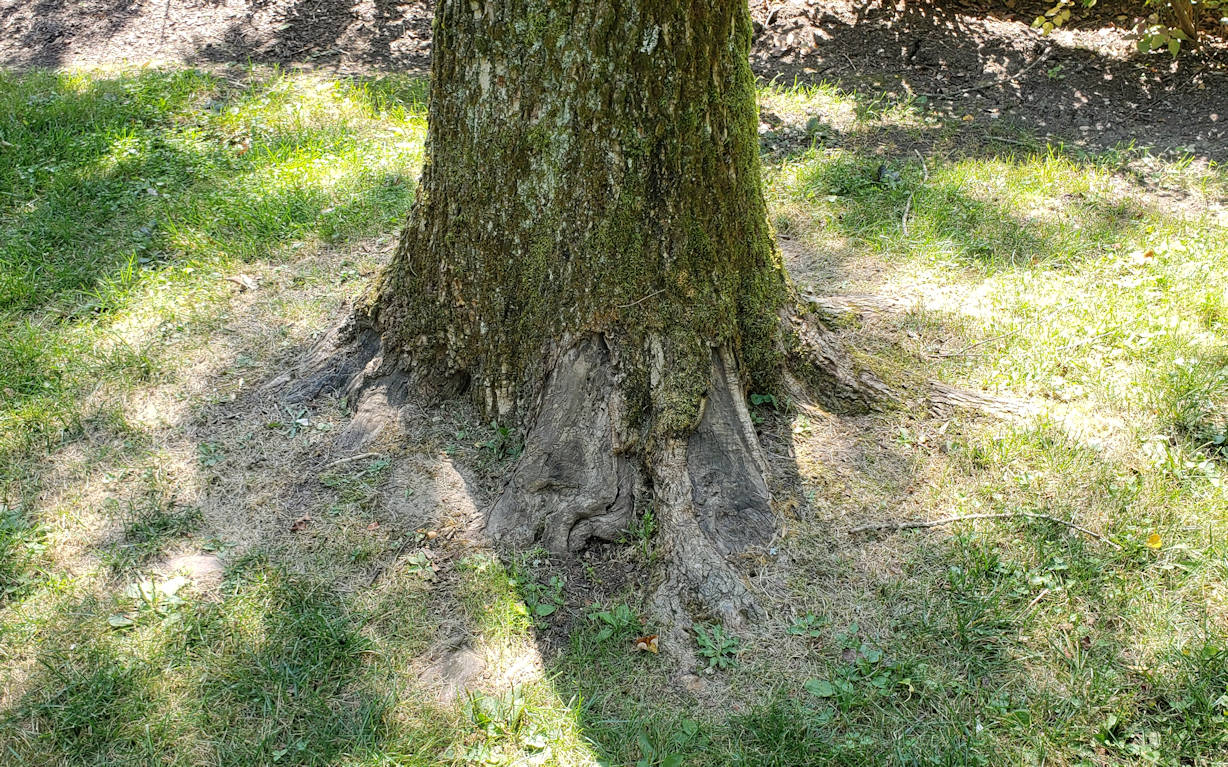
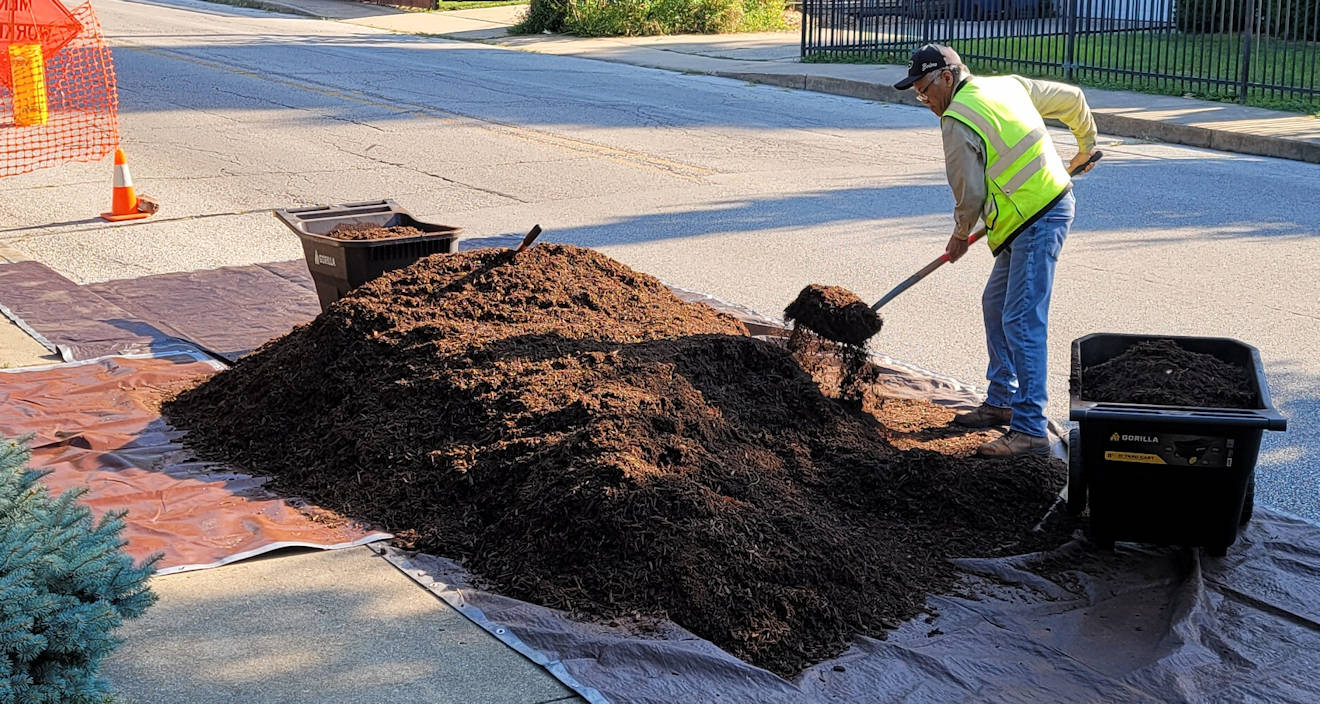
Let’s face it. Mulching can be a pain to have to do every year, and some property owners simply don’t like trouble and time it takes to do it themselves. There are many who don’t use mulch around their property at all and will let grass grow around the base of their landscape trees. That’s their decision, and it’s okay, but some safeguards are advised.
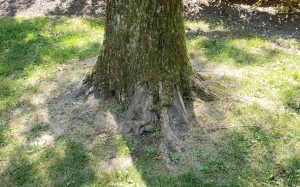
Lack of mulch around this mature tree resulted in the mower service severely damaging the trunk flare repeatedly over several years. This tree eventually died from these injuries and was taken down. Often plants lacking the protection of mulch will suffer injuries from weed-trimmers and mowing equipment (a.k.a., mechanical damage).
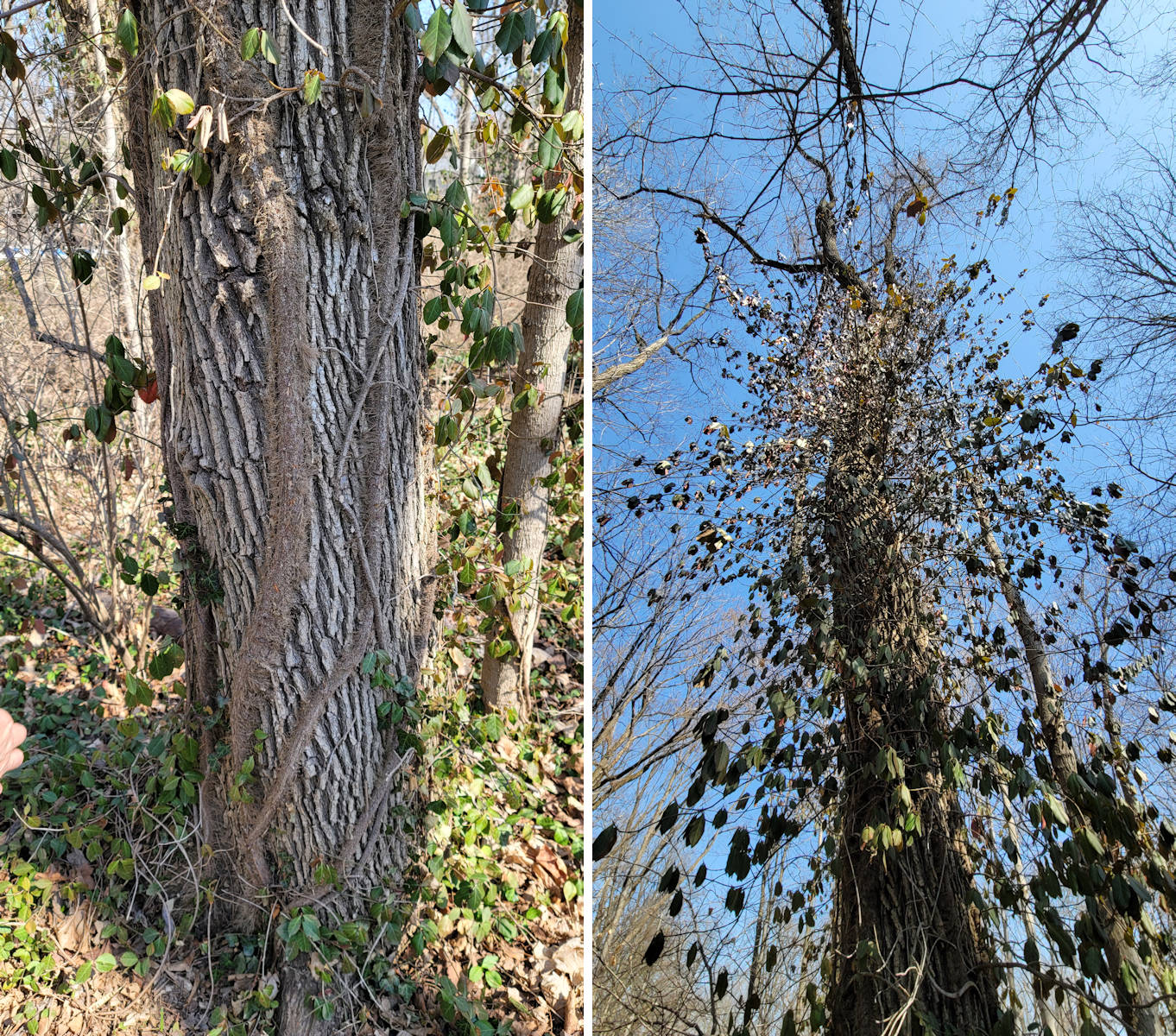
Sometimes ground covers, like ivy or euonymus vines, are used, but some of these crawling vines may have a tendency to creep up on plants, which can result in bark damage, crowding out sunlight, and strangling if left unmanaged.
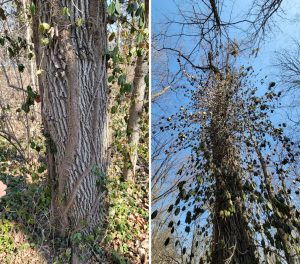
Overgrown vines on trees can damage the bark, crowd out sunlight light, and strangle the trunk stem. Alternatives to mulch have been very popular. A few well-meaning landscape designers have sold homeowners who dislike annual mulching and wanted another solution into using rubber mulch or stones in their landscape beds. Shredded rubber mulch (sometimes made from recycled rubber tires) can look very much like wood mulch, even upon closer inspection. The key benefit being promoted is that rubber mulch doesn’t break down like normal organic wood mulch, and, if used in playgrounds, for example, it’s a softer alternative, and kids wouldn’t get splinters. Ultimately, using rubber mulch means less frequent applications.
Stones like pea gravel, crushed pumice rock, riverbed rocks, and similar rocks have also been promoted for use in landscape beds. Many designer portfolios feature eye-catching landscapes with compellingly attractive pebble-covered landscape beds. The “bonus” again is that these stones don’t break down like organic mulch, and that immediately translates into no annual reapplications.
While it is true that non-organic mulches save time and effort of having to reapply every year, all too often, the greater benefits of organic mulching, as discussed in the next section, are overlooked or ignored.
Mulch is any material, organic or inorganic, that is spread on the soil’s surface in a landscape to conserve moisture, suppress weeds, moderate soil temperature, and improve appearance. Common organic mulches include wood chips, bark, straw, and leaves, which break down over time and add nutrients back into the soil. Inorganic options include gravel, rocks, or rubber, which can last longer but don’t improve soil quality. These types of materials are mostly for “looks” (a.k.a., curb appeal). Which type of mulch you choose depends on the aesthetic results you want to achieve, and while doing so, whether you also desire to improve the soil quality for your landscape plants or simply want a longer-lasting ground cover. Either choice will still require maintenance again when weeds reappear.
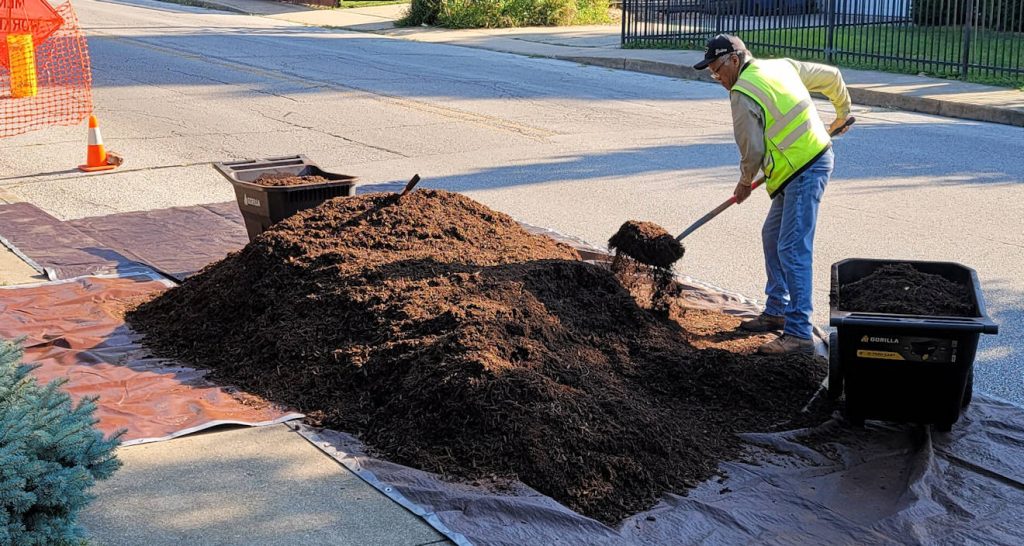
Hardwood mulch (wood chips) is a common organic material used for landscaping and has additional benefits when properly applied. Key functions of mulch in a landscape: The Benefits of Mulch
-
- Moisture conservation: A layer of mulch reduces water evaporation from the soil.
- Weed suppression: Mulch blocks sunlight, which helps prevent weed seeds from germinating.
- Temperature regulation: It helps keep soil cooler in the summer and warmer in the winter, protecting plant roots.
- Soil improvement: Organic mulches decompose, adding nutrients and improving soil structure over time. This is not a benefit produced by non-organic mulches.
- Erosion control: Mulch helps prevent soil from washing away due to heavy rain or foot traffic.
- Aesthetic enhancement: It provides a neat, finished look that contrasts with plants and can be chosen for specific visual effects.
In the following section, we are going to offer simple guidance on properly applying mulch around trees to gain the most benefits from using it in your landscape.
Properly Applied Mulch
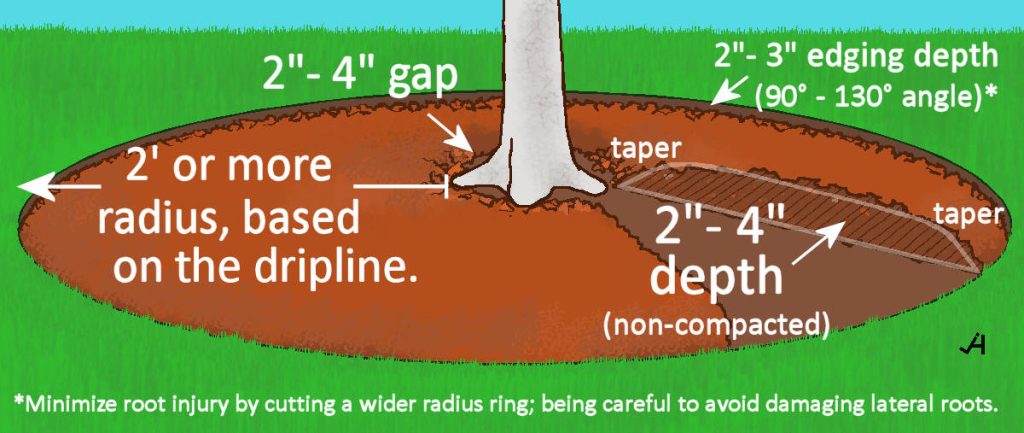
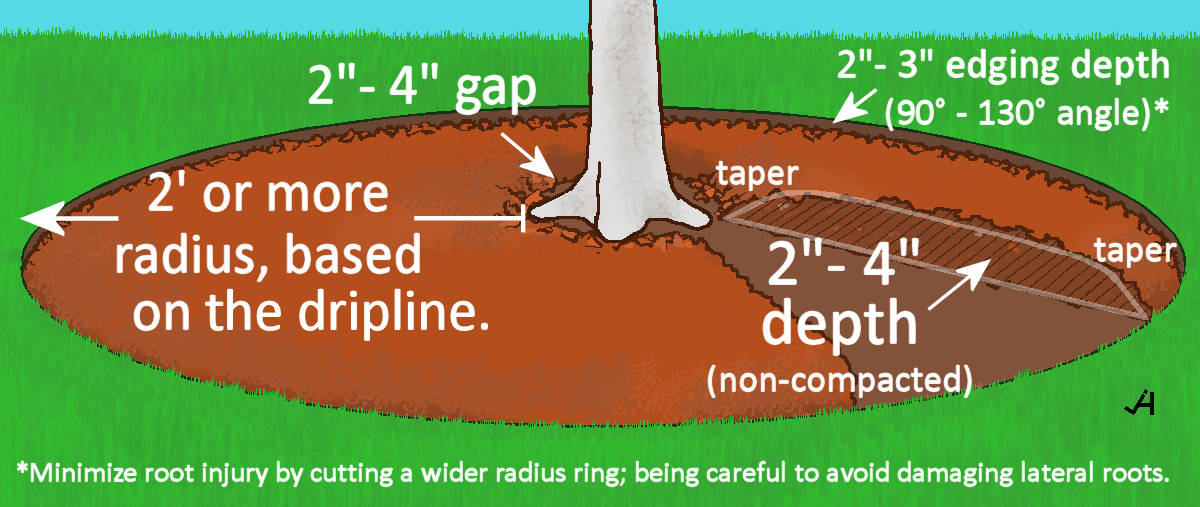
This diagram displays recommended basic guidelines for the successful application of organic mulch materials. Applying organic mulch correctly is key to a tree’s health, as improper mulching can cause rot, disease, and even damage to the trunk and its bark! Around individual trees, the “donut” (doughnut or mulch ring) method is recommended because it keeps the base of the tree at the trunk flare exposed (about a 2″ to 4″ gap), which will also minimize the development of girdling roots. The mulch should not be compacted, nor deeper than 4″. If cutting an edge around the mulch ring, use caution and avoid damaging the lateral roots underneath.
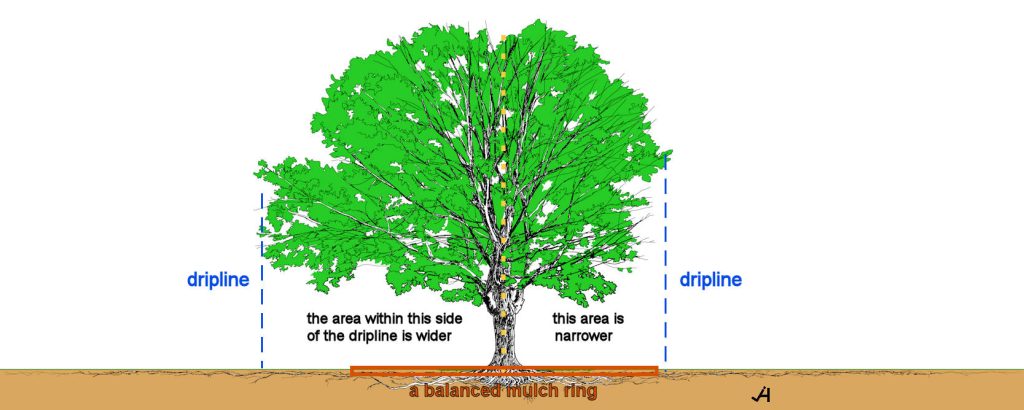
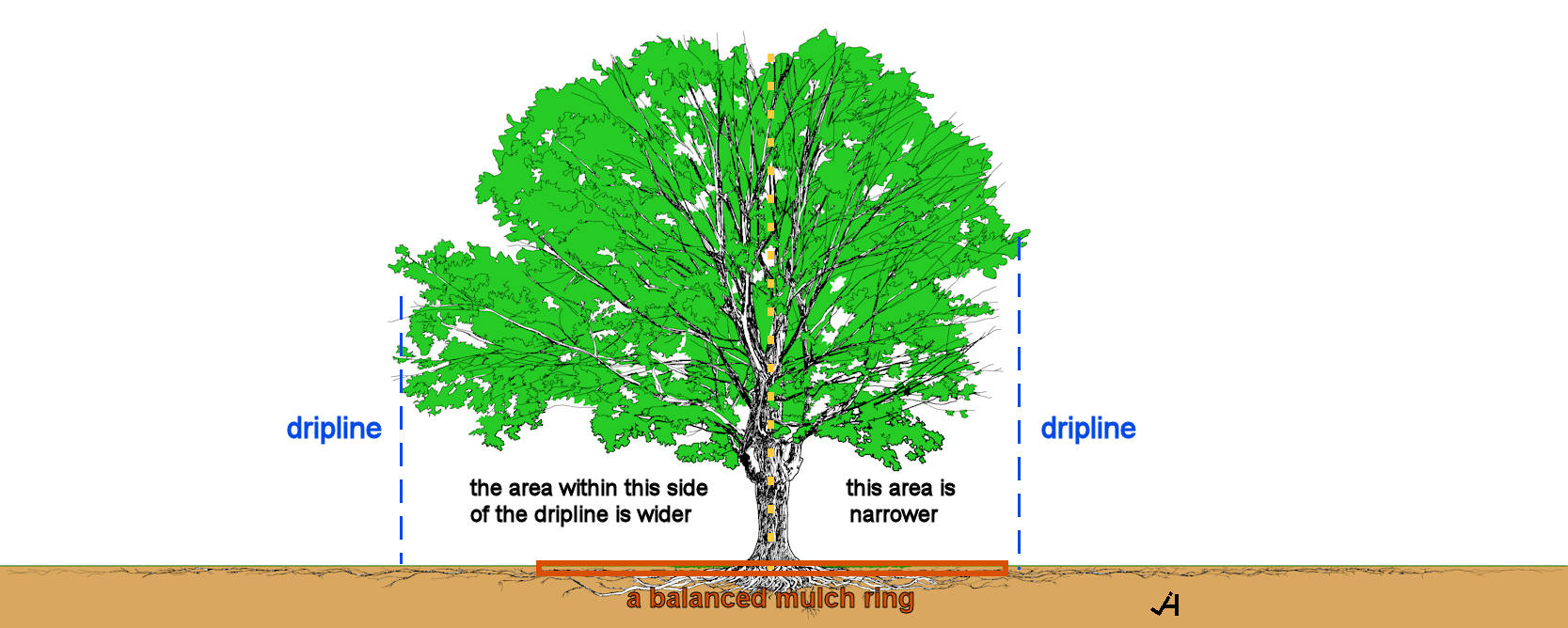
Base the diameter of your mulch ring on the dripline of the tree. Increase or decrease the diameter as best fits your property aesthetic needs. The diameter of the mulch ring should be based on the dripline of the tree. For newly planted seedlings, this may be as little as 2 feet across, but the ring size can scale up to several feet for mature trees. Of course, each property is unique, and your preference of mulch ring size will have to balance with how much turfgrass you prioritize for your lawn, so determine the size of each ring for what works for your landscape. Note that not all tree canopies, that is, the limbs and foliage that make up the “crown” or upper portion of a tree, grow equally, and so portions of the tree may extend further than others. Therefore, if there is a difference in the radius from the center of the tree on one side and the radius from the center of the tree on another side, determine the mulch ring diameter using the shortest dripline radius from the central trunk as your guide to balance the mulch ring to improve aesthetics.
AVOID Volcanic Mulching!
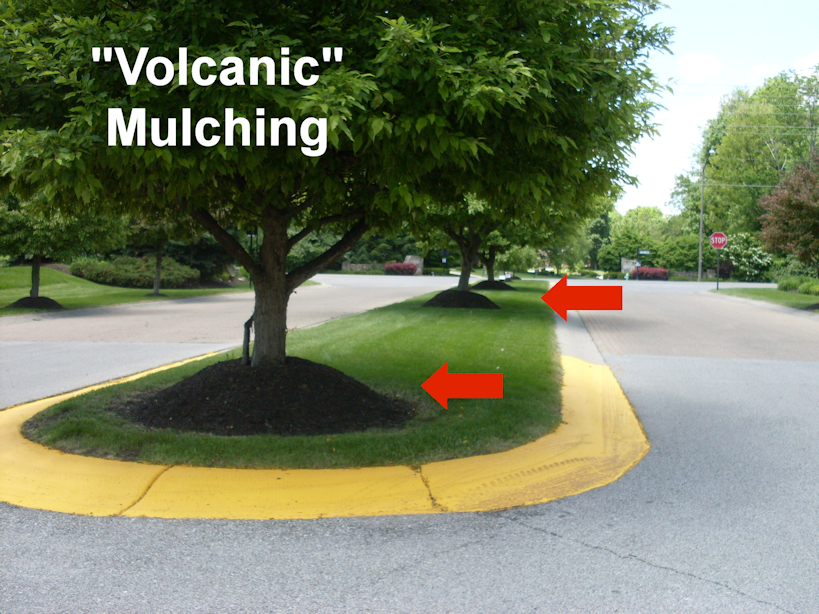
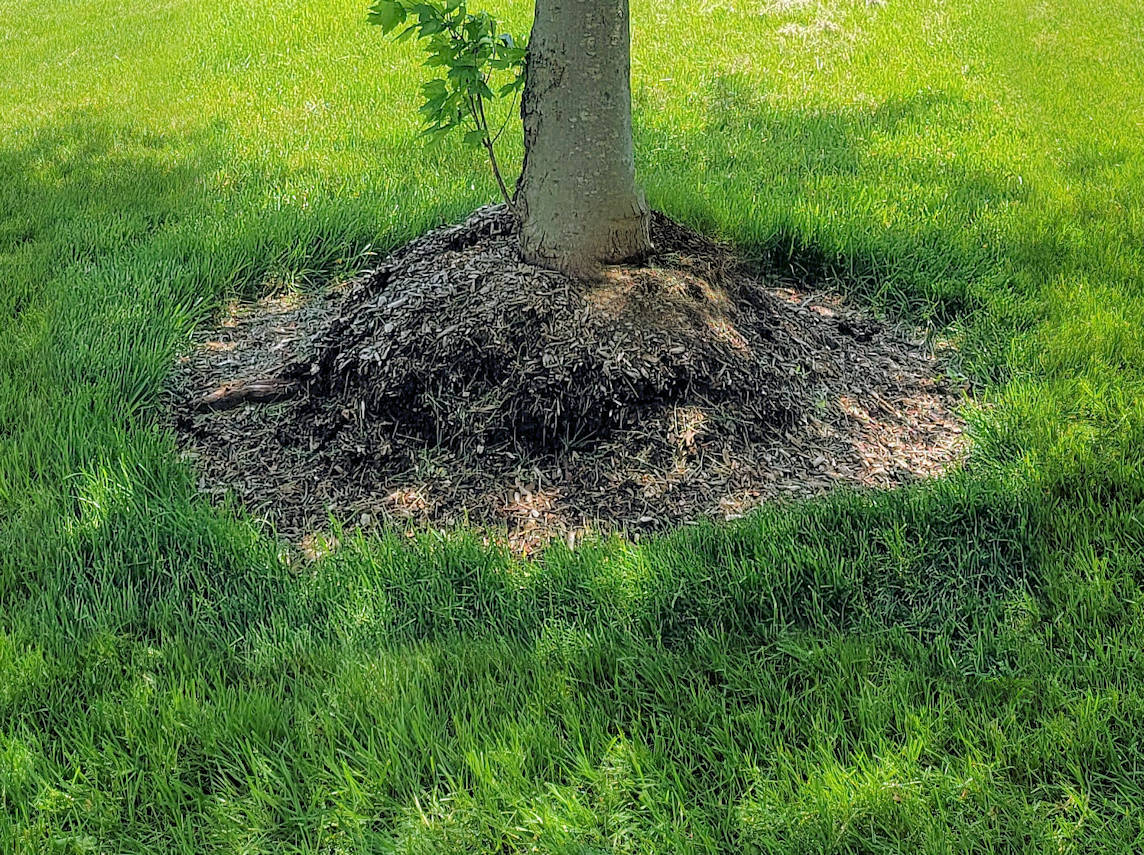
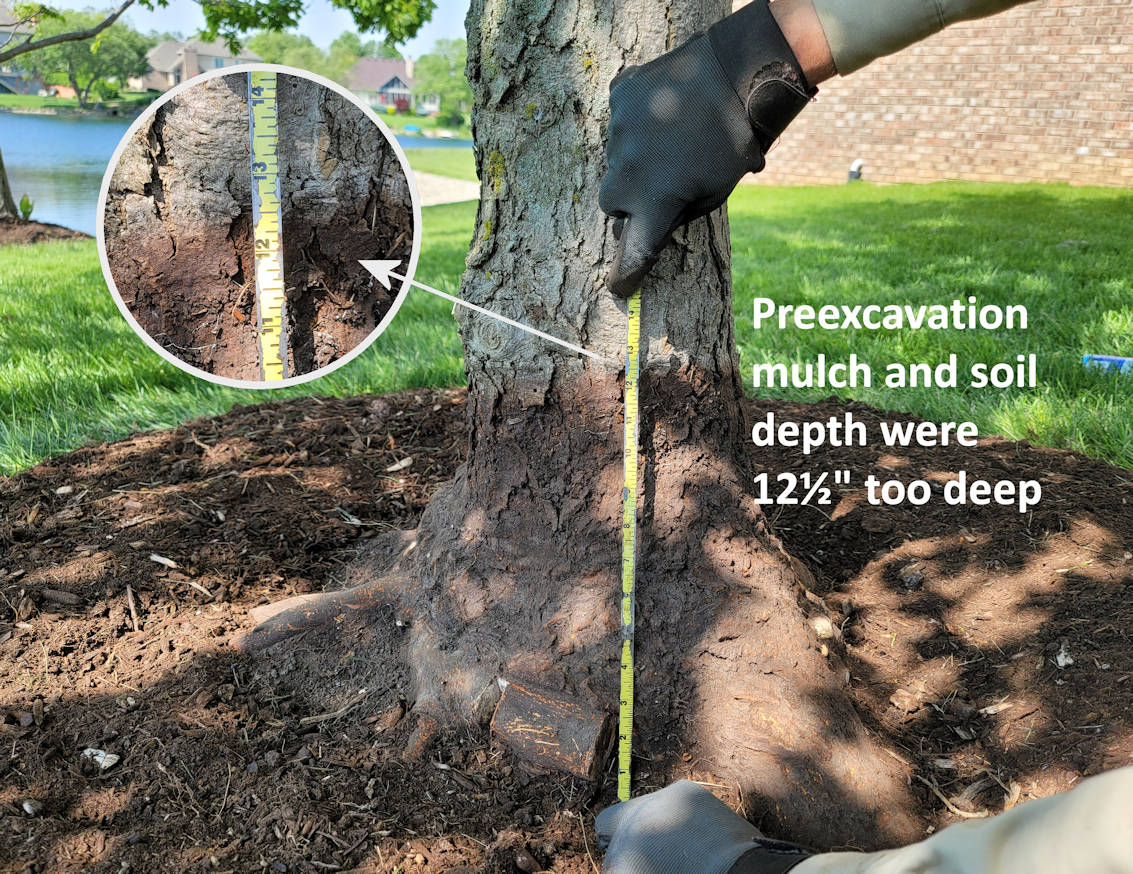
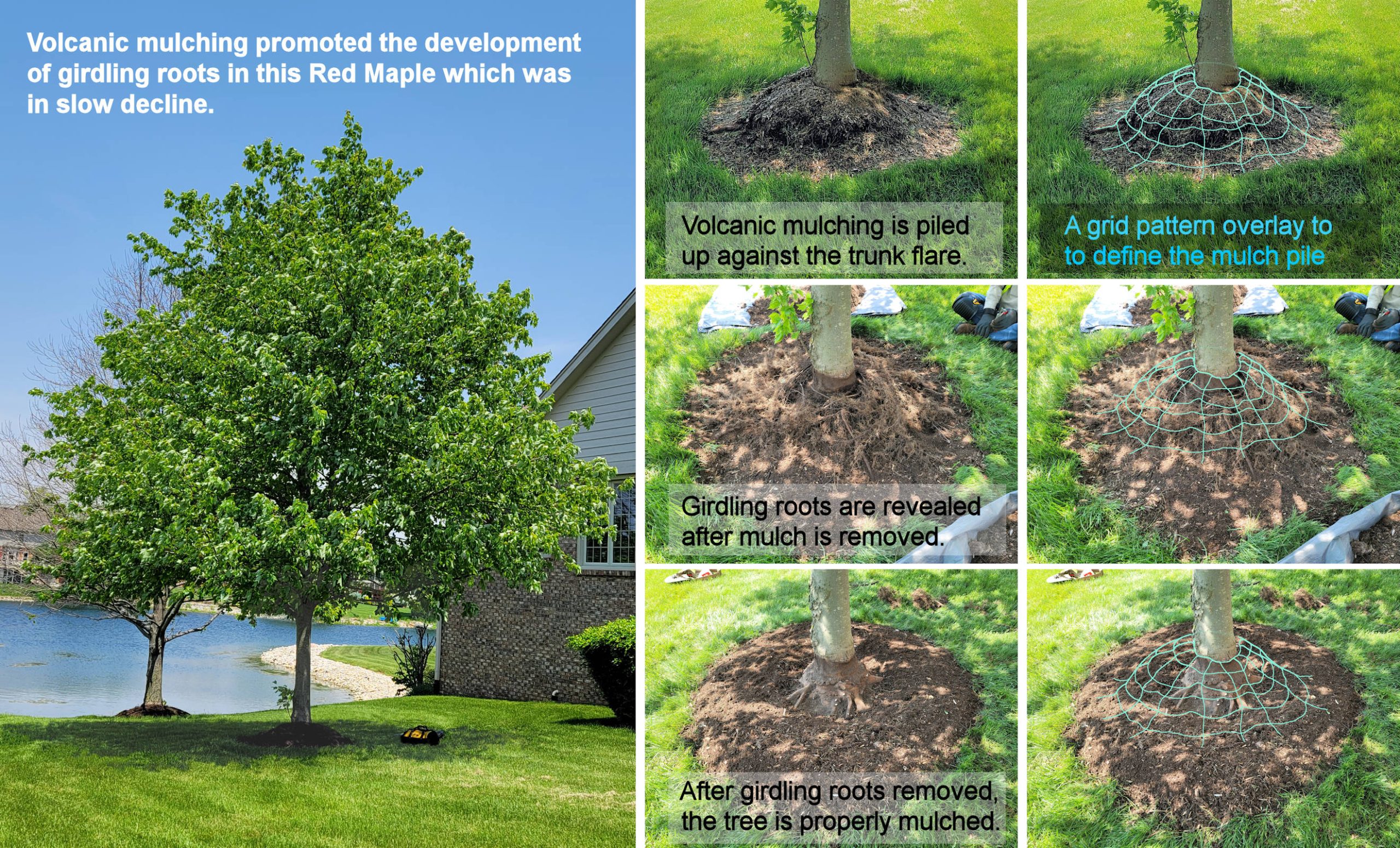
Volcanic mulching around trees, which piles mulch against the trunk, can cause root rot, fungal diseases, and bark decay due to excessive moisture. It also leads to poor root growth, as roots may grow into the mulch instead of the soil, potentially causing them to girdle the tree. These issues weaken the tree, making it susceptible to pests, and can ultimately lead to decline and death.
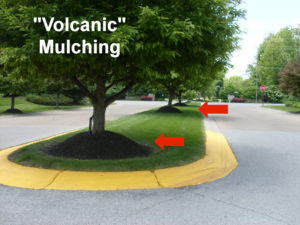
Ornamental crabapples that were meant to adorn this community’s common entrance were improperly mulched. 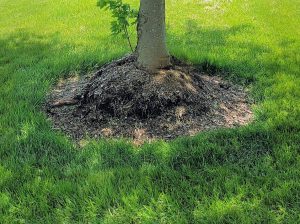
Volcanic mulching around trees can lead to trunk deterioration due to excessive moisture, among other problems. Problems caused by volcanic mulching:
-
- Moisture and rot: Piling mulch against the trunk traps moisture, which can cause the bark to rot and decay. This opens the tree up to cankers and other diseases.
- Poor root growth: It encourages roots to grow into the mulch layer instead of spreading into the soil. These shallow, adventitious roots can then girdle the tree, strangling the root system and causing stress.
- Oxygen deprivation: A thick, dense layer of mulch can block oxygen from reaching the roots, especially if the soil is already poorly drained.
- Pest and disease habitat: The moist, decaying material provides an ideal environment for insects and rodents that can damage the tree.
- Hydrophobic mulch: In dry conditions, thick layers of mulch can become hydrophobic, meaning they repel water and prevent rain from reaching the roots.
- Heat damage: As mulch decomposes, it can produce heat that may damage the inner bark of young trees or interfere with the natural hardening-off process in the fall.
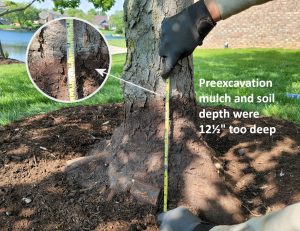
Removing the volcanic mulch aids in drying the overly saturated bark, provides better airflow, and minimizes girdling root development.
How to fix volcanic mulching:
-
- Pull back the mulch from the base of the trunk to create a 2″ to 4″ gap.
- Ensure proper depth by keeping the total mulch depth to a non-compacted 2″ to 4″, extending it out from the trunk based on the dripline.
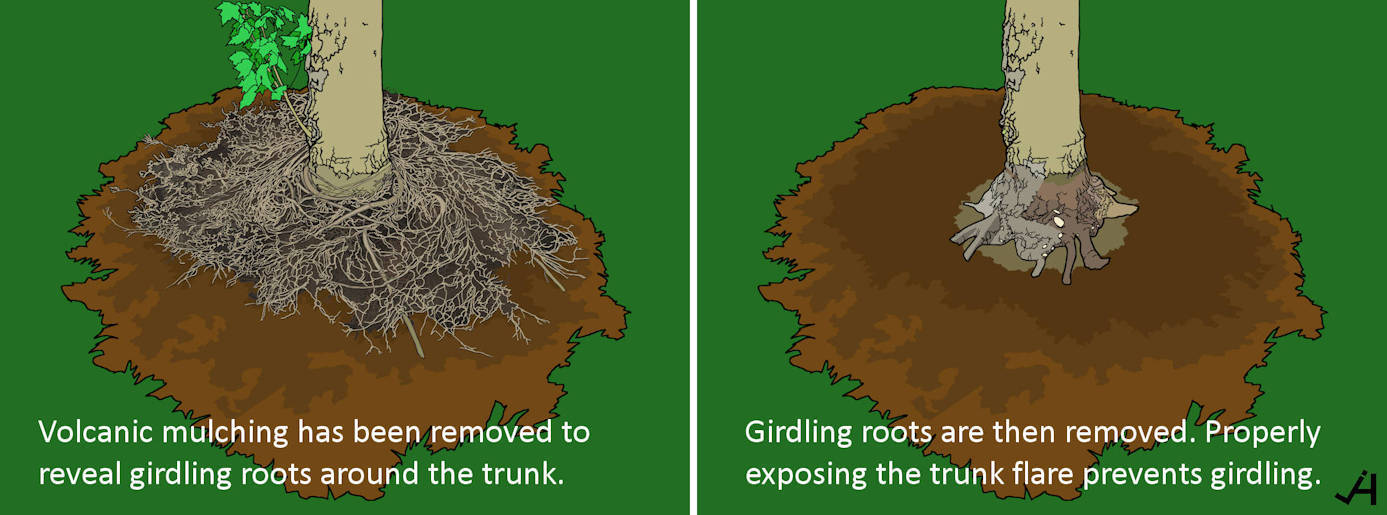
- Expose the trunk/root flare. The flare is where the trunk widens before meeting the roots. This area should be visible, and if you discover girdling roots, many of these may be removed; however, we recommend consulting with a qualified certified arborist before performing any root pruning.
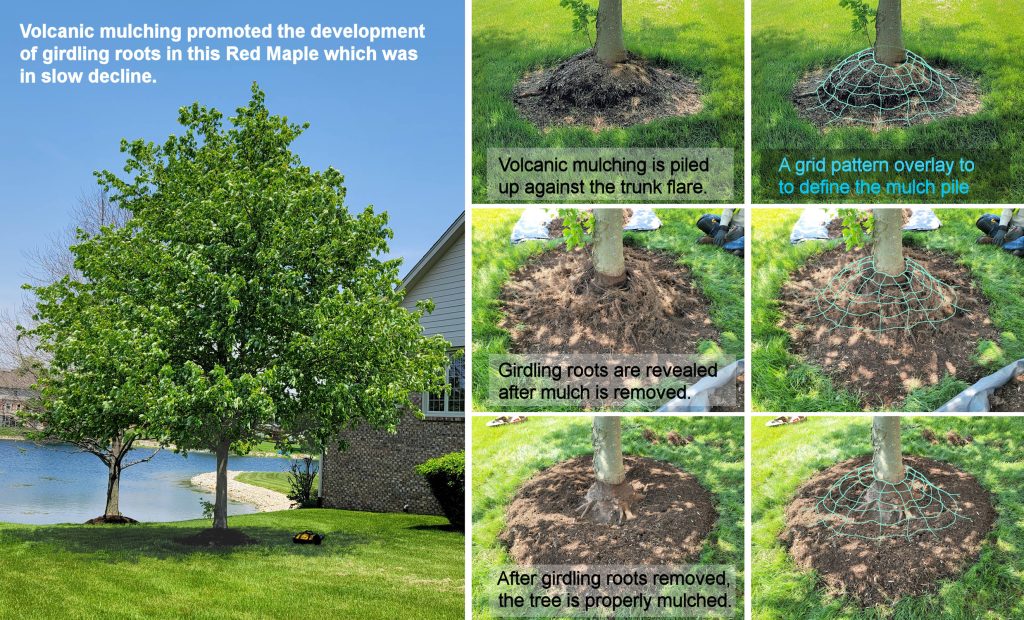
Red Maple decline due to girdling roots hidden within volcanic mulch. 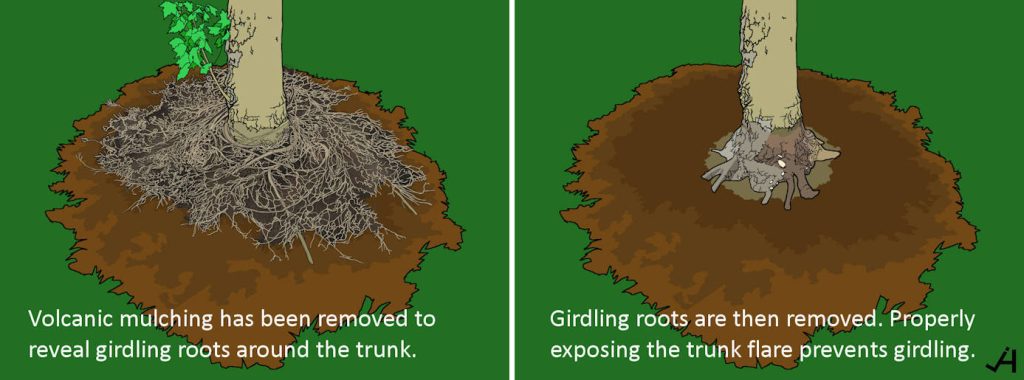
Removing volcanic mulch may reveal a surprising network of girdling roots! Seek professional advice before attempting to remove these girdling roots to minimize unnecessary injury to the tree.
Disclaimer: As tree stewards and advocates, we investigate and research plant health care sciences and best management practices that have proven successful in the tree care industry. That said, some of the views, insights, advice, and opinions we post on our website may differ in perspective from other websites or publications sharing similar topics. That’s okay. Science is an evolving practice of discovery and meticulous research that is continually shaping our knowledge and beliefs. We will continue to engage in that research, and where opinions differ, work toward finding an amicable solution whenever possible. We are not always able to monitor changes or revisions made by external websites, so if any of the links used in this article fail, please let us know. Thank you! -
-
Planting New Trees – Spring, Fall, or When?
[Last update: October 2025]
Quick Links to Topics Covered in This Article:
INTRODUCTION • Seasonal Recommendations for Tree Planting
INTRODUCTION
Times have changed in Midwest America, and we’re not talking about clock settings. Our summers are hotter, and we experience more frequent droughts, while warmer overall temperatures result in less precipitation falling as snow and more as rain.
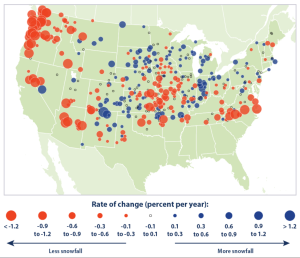
U.S. EPA Climate Change Indicators: Snowfall; Source: Kunkel et al., 2009 Data collected from nearly eight decades, since 1930, by the U.S. Environmental Protection Agency (EPA) indicates a change in total snowfall in the country. A warmer atmosphere can hold more moisture, but higher temperatures mean winter precipitation is more likely to fall as rain. In some cases, a cycle of drought can cause warmer soil to absorb more solar radiation, creating high pressure that further suppresses rain and exacerbates heat.
With all of these changes in weather patterns impacting temperatures and rainfall, when is the best time to plant a new tree?The best time to plant new trees is late fall or early spring when temperatures are moderate. This allows the tree to establish a strong root system before extreme summer heat or winter freezes. Planting during a tree’s dormant season in the cooler, wetter months is ideal because it is less stressful for the tree and allows it to focus energy on root development. In tropical climates, planting is best done right before the rainy season starts.
- Late fall/early spring: This is the ideal time for most climates because the soil is still warm enough for root growth in the fall, and cooler temperatures in the spring prevent the stress of hot summer weather. This allows the tree to establish itself for several months before the next summer’s heat arrives.
- Late winter: If planting is delayed until winter, the tree is still dormant, but care must be taken if the ground is frozen.
- Summer: This should generally be avoided due to extreme heat and drought, which can stress the tree and hinder root establishment.
- Tropical/subtropical climates: Plant right before the rainy season begins to take advantage of natural watering.
Important Factors:
- Soil test: Get your soil tested to guide your tree selection.
- Tree type: Evergreens, for example, are often better planted in the spring because they continue to lose water through their needles all winter, which can lead to dehydration when the ground is frozen.
- Water availability: Ensure adequate watering after planting. Planting during a period of regular rainfall can significantly help the tree establish itself.
- Adapt to local conditions: Extreme weather patterns make it crucial to adjust planting times to your specific region’s conditions.
- Focus on resilience: Planting during the optimal moderate, wetter periods helps trees better adapt to changing climate conditions, including intense heat waves and droughts.
- Choose appropriate species: Selecting tree species that are well-suited to your local climate and the projected future climate is a critical component of successful tree planting.
Are you ready to plant your new tree?
Here are some helpful tips on How To Plant A Tree (See additional resources below.)
RESOURCESAside from what we post here on our website you can find great tips related to planting new trees from the links listed below:- Purdue University Publications & Videos
-
-
- “Consumer Horticulture: Collecting Soil Samples for Testing” https://mdc.itap.purdue.edu/item.asp?Item_Number=HO-71-W
- “Tree Planting Part 1: Choosing a Tree” https://mdc.itap.purdue.edu/item.asp?Item_Number=FNR-538-WV
- “Planning the Tree Planting Operation” https://mdc.itap.purdue.edu/item.asp?Item_Number=FNR-223
- “Tree Planting Part 2: Planting Your Tree” https://mdc.itap.purdue.edu/item.asp?Item_Number=FNR-540-WV
- “Tree Pruning Essentials” https://mdc.itap.purdue.edu/item.asp?Item_Number=FNR-506-W
- “Tree Pruning: What Do Trees Think?” https://mdc.itap.purdue.edu/item.asp?Item_Number=FNR-534-W
-
- Indiana Department of Natural Resources (INDR/CUF) Community & Urban Forestry https://www.in.gov/dnr/forestry/2854.htm
- ISA “Planting Details and Specifications” https://wwv.isa-arbor.com/education/onlineresources/cadplanningspecifications
Disclaimer: As tree stewards and advocates, we investigate and research plant health care sciences and best management practices that have proven successful in the tree care industry. That said, some of the views, insights, advice, and opinions we post on our website may differ in perspective from other websites or publications sharing similar topics. That’s okay. Science is an evolving practice of discovery and meticulous research that is continually shaping our knowledge and beliefs. We will continue to engage in that research, and where opinions differ, work toward finding an amicable solution whenever possible. We are not always able to monitor changes or revisions made by external websites, so if any of the links used in this article fail, please let us know. Thank you!
-
Stan Vera-Art: Grow With Trees

Stan Vera-Art of Grow With Trees is an advocate and leader in finding ways to enhance habitat and encourage biodiversity. Check out the wonderful ways he and his colleagues help vegetation management crews and contractors become successful in these goals:
https://www.growwithtrees.com/home
From all of us here at Arbor Rangers, we THANK YOU!
-
EAB in Central Indiana: Then & Now
[Last update: November 2025]
Quick Links to Topics Covered in This Article:
INTRODUCTION • What About EAB Today?
Host Identification • Signs & Symptoms
Pest Identification • “Is It Too Late?”
Post-Injection Expectations • Additional Resources
Common abbreviations used in this article:
EAB – Emerald Ash Borers, PHC – plant health care, AC# – Ash canopy condition rating numberUnless otherwise cited, all illustrations and photographs used in this article are by Jeff Harris or Jaira Harris. © Arbor Rangers, LLC
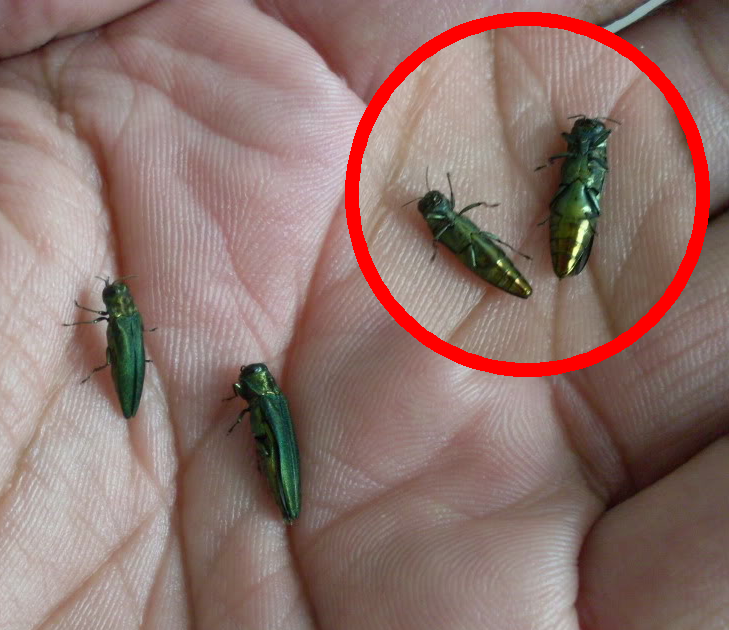
Exhibit A: The adult male EAB (left in photo and inset) are naturally smaller than female EAB. (Click to enlarge.) INTRODUCTION
The sharp decline and deaths of hundreds, then thousands, of Ash trees in Michigan prompted an investigation where the Emerald Ash Borer (Agrilus planipennis Fairmaire, also referred to by its acronym EAB) was identified in the summer of 2002. These exotic stowaways arrived in the United States from international shipping crates and packing materials from Asia. By 2009 these devastating pests had spread to 11 states (including Indiana) and were also found in adjacent parts of Canada, killing more than 50 MILLION unprotected Ash trees (Fraxinus spp.). Unsurprisingly, the number of states affected increased to 14 states by the following summer (Exhibit B)!
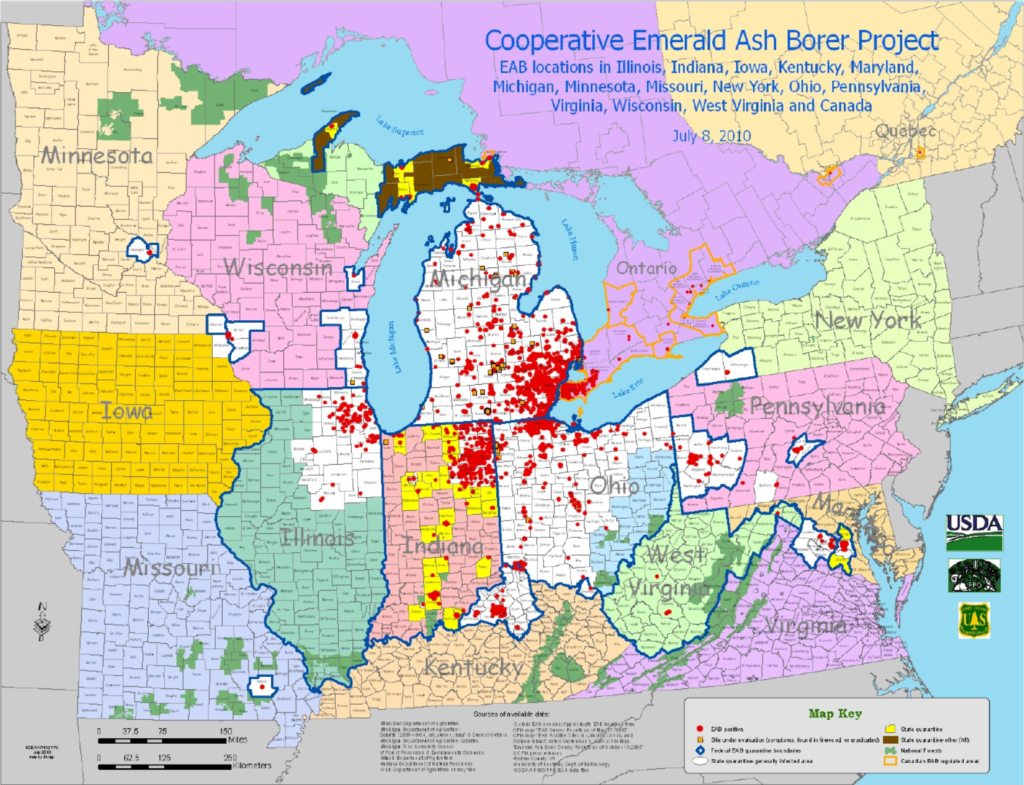
Exhibit B: THEN – Nearly eight years after their discovery in 2002, this was the situation as of July 8, 2010, over a decade ago. Multi-state EAB locations data was collected by USDA-APHIS. Diagram map © 2010 USDA-APHIS
WHAT ABOUT EAB TODAY?
Nearly two decades have passed and many weary property owners in the Midwest are wondering if they should still be concerned about EAB? Whether you have been treating your Ash trees over the years to control this exotic pest or not, there will always be a risk of re-infestation as long as…
→ you still have Ash trees on your property.
→ EAB are still present within a 30-mile radius of your Ash trees.
As of JANUARY 2021, the number of US states reporting EAB infestations is 35, along with the Canadian provinces of Ontario, Quebec, New Brunswick, Nova Scotia, and Manitoba. (Exhibit C) The cumulative Ash tree death toll is estimated to run into the HUNDREDS OF MILLIONS!
EAB infestations were also confirmed in White Fringetrees (Chionanthus virginicus) in 2014 and in cultivated Olive trees (Olea europea) in 2015. The EAB was first observed attacking White Fringetrees in Ohio during the summer and fall of 2014, with formal confirmation occurring shortly after. Researchers then began testing the beetle’s ability to infest Olive trees, with initial lab experiments showing a potential to attack them in 2015.
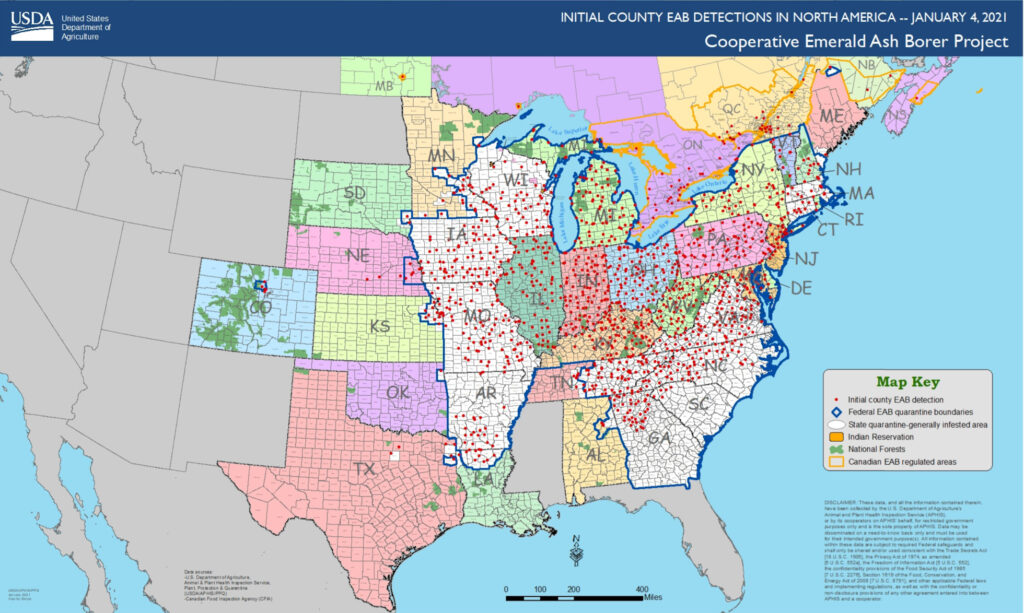
Exhibit C: NOW – This is the situation as of January 4, 2021, nearly 19 years after their initial discovery in Michigan back in 2002. Multi-state EAB locations data was collected by USDA-APHIS. Diagram map © 2021 USDA-APHIS (Click to go to image on USDA site.) If you have never had your Ash trees treated to control EAB before or they haven’t been treated in several years (and are not beyond saving), the first step in EAB control management is to ensure you’ve properly identified the host plant (e.g. true Fraxinus species more widely known as Ash trees). You also need to familiarize yourself with the signs and symptoms associated with EAB infestations, along with getting to know how to identify this invasive species (or hire an ISA Certified Arborist to inspect your trees. An experienced arborist can help identify problems negatively impacting the health of your trees and may offer advice on your plant health care (PHC) options.
Scientific studies have shown that untreated Ash trees that become infested by EAB have a 100% mortality rate. Therefore, the old saying, “An ounce of prevention is worth a pound of cure,” would definitely apply in this instance. Treating your Ash trees now may save you the worry of losing them later. At this time, the MOST EFFECTIVE and best products available to kill EAB contain the active ingredient Emamectin Benzoate (developed by Syngenta) and commercially distributed for licensed pesticide applicators under various brands. To assist Ash tree owners in their decision-making, Dr. Cliff Sadof, (Entomologist, Purdue University) has created an invaluable online tool, the Emerald Ash Borer Cost Calculator that helps estimate out-of-pocket expenses associated with Ash management strategies over a 25 year period. The proper timing of any PHC application is critical in achieving maximum pest control.
HOST IDENTIFICATION
ASH TREES (Fraxinus spp.)
The following information applies mostly to Indiana residents, but the Ash trees described may be common in other Midwest and surrounding regions as well.
Sometimes Ash tree ID comes down to which of the types is native to the area, but keep in mind that transplanted trees from nurseries may be rare or non-native to Indiana. In most instances, however, your best guess based on your field experience and knowledge of local Ash trees is the way to go. Even if you get the exact type of Ash wrong, you are sure to get the species correct. And from a PHC viewpoint, when it comes to disease & insect control specific to species that’s really what’s going to count most!
• Most Common in IndianaGreen Ash (Fraxinus pennsylvanica) – Data source: Purdue, Fort WayneThe Green Ash leaves tend to have a darker green, slightly waxy, appearance to their serrated leaflets which turn various shades of yellow in the fall. Like the Black Ash, the leaflet petioles are almost non-existent.White Ash (Fraxinus americana) – Data source: Purdue, Fort WayneWhite Ash limb bark tends to be “smoother” than the Green Ash and their leaves aren’t as deep green as the Green Ash and have a lighter underside. They turn more reddish to purple in the fall.• Common to Northern IndianaBlack Ash (Fraxinus nigra) – Data source: Purdue, Fort WayneBlack Ash typically grows in swampy areas or near streams in deciduous forests or seasonally flooded areas. This would have to be purposely transplanted in a landscape in central Indiana because they don’t naturally grow in our area.• Common to Southwestern IndianaPumpkin Ash (Fraxinus profunda) – Data source: Purdue, Fort Wayne
Pumpkin Ash can be found in small pockets statewide, but they are most prevalent in the southwestern counties. Its swollen base earns it its name.• Rarely Found in IndianaBlue Ash (Fraxinus quadrangulata) – Data source: Purdue, Fort WayneIts botanical name—quadrangulata—comes from the tree’s four-sided twigs. If anything, this makes this Ash tree VERY distinguishable from the other three Ash types above.For more information on these native trees of Indiana, go HERE and enter “Fraxinus” into the search box.
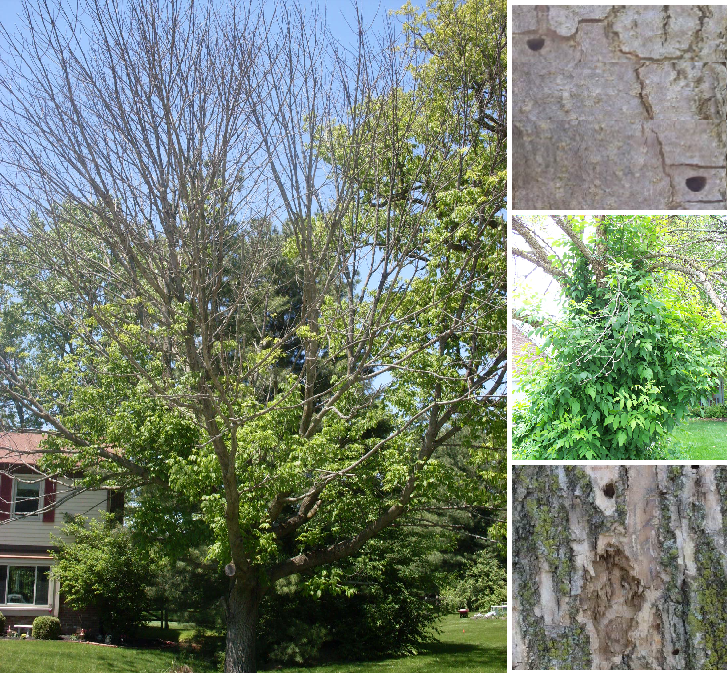
Exhibit D: EAB infestation signs & symptoms include Ash tree decline (loss of leaves, dieback of twigs & branches, watersprouts, and “D-shaped” borer exit holes. (Click to enlarge.) SIGNS & SYMPTOMS
Here are some things to look for…
(Refer to Exhibits D through F)- Canopy Dieback and Thinning of Foliage from Upper Crown Downward
- D-Shaped Exit Holes
- Epicormic Shoots (aka Watersprouts)
- Vertical Bark Splits with many revealing S-Shaped Larval Galleries
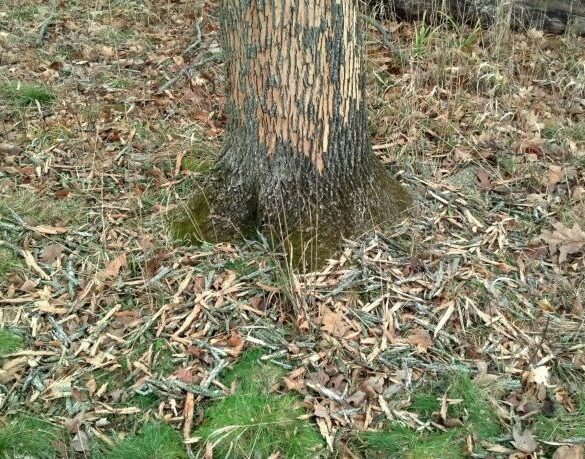
- Increased Woodpecker Activity Resulting in Visible Bark Damage
Note: Some of these symptoms are very similar to those caused by other insect and disease pests or site and climate conditions which to the untrained eye could mistakenly be attributed to EAB. Sometimes several combined factors are involved. It is recommended to seek the aid of an experienced ISA Certified Arborist to more accurately diagnose your PHC concerns.
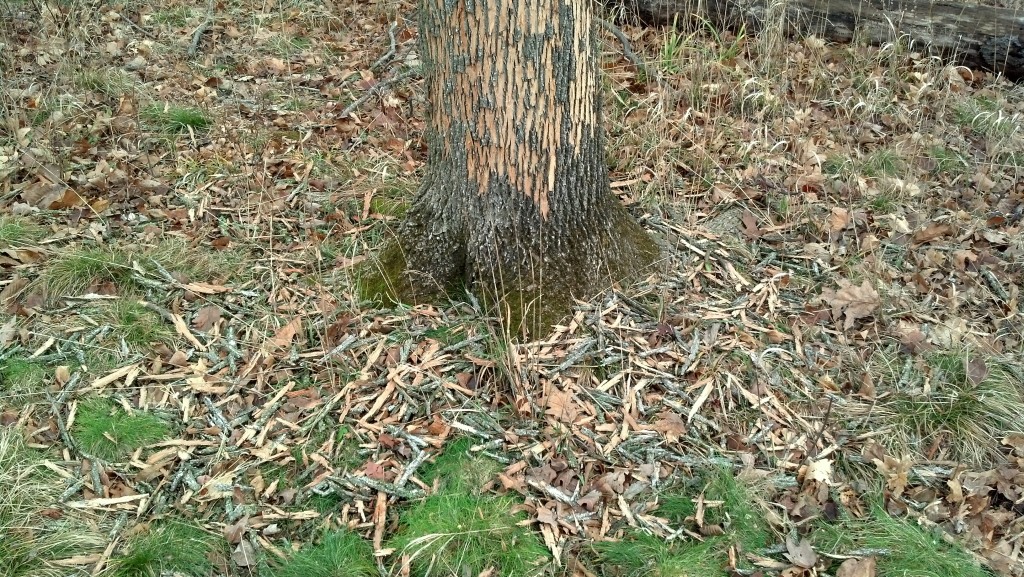
Exhibit E: The bark of this infested Ash tree has been stripped by hungry woodpeckers in search of EAB larvae underneath. (Click to enlarge.) 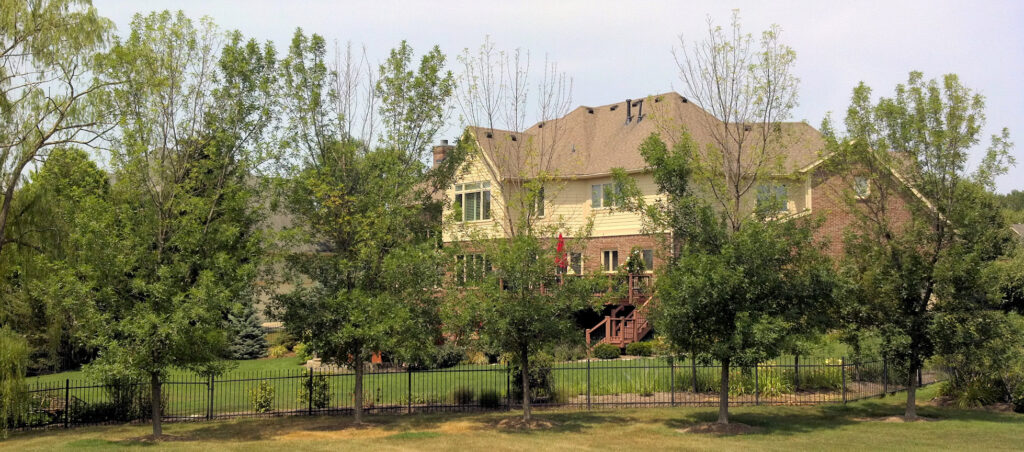
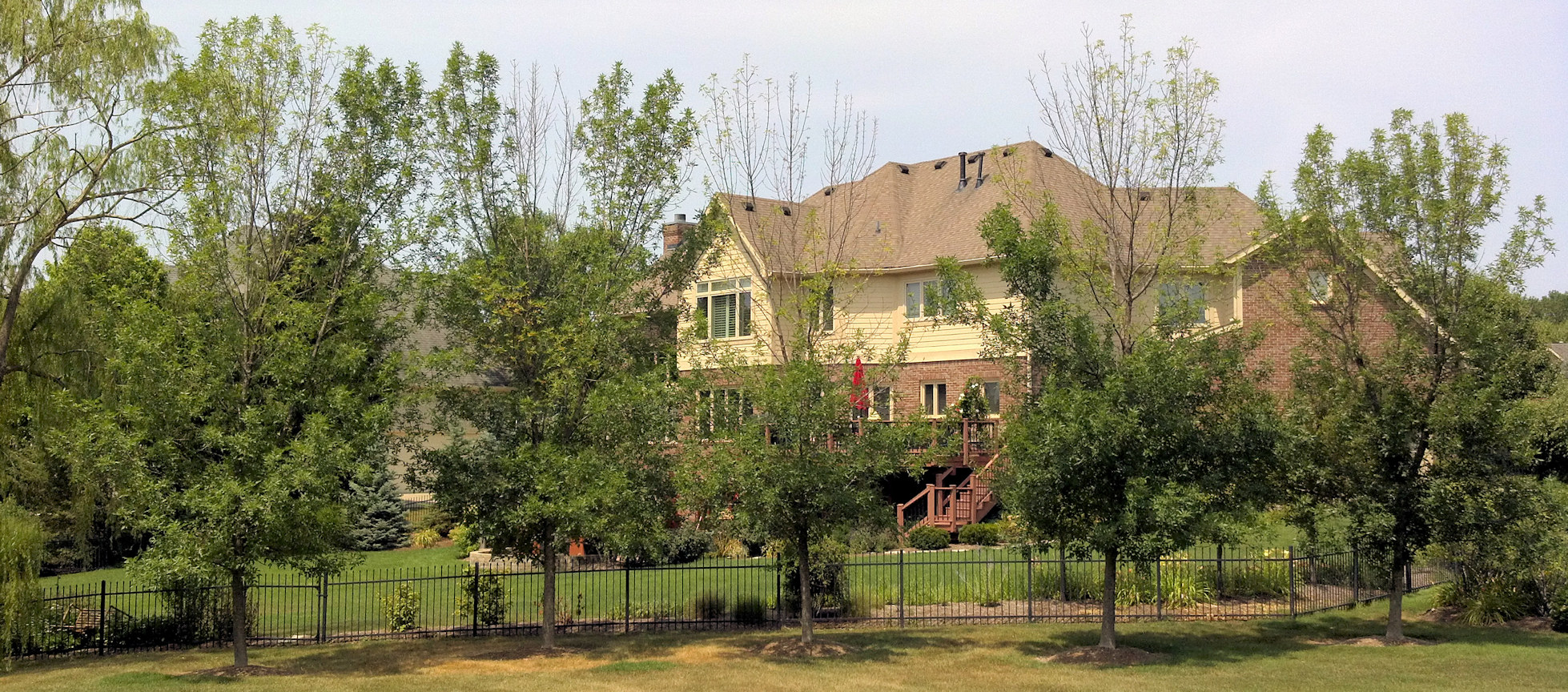
Exhibit F: Severe EAB damage to a row of Green Ash trees in West Carmel, Indiana (July 2012). (Click to enlarge.)
PEST IDENTIFICATION
Emerald Ash Borer
Agrilus planipennis Fairmaire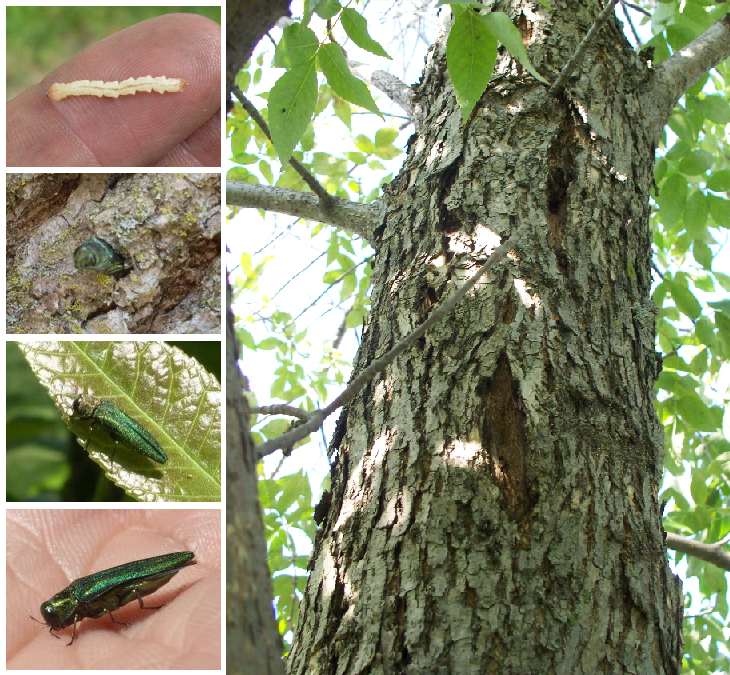
Exhibit H: EAB that have infested an Ash tree. (Click to enlarge.) Also, see Native Ash Borers and Emerald Ash Borer Look-alikes by Michigan State University Extension and the Emerald Ash Borer Look-Alike chart by the University of Nebraska.
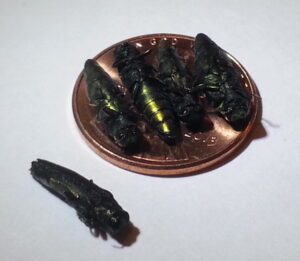
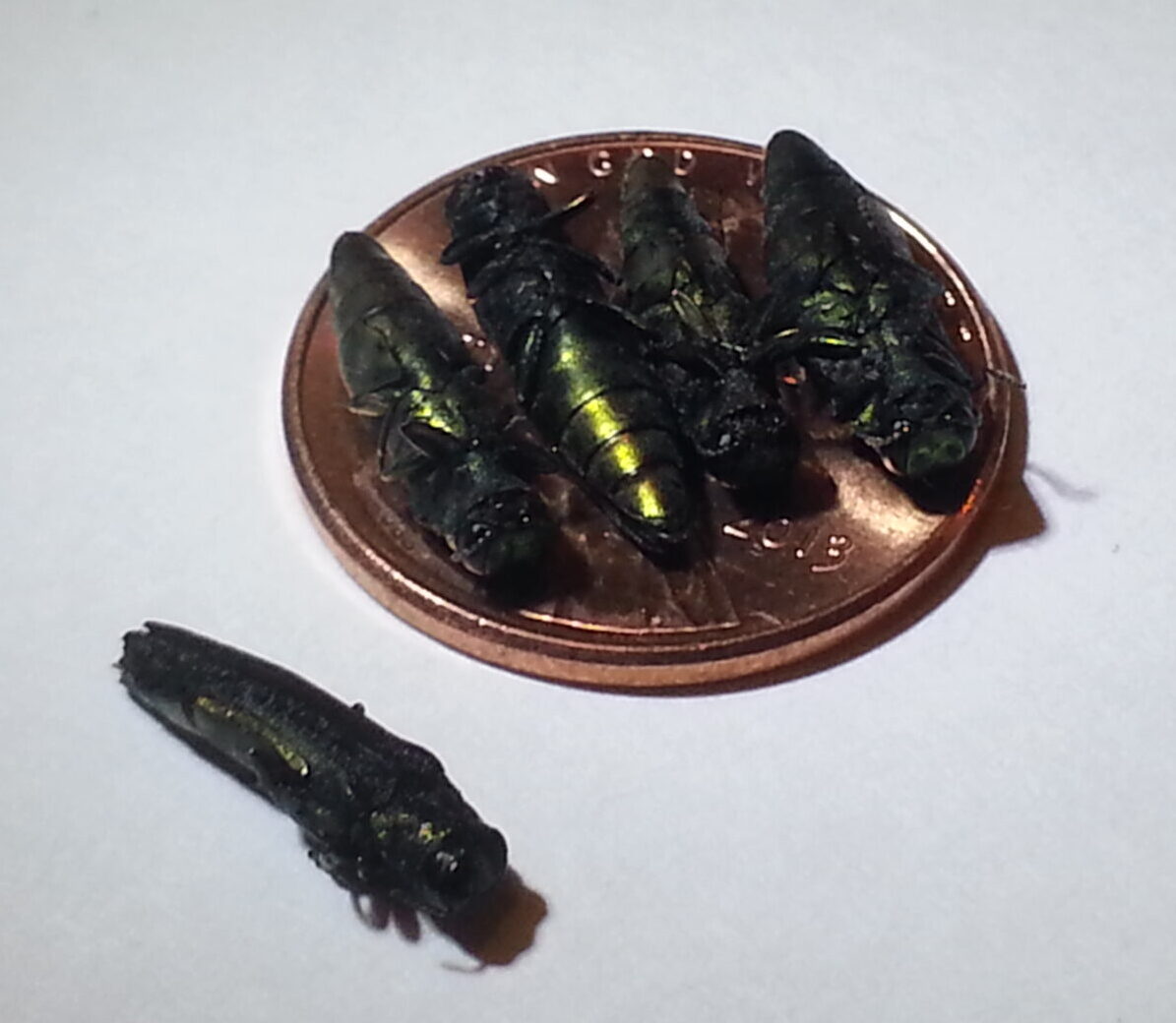
Exhibit G: Four EAB adult beetles can fit onto a penny. (Click to enlarge.) - EAB Eggs
- Are laid in the cracks and crevices of Ash tree bark
- Darken to a brownish color in about 3 to 4 days
- Hatch in about 7 to 19 days, depending on location and environmental conditions
- EAB Larva
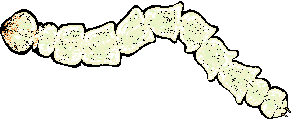
- Reach a length of 26 to 32 mm.
- Creamy White Flattened Bodies
- Bell-Shaped Segments
- No Legs or Prolegs
- 4 Growth Stages
- Feed on outer sapwood (Phloem) and Cambium layers under bark
- Feeding pathways (galleries) are serpentine (S-shaped) patterned
- Pre-pupal larvae excavate a deeper chamber to overwinter and pupate
- EAB Pupa
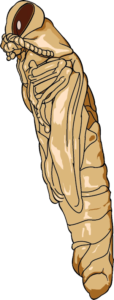
- Are about 11–16 mm in length.
- Mature in about 20 days
- Overwinter under tree bark
- EAB Adult Beetle
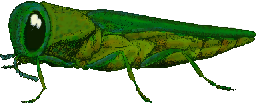
- Are 7.5 to 13.5 mm in length and four can fit onto a penny (Exhibit G)
- Winged Insects
- Irridescent Metallic Green Exoskeletons
- Slender Bodies
- Feed on Ash (Fraxinus spp.) leaves
- Females Larger than Males (Exhibit A); live an average of 20 days after emerging
- Females may lay up to about 100 or more ivory-colored eggs during her lifetime
- Males live an average of 22 days after emerging
EAB typically have a one-year life cycle. Adult beetles will begin emerging from Ash trees around mid to late May to early June. A good timing indicator for EAB emergence is to watch for Black Locust trees (Robinia pseudoacacia) blooming in your area.

Exhibit I: Black Locust trees (Robinia pseudoacacia) in bloom usually coincide with the time when EAB begin emerging from Ash trees in the area. A reminder: EAB attack only true Ash species (Fraxinus spp.) and very rarely White Fringetree (Chionanthus virginicus), but not Black Locust trees. (Click to enlarge.)
“HOW CAN I TELL IF IT’S TOO LATE TO SAVE MY ASH TREES?“
The Ash Canopy (AC) Condition Rating System
The Ash canopy condition rating system was developed through the collaborative efforts of the Department of Biological Sciences (University of Illinois at Chicago) and the USDA Forest Service (Northern Research Station) in 2014, further expanding the extensive research by Annemarie Smith, B.S. (Ohio State University, 2006). It is recommended to seek the aid of an experienced ISA Certified Arborist who can evaluate your Ash trees.
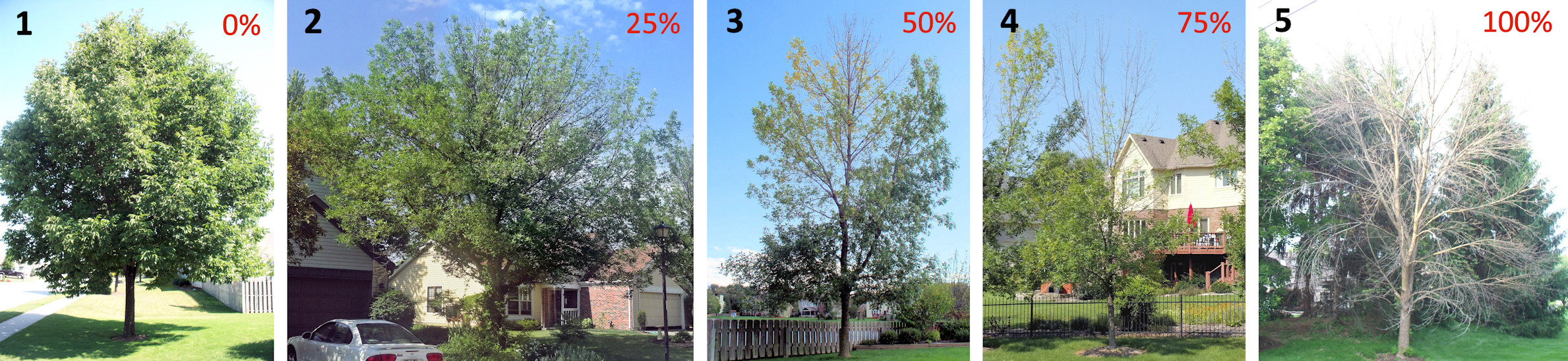
This rating system helps PHC providers to visually assess the amount of Ash tree canopy decline and dieback, ranging from 1 (full and healthy) to 5 (no leaves, or essentially dead). It is useful as part of the decision-making process to have your Ash trees treated or not.
1 (AC1) = Canopy is full and healthy
2 (AC2) = Canopy has started to lose leaves (thinning), but no dieback (dead top canopy twigs without leaves) is present
3 (AC3) = Canopy has less than 50% dieback
4 (AC4) = Canopy has more than 50% dieback
5 (AC5) = Canopy has no leaves, epicormic sprouts may be present on the trunk
Here are a collection of photos we’ve taken over the years that demonstrate each of the five states of canopy decline as graded using the Ash Canopy Condition rating system.
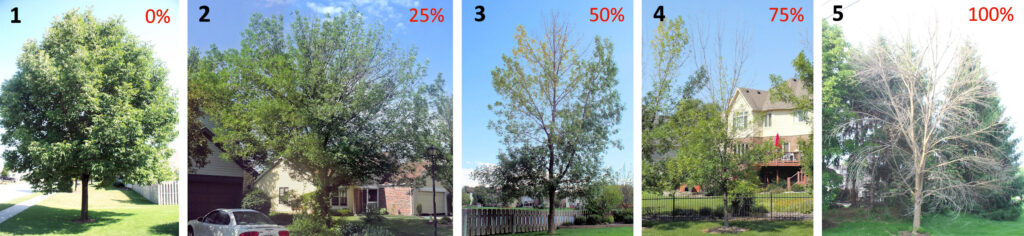
Exhibit J: Ash Canopy Condition Rating System (Click to enlarge.) “I’ve had my Ash trees treated but they seem to be getting worse and more limbs are dying and the bark is starting to come off!”
Take a deep breath. There. Now before you go off and fire your PHC provider, be sure you are not mistaking natural recovery progression with bad or misapplied service! Think back to when you first had your trees treated. Prior to any EAB control treatment what were your Ash trees rated? Keep in mind that other factors, such as a fungal disease, can cause the AC# rating to be higher due to increased leaf loss from the infection as well as EAB infestation.
• AC1 or AC2: Your trees were most likely deemed good candidates for EAB control treatment. Vascular damage was low and uptake of treatment should have been successful if properly administered.
• AC3: Canopy loss ranged from 25% up to 50% therefore treating your trees involved a degree of risk for failure and you should keep your expectations low. On the other hand, there have been a few success stories. Think of why you went ahead and had your Ash trees treated despite their rating. (Caution: The potential danger of injury or damage from falling dead limbs onto nearby pedestrians or property from AC3-rated trees should have been evaluated along with other precautions and recommendations from your PHC provider. Some property owners may elect to take move forward with treatment because of the importance of their Ash trees, such as:
› historic value
› sentimental value
› landscape asset value
› etc.• AC4 or higher: Canopy loss was extremely high ranging from 50% on up. You should not have had your Ash trees treated and your PHC provider should have recommended removal instead. The extent of vascular damage was too great and therefore treatment was bound to fail since the control product could not reach necessary areas throughout your trees to stop the feeding EAB larvae from doing further damage.
“WHAT CAN I EXPECT FOLLOWING INITIAL EAB CONTROL TREATMENT?”
This section is about expectations and keeping them realistic following initial trunk injections for EAB control, assuming that it was properly administered by an experienced PHC provider and that there was good uptake of the active ingredient. Success also depends upon the cultural practices YOU contributed following the treatment or that were provided for you by your PHC provider or landscape professional.
Bear in mind that protecting your Ash trees from EAB will take commitment on your part and on the part of your dedicated PHC provider. It will be a journey of patience and trust. The recovery of your valuable Ash trees depends upon it! This is NOT a one or two-time treatment then you’re done situation, however, when compared to the cost and loss of removing your Ash trees your investment in trying to save them is typically well worth the time and effort. (See Emerald Ash Borer Cost Calculator, Dr. Cliff Sadof, Entomologist, Purdue University, and his easy-to-follow Decision Guide.) Let’s take a look at a typical cycle of EAB management and an Ash tree’s recovery process…
YEAR ONE [INSPECTION & INJECTION YEAR]
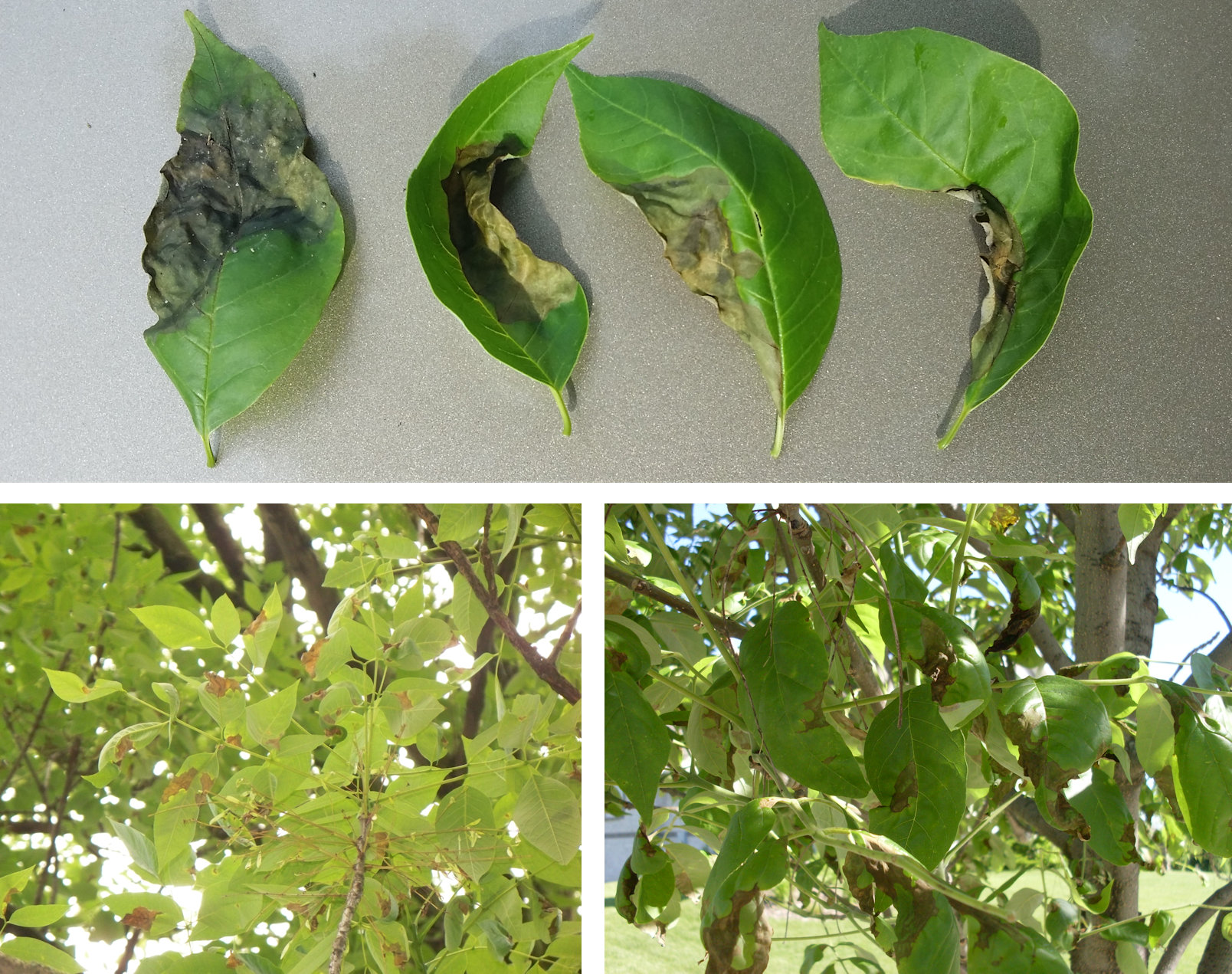
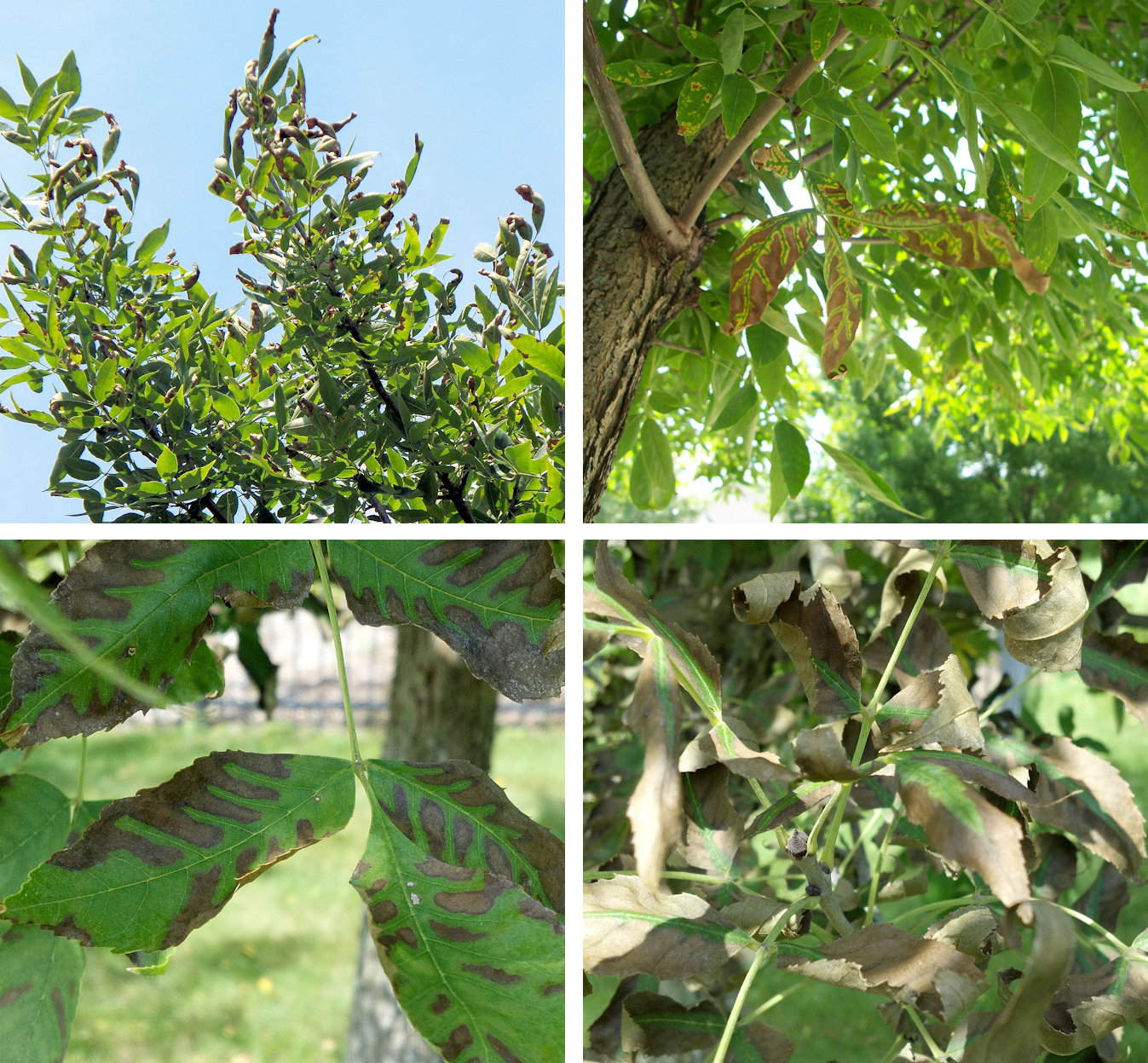
Ash trees are inspected. Ash trees rated AC1 – AC2 (up to 25% overall crown loss) and some trees rated AC3, barring any other negative factors* or circumstances usually qualify for trunk injection of Emamectin Benzoate (active ingredient), with client approval. After successful uptake into healthy vascular tissue, the months following injections will allow the formulation to translocate to vulnerable live plant tissue. Research by Purdue University Extension has found after 15 years of study that traces of the active ingredient may persist in the woody tissue for up to three years, however pesticide labels will state up to two years. Your trees will experience plant stress from their EAB injuries. These internal injuries will cause a loss of foliage and twigs and limbs to decline and dieback. Some may have already died and these will require pruning. Stress is further exacerbated when temperatures reach or exceed 89º F, therefore irrigating your Ash trees IS A MUST! Keeping your Ash trees adequately hydrated during drought periods is critical to their recovery and directly affects the efficacy of treatment! Your Ash trees should NOT be injected when temperatures exceed 89ºF for prolonged periods, regardless of irrigation, to minimize phototoxicity.** Your trees can wait on treatment until temperatures drop a bit if you keep them sufficiently watered. Regarding pruning… Try to postpone pruning until the next year to allow more recovery time for your Ash tree. Sometimes limbs may appear dead but have instead gone dormant. It would be a shame to remove live limbs accidentally. Certain dead limbs may pose an obvious risk of causing personal injury or property damage and should be removed ASAP. Epicormic shoots should not be pruned, if possible. These are your trees’ natural lifelines and should remain for now as they will provide supplemental means for photosynthesis during this recovery period. Also, do not apply any fertilizers this year to your treated Ash trees as this may add further stress to them! (Explained further in YEAR TWO).*A common fungal disease, Anthracnose, will cause infected Ash leaves to brown, shrivel, and drop prematurely particularly as temperatures heat up. It may be harder to distinguish infected leaves from leaves that are dying from dehydration caused by EAB larvae injuries to the tree stems’ vascular tissue. Ash Anthracnose is not usually considered a lethal disease, nor does it typically require any fungicide treatment, but it can cause your Ash tree to look extremely sickly. Leaf abscission of even secondary (replacement) foliage is likely to occur during prolonged rainy seasons which may result in a higher infection rate. Therefore be aware that this disease, coupled with an EAB infestation, can sometimes cause the AC# rating evaluation to be higher (e.g. AC3, instead of AC2).
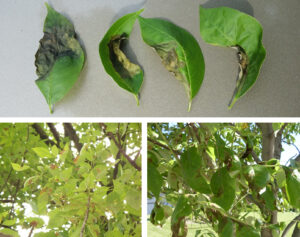
White Ash leaflets infected with Anthracnose disease. (Click to enlarge.) **Phototoxicity can occur by applying too high of a dose of treatment of Emamectin Benzoate so be VERY careful not to overdose! Sometimes what appears to be the correct dose is thwarted because the vascular tissue damage is more than expected and so the product is limited to only a few areas of the Ash tree. This can create an overdose in those areas. Matters are made worse the higher the temperature gets and if there is little to no precipitation. Fungal leaf diseases can exacerbate the situation, but do not confuse phototoxicity with these sorts of infections. Both of these conditions may occur concurrently. Additionally, don’t allow desperation to save a tree, nor emotion, to blur your judgment when treating an EAB-infested Ash tree. It takes years of field experience to know how much and when to use Emamectin Benzoate properly, always following the product label. That is why it is recommended that you hire an experienced ISA Certified Arborist. Studies have proven that a little Emamectin Benzoate goes a long way in stopping EAB larval feeding! (Refer to the research results cited concerning Emamectin Benzoate on page 12 in the section, Trunk-injected Systemic Insecticides of the Insecticide Options for Protecting Ash Trees from Emerald Ash Borer publication produced through the collaborative efforts of several universities.)
This is some of the leaf litter from a White Ash tree that resulted from phototoxic leaf dieback just a couple of days following trunk injections of Emamectin Benzoate to control EAB. (Click to enlarge.) 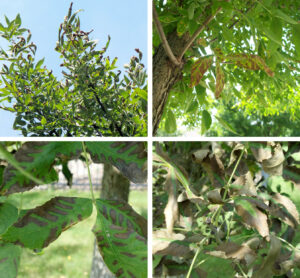
These are some examples of White and Green Ash trees that experienced phototoxicity after they were injected with too much Emamectin Benzoate for EAB. (Click to enlarge.)
YEAR TWO
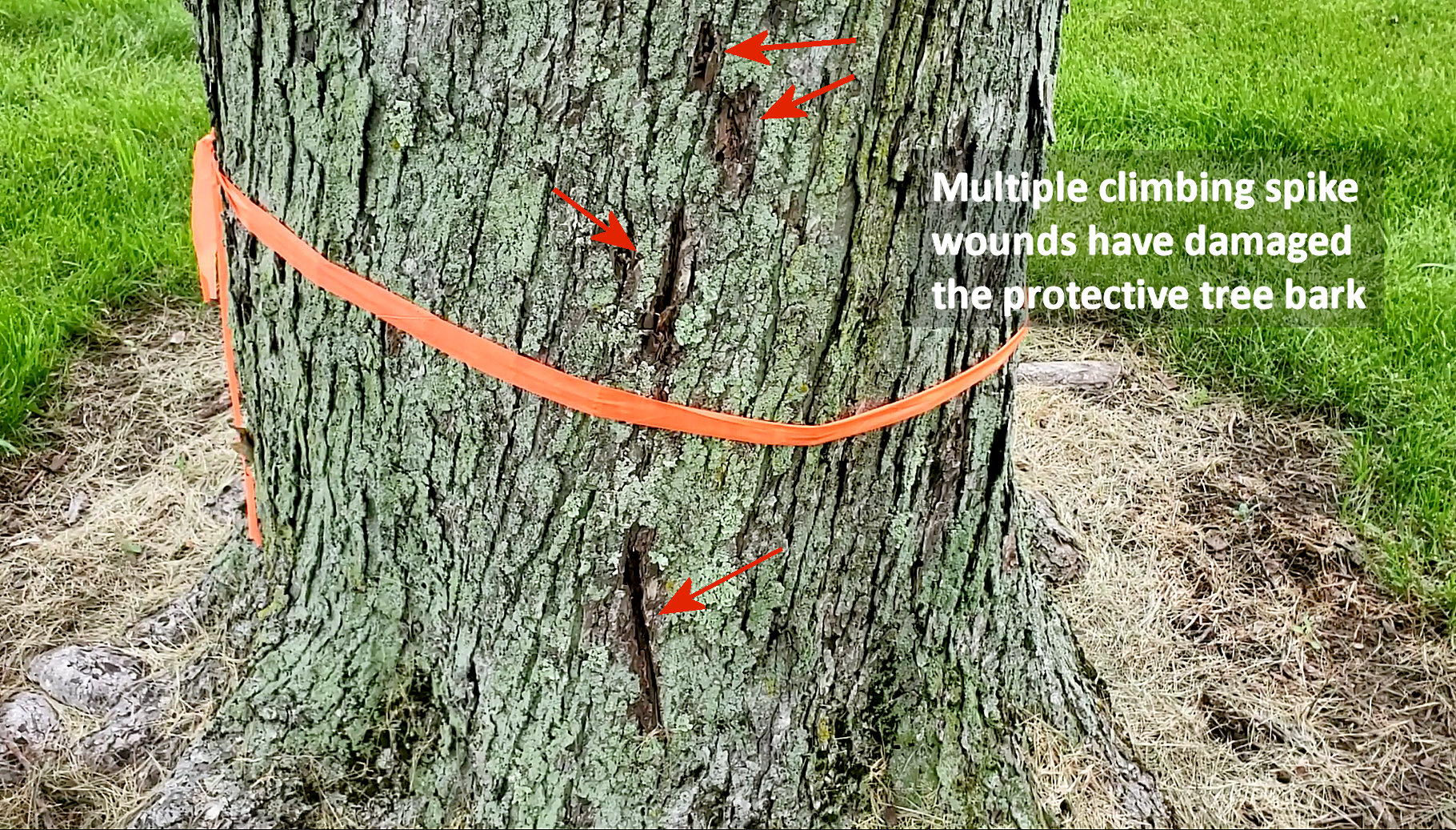
Significant EAB larvae control should have been achieved, as well as broader protection from new invaders. The two-year period of protection provides your trees much-needed relief from aggressive EAB larvae feeding and offers your treated Ash trees a critical time to recover from their EAB injuries. Adequate watering is critical! “Should I fertilize my tree this year?” No. Even mildly infested trees undergo a degree of stress. Fertilizers within the first two years of recovery may add unnecessary additional stress. Recovering trees utilize their energy towards sealing wounds and producing compensating foliage. It takes energy to metabolize fertilizer nutrients and fertilizers, in general, and particularly during periods of drought, can dry out your treated trees disrupting recovery. “Will I see a difference this year?” In general, no. As a matter of fact, you should expect to see some DECLINE in your trees’ overall appearance, including further dieback of limbs! Keep in mind that your Ash trees were ALREADY infested for many years before they began to show significant signs of decline. By that same line of reasoning, it will take time for treated Ash trees to show significant results. Patience is definitely required, along with good watering habits. What we look for during the year following treatment is the emergence of new growth. The tree should start partially callusing (sealing) over the exposed wounds where its bark splits. Epicormic shoots will continue to emerge to compensate for lost limbs and foliage. Epicormic shoots should not be pruned at this time for the same reason as explained in YEAR ONE. About pruning… Unless there are obvious dead limbs present posing a risk of injury or damage then try to wait to prune your Ash on year three. You may need to discuss with your Homeowners Association (HOA) these instructions as part of the recovery process, but be prepared to comply with their requirements to have your trees pruned for community aesthetics.Protect your investment! Pruning maintenance should be performed by a professionally-trained tree service, not amateurs looking to make a quick buck. You may have a tree service you already trust, but be sure they understand the importance of making proper pruning cuts that will facilitate wound sealing. NO TREE TOPPING! Also, please DO NOT hire anyone who plans to climb your trees using climbing spikes unless the goal is to remove your tree entirely. (See exceptions below). The use of climbing spikes can introduce multiple trunk and branch injuries and those injuries can attract a multitude of wood-destroying organisms, including decay fungi, termites, wood borers, etc. BEFORE they do your service, ask your tree service if they plan to use climbing spikes. It may be an annoying question to some of them, but many reputable services will understand your concern and may provide you with a satisfactory explanation as to why they don’t use climbing spikes or why they need to use them.* There are other ways to get up into your trees that will not cause spike injuries.*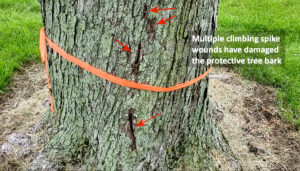 *EXCEPTIONS: Please be advised that under certain circumstances particularly where worker safety is at risk, the use of climbing spikes may be necessary. SAFETY MUST ALWAYS TAKE PRIORITY! Therefore do not refuse a tree service if they plan to use climbing spikes without knowing the reasons why first. On the other hand keep in mind that if you were offered a lowball quote, the tree service may simply be using climbing spikes to get the job done faster to compensate for the low price they offered (e.g. using spikes can make it easier and quicker for a climber to get up into your trees. Time is money.). It could be that the climber is not trained in advanced climbing techniques that don’t use spikes, or perhaps the tree service doesn’t recognize the importance of investing in the proper climbing equipment to protect your trees from unnecessary injuries. That said, maybe your situation is you are on a limited budget or fixed income and you are also having trouble finding an affordable tree service that would serve your area. In such cases you may have to settle for what you can get, but you should NOT allow them to top your trees! You may save a few bucks on the front end, but allowing unnecessary trunk damage to your treated Ash trees (which are already struggling to recover from EAB trunk injuries) is counterintuitive to the efforts by your PHC provider to try and save them.
YEAR THREE [INSPECTION & INJECTION YEAR]
Ash trees that were treated two years prior are inspected again are due for re-treatment to continue protecting them from new EAB infestation. You should continue to see the development of new growth (healthy buds, flowers, twigs, etc.). Some new epicormic shoots may naturally appear but perhaps not as vigorously as before, especially if tree stress is being managed through timely irrigation. We should see more evidence that the tree is successfully callusing over old wounds (internally it will continue compartmentalizing injuries). Don’t be too alarmed if large patches of bark loosen and begin to fall off the trunk and limbs. This usually reveals the tunneled etchings of former EAB larvae. This is a completely natural tree response! Foliar growth rates may vary throughout the canopy and it is again vital to ensure trees receive enough irrigation, particularly during drier and hotter climate periods. Most limbs that were beyond saving are now dead or are very, very near death and will stand out more. This is not an indication that the treatments have failed. It’s an indication of how bad off your tree was suffering before you had them treated. This too is natural. If you haven’t already, you may have maintenance pruning performed during this year as these dead limbs will make them easier to identify and distinguish from limbs that have survived. Pruning can be done almost any time after early spring, but try to get it done during the growing season which will allow the tree some time to start sealing those pruning wounds before it goes dormant in the fall. Try to leave a few Epicormic shoots if the canopies of your trees are still a little thin to provide more active leaf material for photosynthesis.YEAR FOUR (and BEYOND)
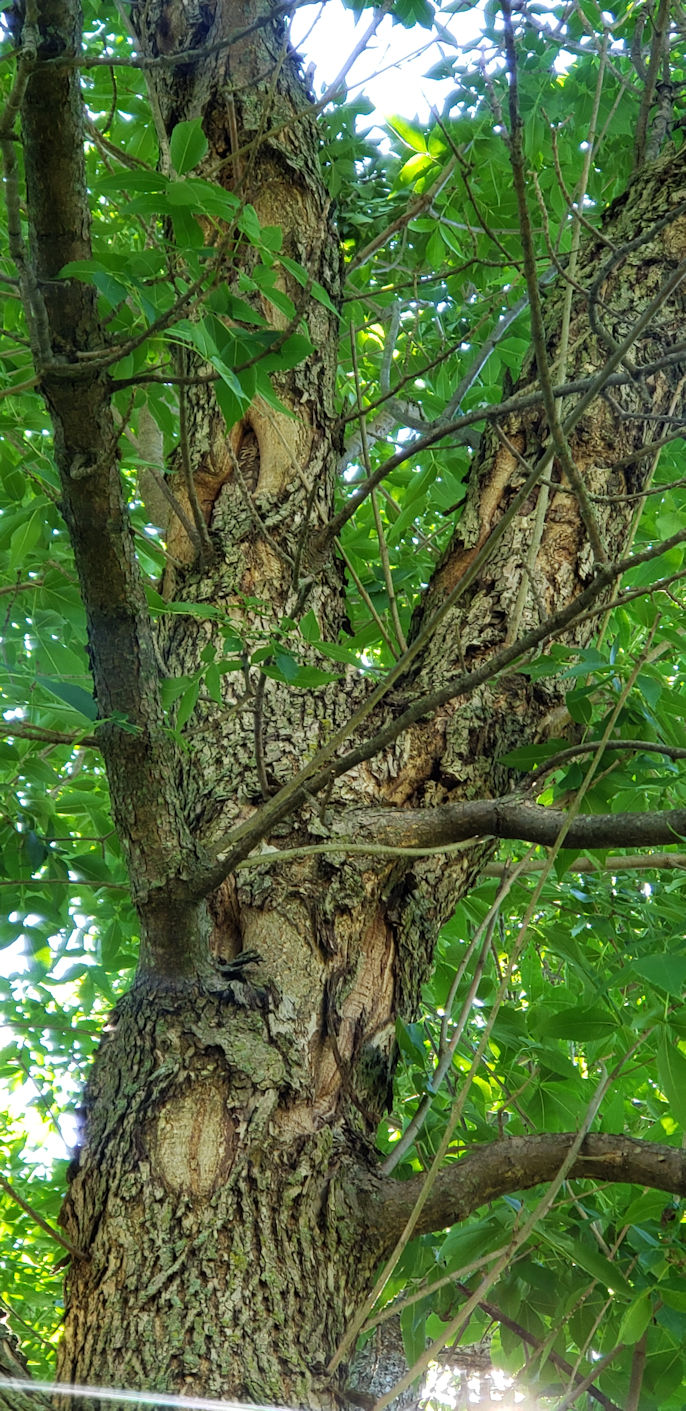
Internal EAB activity in your treated Ash trees should be extremely minimal or null. Your trees are in full recovery mode. If you haven’t had maintenance pruning performed on your tree yet, the dead limbs will be even more pronounced and there may be some breakage in these areas. You may still see some Epicormic shoots forming but some of these may occur naturally and not due to stress or EAB. Prune these according to the overall live crown ratio to always maintain a healthy amount of working foliage while avoiding excessive crossover branches. You may also notice that more old bark has loosened on the trunk and limbs over areas where EAB larvae did damage underneath. EAB galleries will become more exposed and visible as this bark falls off, which may appear troubling to see at first. You should direct your focus and note the plant tissue swelling around these wound areas. This is an excellent indicator that your recovering Ash trees are continuing to put energy towards sealing these wounds. Note the process of recovering from wounds through the series of bark photos below. (Click each for a larger view.) Congratulations! Your Ash trees are progressing well on their road to recovery. You should see steady improvement year after year, provided no other PHC concerns creep in to disrupt their progression, like girdling roots. You MUST maintain good cultural practices, like providing sufficient irrigation and avoiding volcanic mulching, etc. Contact your PHC provider at the first sign of trouble to try to help you to mitigate these issues if possible before they become worse. Infection by fungal leaf pathogens, such as Anthracnose mentioned in section YEAR ONE, can cause your trees to look bad, so don’t confuse this condition as a sign that the EAB control treatments aren’t working.The Three-Year Treatment Cycle – Although Emamectin Benzoate is typically labeled to protect for up to two years, recall our earlier mention concerning Research by Purdue University Extension after 15 years of study. They found traces of the active ingredient that persisted for up to three years within the woody tissue of the treated Ash trees they were monitoring. Therefore, at the discretion of your PHC provider and based on the density of untreated Ash trees in your area, the level of EAB infestation, and the extent that your tree has recovered, they may recommend changing how frequently your Ash trees are treated by replacing the every-second-year treatment cycle with an every-third-year cycle. (Example: You are on a two-year treatment cycle. Your Ash trees were last treated in 2020 and are not due for their next injections until 2022 (i.e. two years later). On that 2022 service visit, your PHC provider determines that your Ash trees appear to be in remarkable condition and that most of their wounds have sealed. This prompts the PHC provider to put your trees on a three-year treatment cycle. Therefore, after the 2022 injections are completed, the next set of injections will not be scheduled until 2025 (i.e. three years later).
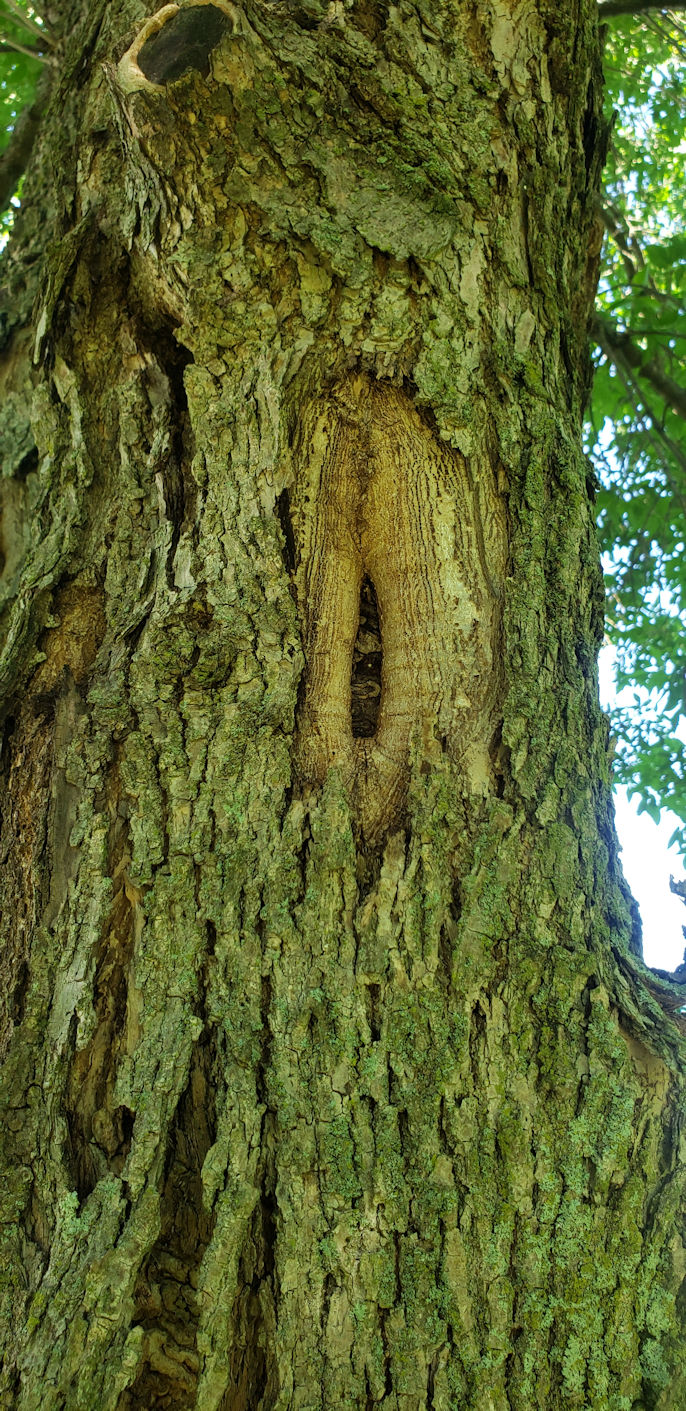
Exhibit K: At first glance, the appearance of the bark may be upsetting or even alarming following EAB control treatment, but in actuality, this is exactly what we want to see happening!
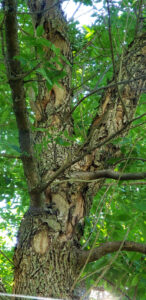
(Click to enlarge.) Exhibit L: As your treated Ash trees experience far less EAB larvae activity as the Emamectin Benzoate stops the pests’ feeding, your trees gain a measure of relief as they seal over their EAB injuries. Since the original bark’s underlying phloem and cambium layer were badly damaged from EAB larval feeding, it dies over each internal wound. The natural response is to compartmentalize the wounds and to form new callous tissue to seal these wounds. As a result, the old bark will loosen from the tree and begin to flake away in small or large sections depending on the areas affected by each wound.
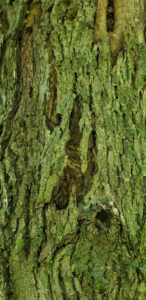
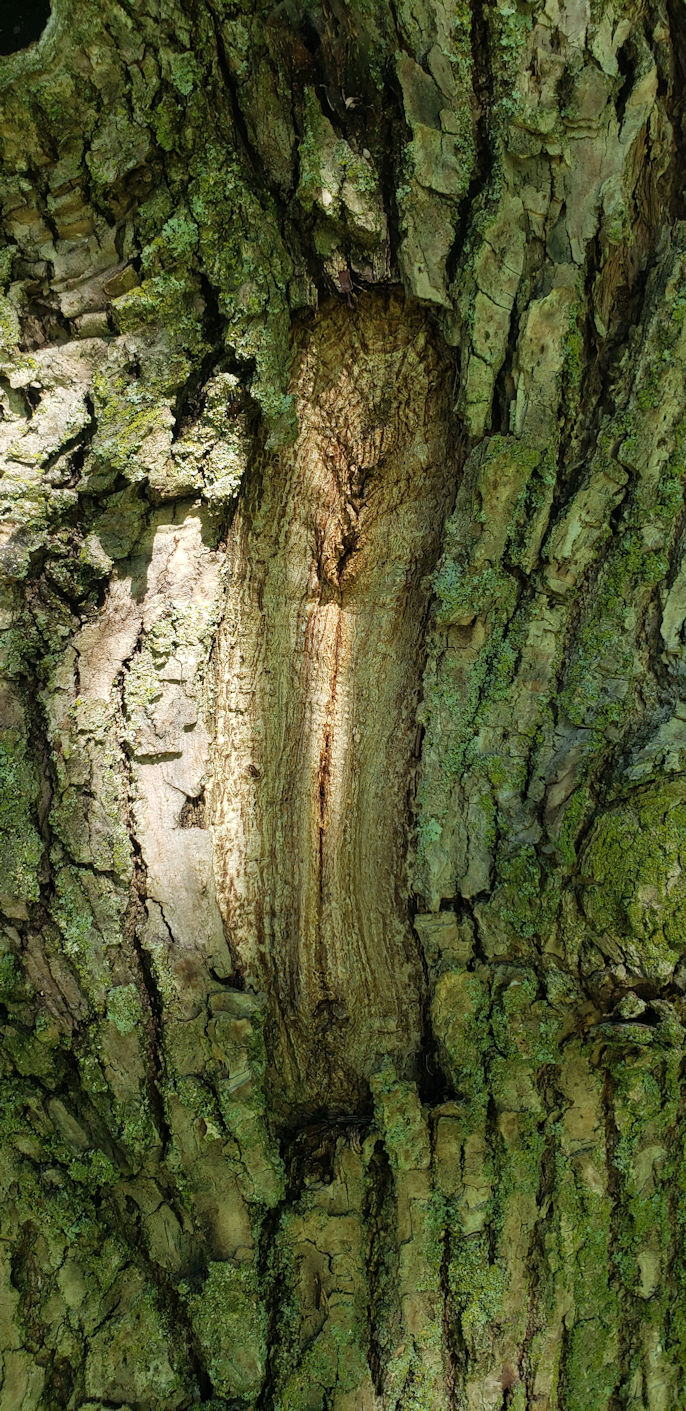
(Click to enlarge.) Exhibit M: In most cases, after the old bark has flaked off this will reveal the damage below. Serpentine (winding S-shaped) feeding paths or galleries were carved as the EAB larvae fed on the phloem and cambium layers beneath the bark. The swollen appearance of the areas surrounding these wounds as discussed before is reactive wood produced in response to injury. When your treated Ash trees use energy to seal over their wounds, this can be a positive indicator that the tree has the vigor for new tissue development. Therefore, it is vital that recovering Ash trees receive sufficient water to help them maintain that vigor!
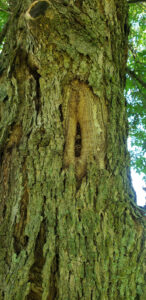
(Click to enlarge.) Exhibit N: Upon successful closure, the sealed wound area will have a puckered, closed-mouth-looking surface. This is worth celebrating because now the interior deadwood will not be as exposed, thus reducing the opportunities of invading wood-destroying organisms such as decay fungi and Carpenter Ants. You may still have to contend with hungry woodpeckers that can damage the new bark while in search of larvae remnants.
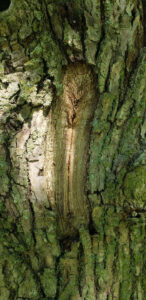
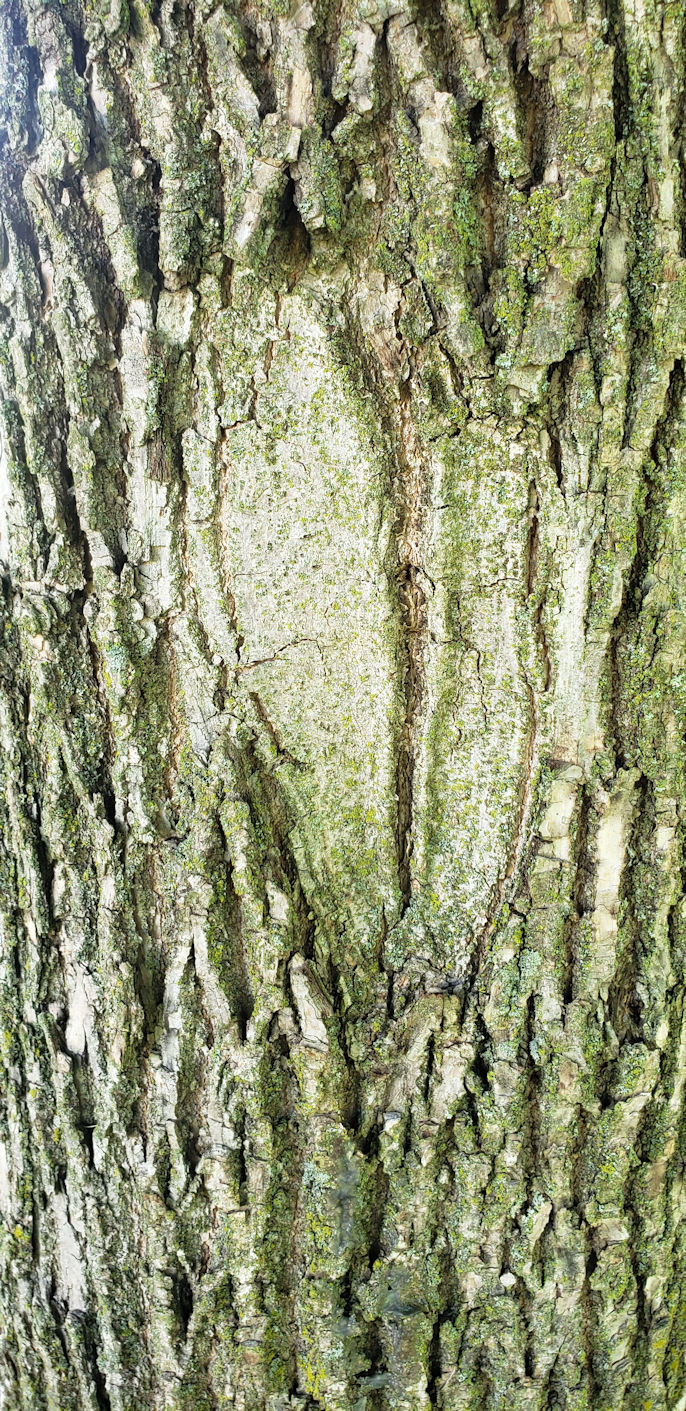
(Click to enlarge.) Exhibit O: As the new bark ages, you will notice its transition over time blend in more with the bark in areas that were not damaged severely by EAB larvae simply because that is exactly what is happening! These restored areas are going to continue to develop and grow with the rest of the tree. As each new annual growth rings develop underneath it will soon be difficult to identify where the original wounds were.
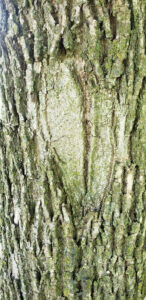
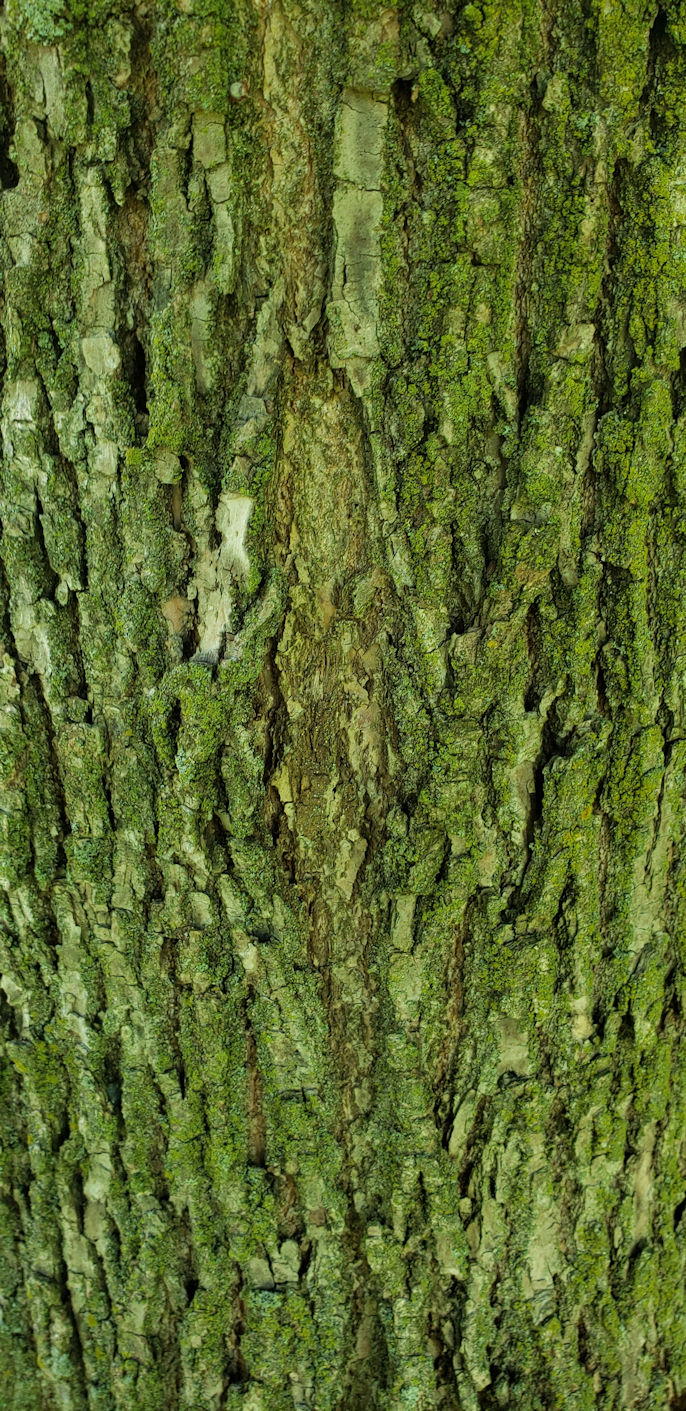
(Click to enlarge.) Exhibit P: Here is a near-complete restoration of a former EAB wounded area. In time, following diligent care and treatments to control EAB, almost every exposed wound will be sealed just like this one on your treated Ash trees! Just be patient and take note of this amazing recovery process!
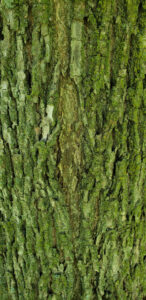
(Click to enlarge.)
DON’T PUT TREATMENT OFF ANY LONGER
Remain vigilant. The likelihood of total eradication of EAB is slim to impossible, but the situation is not hopeless, even for areas that have already lived past the initial wave of devastation. Count yourself fortunate if you reacted in time to have your Ash trees treated and they are still around today for you to tell about it. In some astonishing cases, there are a few Ash trees that have somehow dodged death and survived (so far) that were never treated. Upon closer inspection, however, you will see at least some sign of EAB injury. If you want to save your Ash trees, do not take further chances by delaying treatment. Contact a professional and experienced PHC provider and have your Ash trees treated to protect them from severe EAB infestation. It’s only a matter of time before all untreated Ash trees suffer their demise by this invasive exotic beetle. Let’s hope your Ash trees aren’t among them!
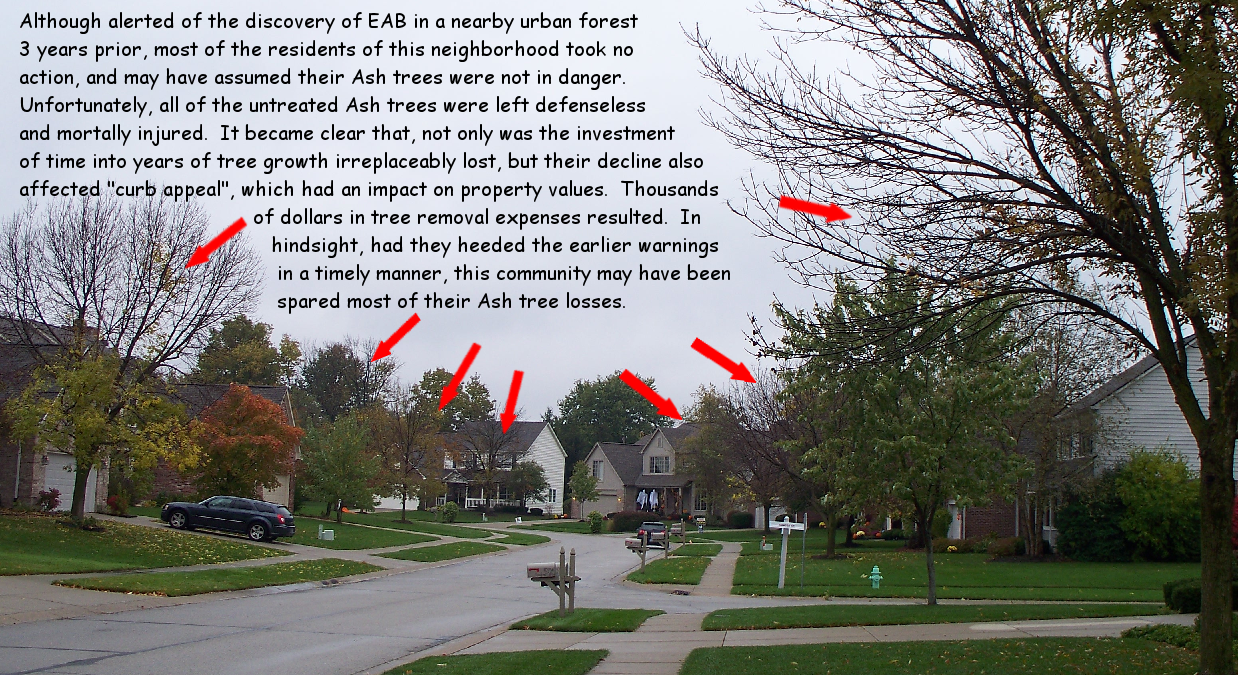
Exhibit Q: An EAB infestation in a Fishers, IN, neighborhood. The first confirmed finding was made by ISA Certified Arborist Mike Webster (IN-1480 B) back in 2009. Unfortunately, many property owners had not heeded the DNR alerts to treat their Ash trees and as a result, most of the trees shown in this photo had to be removed. (Click to enlarge.) Our friend, Mike Webster, has since become an ISA Board Certified Master Arborist and is working for Arbor Care Tree and Landscaping. Mike has a wealth of knowledge and experience and we couldn’t be more proud of him!
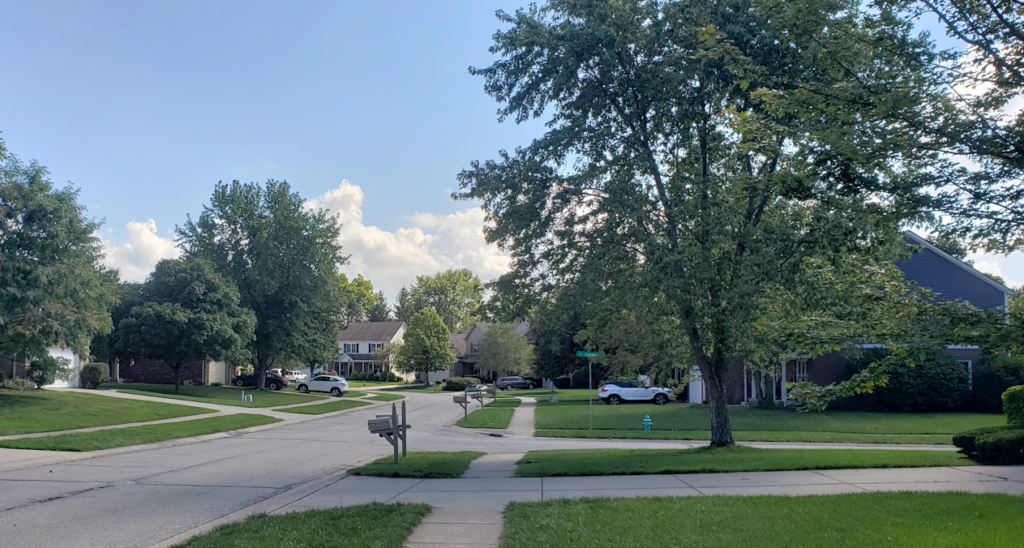
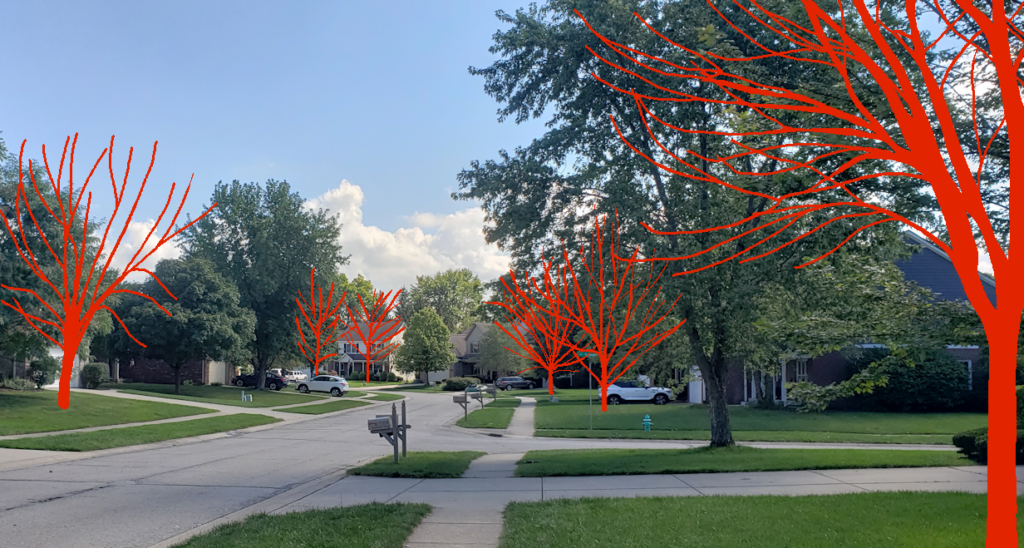
Here’s that same Fishers neighborhood 12 years later in 2021. Although it lost many Ash trees, many of the younger Maple trees in 2009 have grown larger and some of the dead Ash trees were replaced. Still… It’s interesting to image how much more beautiful this area could have looked like if those Ash trees had survived and become more mature.
A reminder of the Ash trees lost…
DON’T FORGET TO WATER YOUR TREES!
ADDITIONAL EAB RESOURCES ONLINE
- Why Hire An Arborist? – International Society of Arboriculture
- Purdue University Extension – Emerald Ash Borer in Indiana
- Emerald Ash Borer Information Network
- USDA-APHIS Emerald Ash Borer Program Manual
- Colorado Emerald Ash Borer First Responder Manual
- New York Invasive Species Information – Emerald Ash Borer: Biology and Life Cycle
Be sure to check your local government and Extension office websites for EAB information directly affecting your area and please, if you go camping or engage in any other outdoor activity using a campfire, fire pit, bonfire, or fireplace, please avoid transporting fire logs across county lines. Beware of EAB hitchhikers! Burn it in the local area you buy it or gather it from.
EAB eggs and larva may be on the firewood you use. Help slow the spread of EAB and don’t transport firewood across county lines! (Click to enlarge.) • Arborist Services Terms and Conditions • Terms of Use • Privacy Policy •
Disclaimer: As tree stewards and advocates, we investigate and research plant health care sciences and best management practices that have proven successful in the tree care industry. That said, some of the views, insights, advice, and opinions we post on our website may differ in perspective from other websites or publications sharing similar topics. That’s okay. Science is an evolving practice of discovery and meticulous research that is continually shaping our knowledge and beliefs. We will continue to engage in that research, and where opinions differ, work toward finding an amicable solution whenever possible. We are not always able to monitor changes or revisions made by external websites, so if any of the links used in this article fail, please let us know. Thank you!
-
ARBOR RANGERS, LLC ARBORIST PHC AND GENERAL SERVICES STATEMENT
ARBOR RANGERS, LLC ARBORIST PHC AND GENERAL SERVICES STATEMENT
Terms and Conditions
These Terms and Conditions apply to existing and new clients of Arbor Rangers, LLC for for-hire arborist plant health care (PHC) and related services performed by Jeff Harris and his associates.
Invoices are due upon receipt. Thank you for your prompt payment!
QUOTES EXPIRE IN 30 DAYS: Estimates are based on the anticipated duration and difficulty of the service(s) quoted and on the assumption that unexpected circumstances that could prolong or deepen the scope of work will not be encountered. If significant additional time is necessary, I (or an assignee) will make every effort to contact you via a mobile device (text message, phone, and email) to document and discuss the situation prior to taking any other action. With approval, my fee(s) will be adjusted accordingly and work will proceed. If I am unable to receive a response from you within the allotted project time frame, as may be estimated in my quote or work order, work will be suspended before any additional costs are incurred beyond the original quotes (unless you had given me carte blanche at the time you approved the original work estimate). After 30 days a quote is issued, certain services may become unavailable or otherwise discontinued and associated fees for eligible services may increase or decrease, without prior notification. Quotes found on our official website are being updated and will change therefore only quotes contained in this communication are valid for up to 30 days.
PAYMENT FOR SERVICE(S) and LATE PAYMENTS: Invoices are due upon receipt. Invoices will be sent via email or PayPal and are due upon receipt. You may pay this invoice securely via PayPal or by credit or debit card. You DO NOT need a PayPal account to pay your invoice using PayPal or a card, however, payment via PayPal or card will incur an additional transaction fee of 30 cents, plus a processing fee of 2.9%. To save on fees, you may pay by check. Please write your Invoice# in the Memo section on the front of your check and make your check out to “Jeff Harris” and mail your payment to: Jeff Harris, Arbor Rangers, LLC, PO Box 80006, Carmel, IN 46280. At 30 days, clients with invoices that are still unpaid will receive a courtesy reminder email. At 60 days, there may be an additional late fee of $15.00 added to an unpaid invoice, unless the client has made contact regarding the delayed payment and special arrangements have been approved in writing (e.g. electronic communication via email) waiving the fee for late payment. Past due invoices, including payment of any applicable late fees, of 60 days or more may result in suspension or cancellation of remaining PHC services and disqualification for future services offerings and may become subject to litigation and associated costs.
CANCELLATION of SERVICE: For documentation purposes, once you’ve approved recommended treatment(s) of an estimate that entail more than one application and after the first service(s) have been performed, if you do not wish to continue treatments (i.e. you want to cancel your service(s)), then please write me a letter (or email me) requesting cancellation PRIOR TO the next PHC treatment so that I will not waste a trip out to your property to perform scheduled service(s) you no longer want. If you do not cancel in time prior to my service visit and I make the trip out to your property to perform the scheduled PHC treatment(s), you will be invoiced at least a $75.00 trip charge, however, if any treatment service(s) were completed then the current fees for those will be billed to you instead. Past due invoices, including payment of any applicable late fees, of 60 days or more may result in suspension or cancellation of remaining PHC services and disqualification for future services offerings and may become subject to litigation and associated costs.
DISCOUNTS: Discounts are applied at our discretion and cannot be combined with any other discount offer(s). If applicable, the highest discount amount will be applied to each invoice. Because discounts are at our expense and economic times are unpredictable, we reserve the right to change or cancel offering discounts at our discretion without prior notice. Thank you for understanding.
-
EAB Crossword Challenge
EAB Crossword Challenge
EAB Crossword Challenge The EAB Crossword Challenge puzzle sheet and solutions have been moved to here.
-
Native Trees of Indiana
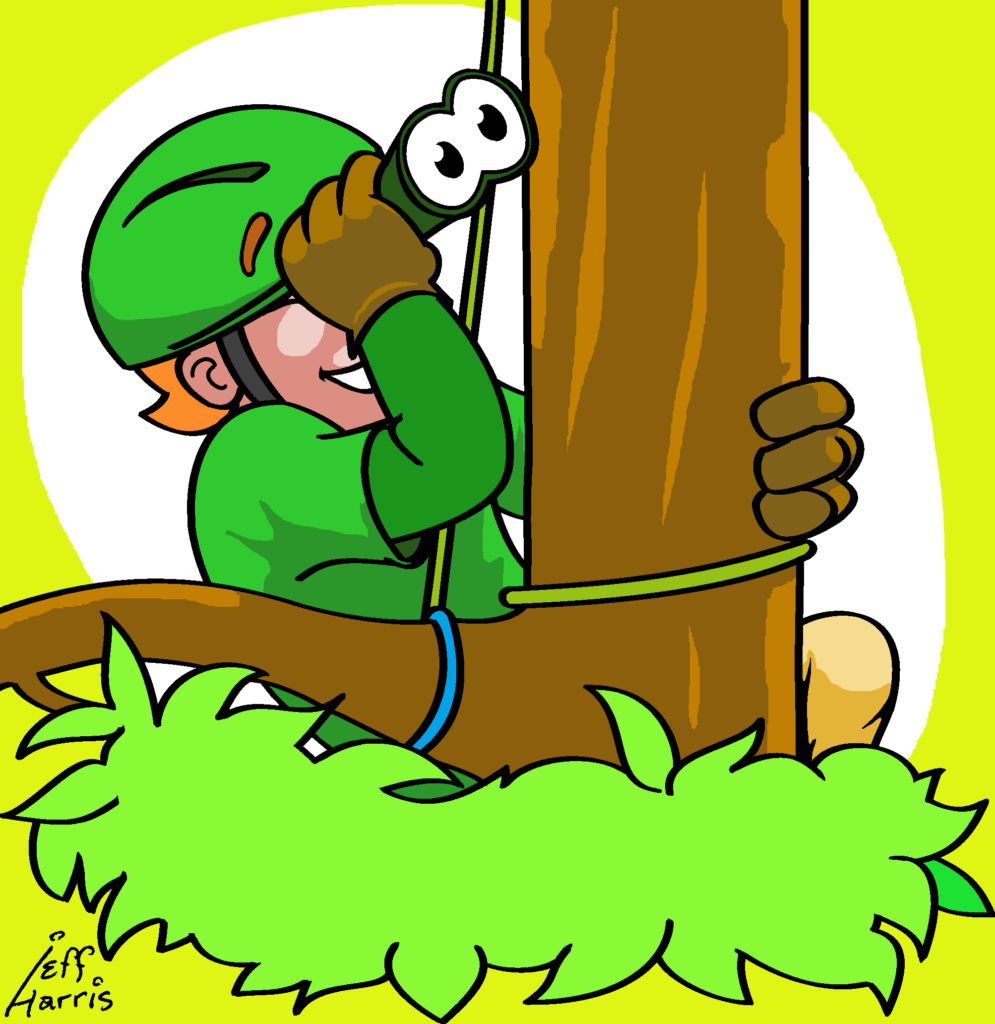
Sandy gets up close to view trees! Sandy loves the diversity of trees that are native to Indiana! Whenever she gets a chance, she puts on her safety equipment and goes out with her fellow Arbor Rangers ™ to view and climb trees.
Trees come in all shapes and sizes and Indiana, for example, has over 100 native species!
Did you know that some of these Indiana tree species are in common with nearby states?
For instance, the Indiana State Tree, the Tulip Tree (also known as Yellow Poplar; scientific name, Liriodendron tulipifera), is also the State Tree of Kentucky and Tennessee! It is native from Connecticut and southern New York, westward to southern Ontario and northern Ohio, and south to Louisiana and northern Florida.
The most common types of trees in Indiana range from:
- CONIFER (a.k.a. EVERGREEN or Softwood) trees bear cones with embedded seeds and have needle-like or scale-like leaves that remain “ever” green throughout the year. Because these plants do not produce flowers, they are among the group of plants known as “Gymnosperms“.
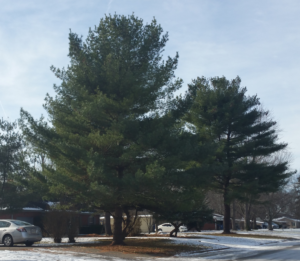
Eastern White Pines (Pinus strobus) adorn a front yard in this neighborhood. - DECIDUOUS HARDWOOD (a.k.a. Broadleafed) trees which are trees with broader, flattened, “fan-like” leaves (simple or compound of various shapes and sizes). These are seed-producing plants, like conifers, but they differ because they bear flowers (some more distinctly than others) and thereby are among a larger diverse group of plants called “Angiosperms“. Most species’ leaves will change color before dropping off in the fall season. This is true in other cooler climate states, but rarer in warmer or tropical climate states.
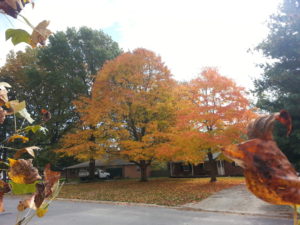
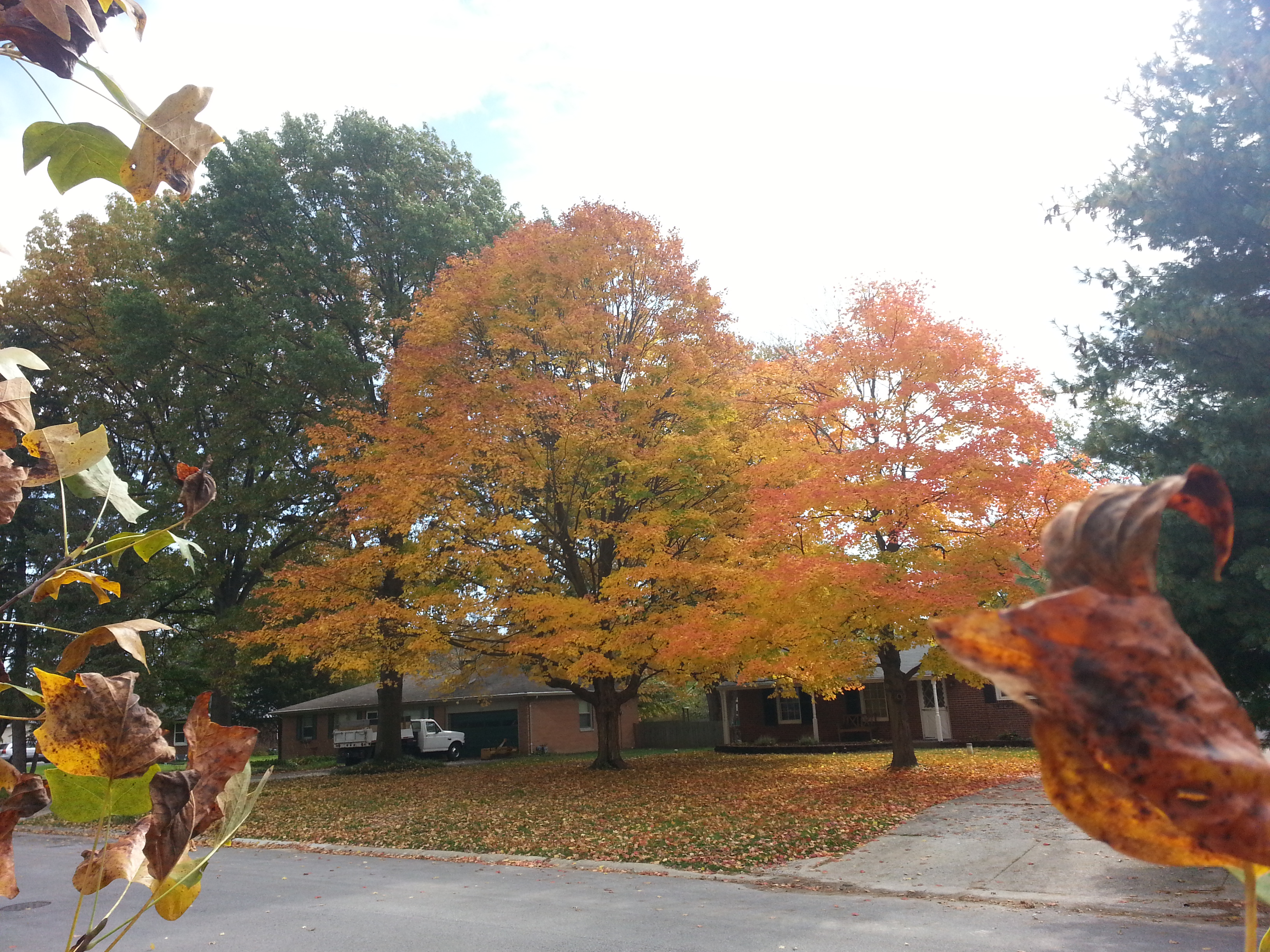
Sugar Maples (Acer saccharum) brighten up a neighborhood in fall! - DECIDUOUS EVERGREEN trees which look like typical conifers, but surprisingly lose their foliage in the fall just like deciduous hardwood trees! These are also among the group of plants known as “Gymnosperms“.
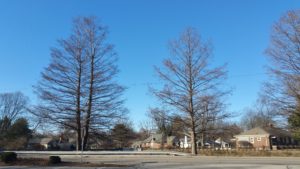
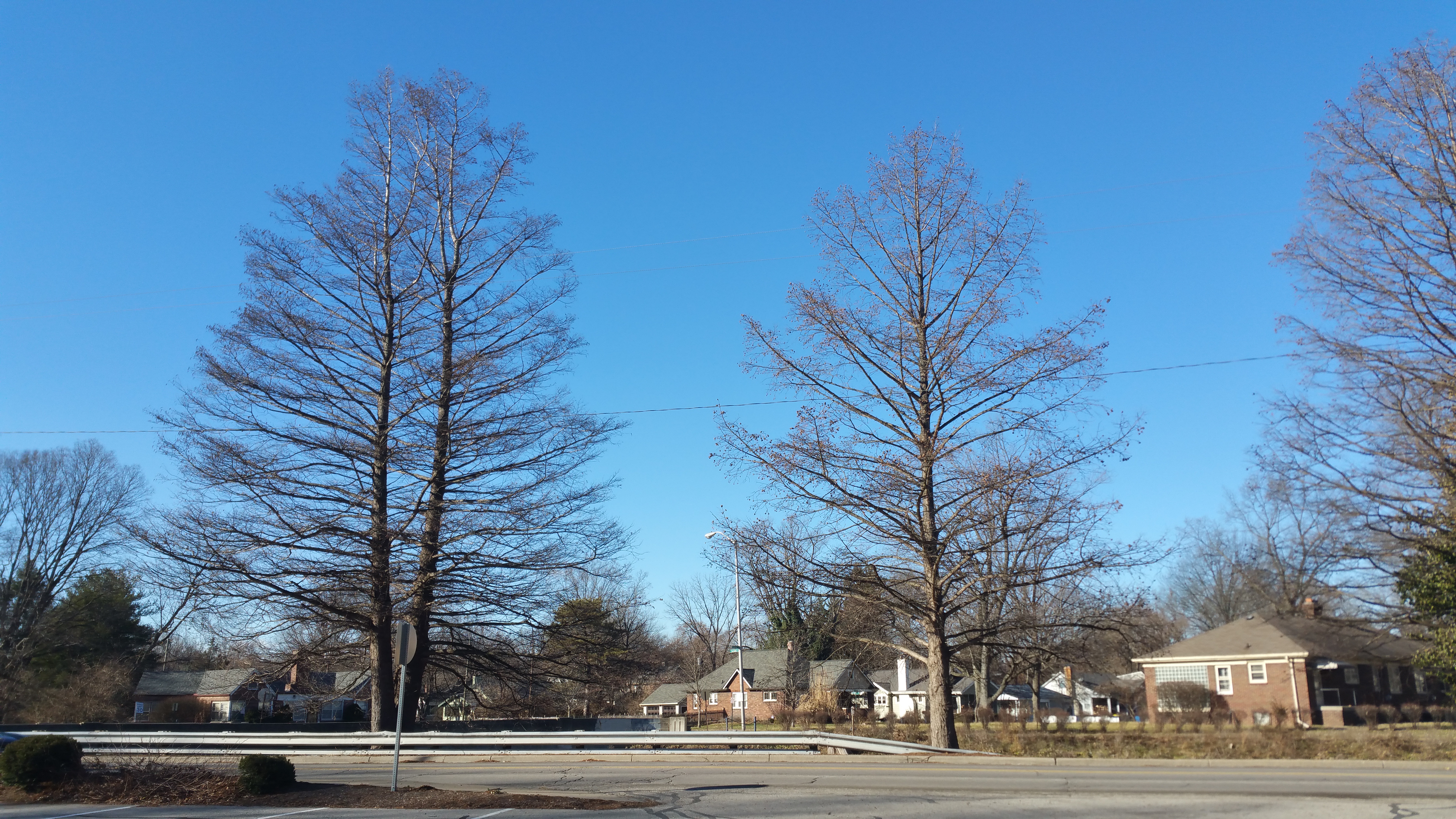
Baldcypress (Taxodium distichum) by the canal have lost their summer foliage. Do Your TREE-Search!
Sandy has helped put together the following list of trees that are native to Indiana. Included are non-native, INVASIVE SPECIES.* This is a searchable & sortable list of conifers and hardwood trees featuring their Scientific Names as well as Common Names by which they are generally known and includes links to more tree information** by clicking on their Scientific and Common Names.
DEFINITIONS The list also reflects some quick tree facts, such as:
- Type: One of the three tree types: Conifer, Deciduous Hardwood, or Deciduous Evergreen.
- Leaf: The general type of leaf form.
- Simple – a single leaf blade joined by its stalk (or petiole) to a woody stem.
- Compound – a leaf that is itself composed of more than one leaflet and these leaflets are attached to its single leaf stalk.
- Needle-like – slender, sharp-pointed leaf.
- Scale-like – leaves with short overlapping segments.
- Branching: Briefly describes the general, characteristic, growth structure of the plant’s stems/branches.
- Alternate – branching that is staggered or not directly across from one another.
- Opposite – branches that are directly across from each other.
- Height: The approximate average maximum height the tree species may obtain at maturity.
- Spread: The approximate average maximum width the tree species may obtain at maturity.
- Fall Color: The general color of the foliage during the fall/winter season; leaves detach and drop from deciduous tree types. Find out Why Leaves Change Color.
- Hardiness Zones: Range of USDA Plant Hardiness Zones each plant has been reported to grow and usually thrive in. To learn more about hardiness zones, see our USDA Plant Hardiness Zone Map – INDIANA page.
HINT: Viewing the list on a small screen mobile device in portrait position may not display all columns. Try viewing this page with your device in landscape orientation to broaden your view of all featured columns of the tree list.
Explore the Native Trees of Indiana
*An invasive species is defined as a species that is: 1) non-native (or alien) to the ecosystem under consideration and 2) whose introduction causes or is likely to cause economic or environmental harm or harm to human health. Invasive species that occur in urban forests should be removed, if and wherever possible, or at least avoid being planted or replanted.Scientific Name(s) Common Name(s) Type; Leaf; Branching Height Spread Fall Color Hardiness Zones PEST ALERT! Juniperus virginiana Redcedar, Eastern; Red Cedar, Eastern Conifer, Scale-like, Alternate 50′ 20′  Green
Green2-9 EGM (seldom attacked by EGM) Pinus banksiana Pine, Jack; Jack-pine Conifer, Needle-like, Alternate 40′ 18′ Green3-7 EGM, SLF (especially favored by EGM, SLF) Pinus strobus Pine, Eastern White; Pine, White Conifer, Needle-like, Alternate 100′ 50′ Green5-7 EGM, SLF (especially favored by EGM, SLF) Pinus virginiana Pine, Virginia; Virginia-pine; Scrub-pine Conifer, Needle-like, Alternate 50′ 20′ Green4-8 EGM, SLF (especially favored by EGM, SLF) Thuja occidentalis Arborvitae, Eastern; White Cedar, Northern; White Cedar; Tree of Life Conifer, Scale-like, Alternate; Endangered 50′ 15′ Green2-8 EGM (seldom attacked by EGM) Tsuga canadensis Hemlock, Eastern; Hemlock, Canadian Conifer, Needle-like, Alternate 90′ 40′ Green4-7 EGM (especially favored by EGM) Larix laricina Larch, American; Larch, Eastern; Tamarack Evergreen, Deciduous, Needle-like, Alternate 75′ 30′  Yellow
2-8 EGM Taxodium distichum Baldcypress; Bald Cypress Evergreen, Deciduous, Needle-like, Alternate; Threatened 120′ 45′  Red, Copper
5-9 Acer negundo Boxelder; Maple, Ash-leaved Hardwood, Deciduous, Compound, Opposite 60′ 40′  Red-orange
3-8 EGM, ALB, SLF (especially favored by ALB) Acer nigrum Maple, Black Hardwood, Deciduous, Simple, Opposite 80′ 60′ Yellow4-8 EGM, ALB, SLF (especially favored by EGM, ALB) Acer platanoides Maple, Norway, incl. cultivar: Maple, Crimson King INVASIVE SPECIES Hardwood, Deciduous, Simple, Opposite 80′ 40′ Yellow4-8 EGM, ALB, SLF (especially favored by EGM, ALB) Acer rubrum Maple, Red Hardwood, Deciduous, Simple, Opposite 90′ 50′ Red-orange4-8 EGM, ALB, SLF (especially favored by EGM, ALB) Acer saccharinum Maple, Silver; Silver-maple Hardwood, Deciduous, Simple, Opposite 80′ 60′ Yellow4-8 EGM, ALB, SLF (especially favored by EGM, ALB) Acer saccharum Maple, Sugar; Sugar-maple Hardwood, Deciduous, Simple, Opposite 80′ 60′  Yellow-orange
4-8 EGM, ALB, SLF (especially favored by EGM, ALB) Aesculus flava (A. octandra) Buckeye, Yellow; Buckeye, Sweet Hardwood, Deciduous, Compound, Opposite 90′ 50′  Yellow, Brown
3-8 EGM, ALB (especially favored by ALB) Aesculus glabra Buckeye, Ohio Hardwood, Deciduous, Compound, Opposite 50′ 35′  Red-brown
3-7 EGM, ALB (especially favored by ALB) Amelanchier arborea Serviceberrry, Downy; Serviceberry, Common Hardwood, Deciduous, Simple, Alternate 30′ 25′  Yellow-red
4-9 EGM, SLF (especially favored by EGM) Amelanchier laevis Serviceberry, Allegheny: Shadbush, Allegheny; Serviceberry, Smooth Hardwood, Deciduous, Simple, Alternate 30′ 10′ Yellow-red4-8 EGM, SLF (especially favored by EGM) Asimina triloba Pawpaw Hardwood, Deciduous, Simple, Alternate 30′ 30′ Yellow5-8 EGM (especially favored by EGM) Betula alleghaniensis Birch, Yellow Hardwood, Deciduous, Simple, Alternate 60′ 60′ Yellow3-9 EGM, ALB, SLF (especially favored by EGM) Betula nigra Birch, River; Birch, Red Hardwood, Deciduous, Simple, Alternate 80′ 60′ Yellow3-9 EGM, ALB, SLF (especially favored by EGM) Betula papyrifera Birch, Paper; Birch, White Hardwood, Deciduous, Simple, Alternate 50′ 60′ Yellow3-9 EGM, ALB, SLF (especially favored by EGM) Betula populifolia Birch, Gray; Birch, Grey Hardwood, Deciduous, Simple, Alternate; Presumed Extirpated 30′ 20′ Yellow4-6 EGM, ALB, SLF (especially favored by EGM) Carpinus caroliniana Hornbeam, American; Beech, Blue; Musclewood; Beech, Water Hardwood, Deciduous, Simple, Alternate 30′ 25′ Yellow-red3-9 EGM (especially favored by EGM) Carya cordiformis Hickory, Bitternut; Bitternut-hickory Hardwood, Deciduous, Compound, Alternate 80′ 50′ Yellow3-7 Carya glabra Hickory, Pignut; Pignut-hickory Hardwood, Deciduous, Compound, Alternate 60′ 40′ Yellow5-9 EGM, SLF (especially favored by EGM) Carya illinoinensis Pecan Hardwood, Deciduous, Compound, Alternate 100′ 75′ Yellow6-9 EGM, SLF (especially favored by EGM) Carya laciniosa Hickory, Shellbark; Shellbark-hickory Hardwood, Deciduous, Compound, Alternate 120′ 60′ Yellow5-8 EGM, SLF (especially favored by EGM) Carya ovalis Hickory, Red; Red-hickory; Hickory, Sweet Pignut; Sweet Pignut-hickory Hardwood, Deciduous, Compound, Alternate 80′ 80′ Yellow, Brown4-8 EGM, SLF (especially favored by EGM) Carya ovata Hickory, Shagbark; Shagbark-hickory Hardwood, Deciduous, Compound, Alternate 80′ 40′ Yellow4-8 EGM, SLF (especially favored by EGM) Carya pallida Hickory, Sand; Hickory, Pale Hardwood, Deciduous, Compound, Alternate; Threatened 40′ 43′  Yellow, Pale
5-9 EGM, SLF (especially favored by EGM) Carya texana Hickory, Black Hardwood, Deciduous, Compound, Alternate; Endangered 50′ 43′ Yellow, Brown5-9 EGM, SLF (especially favored by EGM) Carya tomentosa Hickory, Mockernut Hardwood, Deciduous, Compound, Alternate 60′ 30′ Yellow, Brown6-8 EGM, SLF (especially favored by EGM) Castenea dentata Chestnut, American Hardwood, Deciduous, Simple, Alternate; Endangered 75′ 75′ Yellow, Brown5-8 EGM, SLF (especially favored by EGM) Catalpa speciosa Catalpa, Northern; Catalpa Hardwood, Deciduous, Simple, Whorled 60′ 40′  Yellow-green
4-9 EGM (seldom attacked by EGM) Celtis laevigata Sugarberry; Hackberry, Southern Hardwood, Deciduous, Simple, Alternate 80′ 80′ Yellow6-9 Celtis occidentalis Hackberry, Common; Hackberry, Northern Hardwood, Deciduous, Simple, Alternate 90′ 60′ Yellow2-9 EGM, ALB (especially favored by EGM) Cercis canadensis Redbud; Redbud, Eastern Hardwood, Deciduous, Simple, Alternate 30′ 35′ Yellow4-9 EGM (especially favored by EGM) Cladrastis kentukea (C. lutea) Yellowwood; Yellowwood, American; Yellowwood, Kentucky Hardwood, Deciduous, Compound, Alternate; Threatened 60′ 55′ Yellow4-8 Cornus alternifolia Dogwood, Pagoda; Pagoda-dogwood; Dogwood, Alternate-leaved Hardwood, Deciduous (Shrubby), Simple, Alternate 30′ 30′  Red, Purple
4-7 EGM, SLF (especially favored by SLF) Cornus florida Dogwood, Flowering Hardwood, Deciduous, Simple, Opposite 40′ 20′  Red, Rust
5-8 EGM, SLF (especially favored by SLF) Crataegus crus-galli Hawthorn, Cockspur; Cockspur-thorn Hardwood, Deciduous, Simple, Alternate 25′ 25′  Orange-red
3-7 EGM (especially favored by EGM) Crataegus mollis Hawthorn, Downy Hardwood, Deciduous, Simple, Alternate 25′ 30′ Orange-red3-6 EGM (especially favored by EGM) Crataegus punctata Hawthorn, Dotted Hardwood, Deciduous, Simple, Alternate 30′ 30′ Orange-red4-8 EGM (especially favored by EGM) Crataegus viridis Hawthorn, Green Hardwood, Deciduous, Simple, Alternate; Threatened 25′ 25′  Red-orange
5-7 EGM (especially favored by EGM) Diospyros virginiana Persimmon; Persimmon, Common Hardwood, Deciduous, Simple, Alternate 60′ 35′ Orange-red4-8 EGM (especially favored by EGM) Fagus grandifolia Beech, American Hardwood, Deciduous, Simple, Alternate 80′ 80′ Orange-red4-8 EGM, SLF (especially favored by EGM, SLF) Fraxinus americana Ash, White; Purple Ash Hardwood, Deciduous, Compound, Opposite 100′ 70′ Red, Purple3-9 EAB, EGM, ALB, SLF (less preferred by EAB, ALB; seldom attacked by EGM;especially favored by SLF) Fraxinus nigra Ash, Black Hardwood, Deciduous, Compound, Opposite 60′ 70′ Yellow3-9 EAB, EGM, ALB, SLF (especially favored by EAB; less preferred by ALB; seldom attacked by EGM) Fraxinus pennsylvanica Ash, Green; Ash, Red Hardwood, Deciduous, Compound, Opposite 50′ 70′ Yellow3-9 EAB, EGM, ALB, SLF (especially favored by EAB, ALB; seldom attacked by EGM) Fraxinus profunda Ash, Pumpkin; Pumpkin-ash Hardwood, Deciduous, Compound, Opposite 60′ 70′ Red, Purple5-9 EAB, EGM, ALB, SLF (seldom attacked by EGM) Fraxinus quadrangulata Ash, Blue Hardwood, Deciduous, Compound, Opposite 70′ 70′ Yellow, Pale3-9 EAB, EGM, ALB, SLF (less preferred by EAB; seldom attacked by EGM) Gleditsia aquatica Waterlocust; Water-locust Hardwood, Deciduous, Compound, Alternate; Endangered 60′ 39′ Yellow6-9 Gleditsia triacanthos Honeylocust; Honey-locust Hardwood, Deciduous, Compound, Alternate 70′ 40′ Yellow, Brown4-9 EGM (seldom attacked by EGM) Gymnocladus dioicus Kentucky Coffeetree; Kentucky Coffee-tree Hardwood, Deciduous, Compound, Alternate 100′ 50′ Yellow3-8 Juglans cinerea Butternut; Walnut, White Hardwood, Deciduous, Compound, Alternate 60′ 50′ Yellow3-7 EGM, SLF (especially favored by EGM) Juglans nigra Walnut, Black Hardwood, Deciduous, Compound, Alternate 80′ 70′ Yellow4-9 EGM, SLF (especially favored by EGM, SLF) Liquidambar styraciflua Sweetgum; Gum, Sweet; Gum, Red Hardwood, Deciduous, Simple, Alternate 120′ 50′ Orange-red5-9 EGM (especially favored by EGM) Liriodendron tulipifera Tuliptree; Tulip-tree; Poplar, Tulip; Poplar, Yellow Hardwood, Deciduous, Simple, Alternate 175′ 50′ Yellow5-9 EGM, SLF (seldom attacked by EGM; especially favored by SLF) Magnolia acuminata Magnolia, Cucumber; Cucumber-tree; Cucumbertree Hardwood, Deciduous, Simple, Alternate; Endangered 100′ 35′  Yellow, Gold
3-8 EGM Magnolia tripetala Magnolia, Umbrella; Umbrella-tree Hardwood, Deciduous, Simple, Alternate; Endangered 20′ 30′ Yellow, Brown5-8 Malus coronaria
(Pyrus coronaria)Crabapple, American; Crabapple, Wild; Crabapple, Wild Sweet; Crabapple, Sweet Hardwood, Deciduous, Simple, Alternate 30′ 25′ Yellow-green4-8 Malus ioensis Crabapple, Prairie Hardwood, Deciduous, Simple, Alternate 25′ 25′ Red-orange4-8 Morus alba Mulberry, White; Mulberry, Silkworm INVASIVE SPECIES Hardwood, Deciduous, Simple, Alternate 30′ 50′ Yellow4-8 Morus rubra Mulberry, Red Hardwood, Deciduous, Simple, Alternate 70′ 35′ Yellow5-10 Nyssa sylvatica Gum, Black; Gum, Sour; Tupelo, Black Hardwood, Deciduous, Simple, Alternate 60′ 30′ Red, Copper3-9 Ostrya virginiana Hophornbeam; Hop-hornbeam, American; Hop-hornbeam, Eastern; Ironwood Hardwood, Deciduous, Simple, Alternate 30′ 30′ Yellow3-9 Oxydendrum arboreum Sourwood Hardwood, Deciduous, Simple, Alternate; Threatened 60′ 25′ Orange-red5-9 Platanus occidentalis Sycamore; Sycamore, American Hardwood, Deciduous, Simple, Alternate 100′ 100′ Yellow4-9 Populus balsamifera Poplar, Balsam; Balsam-poplar Hardwood, Deciduous, Simple, Alternate; Presumed Extirpated 70′ 10′ Yellow3-9 Populus deltoides Cottonwood; Cottonwood, Eastern Hardwood, Deciduous, Simple, Alternate 100′ 75′ Yellow2-9 Populus grandidentata Aspen, Bigtooth; Aspen, Big-toothed; Aspen, Large-toothed Hardwood, Deciduous, Simple, Alternate 50′ 28′ Yellow, Gold3-5 Populus heterophylla Cottonwood, Swamp Hardwood, Deciduous, Simple, Alternate 70′ 40′ Yellow3-8 Populus tremuloides Aspen, Quaking; Aspen, Trembling Hardwood, Deciduous, Simple, Alternate 50′ 30′ Yellow2-5 Prunus americana Plum, American; Plum, American Wild Hardwood, Deciduous, Simple, Alternate 25′ 25′ Orange-red3-10 Prunus hortulana Plum, Hortulan; Plum, Wild Goose Hardwood, Deciduous, Simple, Alternate 15′ 15′ Orange-red5-9 Prunus nigra Plum, Canada; Canada-plum Hardwood, Deciduous, Simple, Alternate 25′ 15′ Red, Purple3-6 Prunus pensylvanica Cherry, Pin; Pin-cherry; Cherry, Fire Hardwood, Deciduous, Simple, Alternate 40′ 30′ Orange-red3-8 Prunus serotina Cherry, Wild Black; Cherry, Black Hardwood, Deciduous, Simple, Alternate 80′ 25′ Yellow3-10 Pyrus calleryana Pear, Callery, incl. cultivar: Pear, Bradford INVASIVE SPECIES Hardwood, Deciduous, Simple, Alternate 50′ 35′ Red, Purple4-9 Quercus acutissima Oak, Sawtooth INVASIVE SPECIES Hardwood, Deciduous, Simple, Alternate 60′ 60′ Yellow, Brown5-9 Quercus alba Oak, White Hardwood, Deciduous, Simple, Alternate 150′ 70′ Red3-9 Quercus bicolor Oak, Swamp White Hardwood, Deciduous, Simple, Alternate 75′ 70′ Yellow, Brown3-9 Quercus coccinea Oak, Scarlet Hardwood, Deciduous, Simple, Alternate 80′ 50′  Red, Deep
4-8 Quercus ellipsoidalis Oak, Northern Pin; Pin-oak, Northern; Oak, Hill’s Hardwood, Deciduous, Simple, Alternate 60′ 70′ Red, Rust3-9 Quercus falcata Oak, Southern Red; Oak, Spanish Hardwood, Deciduous, Simple, Alternate 80′ 50′ Red, Copper7-9 Quercus imbricaria Oak, Shingle; Shingle-oak Hardwood, Deciduous, Simple, Alternate 60′ 70′ Orange-red3-9 Quercus lyrata Oak, Overcup; Overcup-oak Hardwood, Deciduous, Simple, Alternate 80′ 60′  Orange-brown
6-9 Quercus macrocarpa Oak, Bur; Bur-oak; Oak, Mossycup Hardwood, Deciduous, Simple, Alternate 80′ 70′ Red, Copper3-9 Quercus marilandica Oak, Blackjack; Oak, Black-jack Hardwood, Deciduous, Simple, Alternate 40′ 70′ Red3-9 Quercus michauxii Oak, Swamp Chestnut; Chestnut-oak, Swamp Hardwood, Deciduous, Simple, Alternate 80′ 50′ Red6-9 Quercus montana (Q. prinus) Oak, Chestnut; Oak, Rock Chestnut; Chestnut-oak, Rock; Oak, Rock; Oak, Mountain Hardwood, Deciduous, Simple, Alternate 75′ 60′ Yellow, Brown5-9 Quercus muehlenbergii Oak, Chinkapin; Oak, Chinquapin; Chinkapin-oak; Oak, Yellow Hardwood, Deciduous, Simple, Alternate; Endangered 80′ 70′ Orange-brown3-9 Quercus pagoda Oak, Cherrybark; Cherrybark-oak Hardwood, Deciduous, Simple, Alternate 120′ 48′ Red, Copper7-9 Quercus palustris Oak, Pin; Pin-oak Hardwood, Deciduous, Simple, Alternate 80′ 70′ Orange-red3-9 Quercus rubra Oak, Red; Oak, Northern Red Hardwood, Deciduous, Simple, Alternate 80′ 70′ Red, Deep3-9 Quercus shumardii Oak, Shumard Hardwood, Deciduous, Simple, Alternate 80′ 60′ Orange-red5-9 Quercus stellata Oak, Post; Post-oak Hardwood, Deciduous, Simple, Alternate 50′ 70′ Red, Copper3-9 Quercus velutina Oak, Black Hardwood, Deciduous, Simple, Alternate 60′ 60′ Orange-red3-9 Robinia pseudoacacia Locust, Black Hardwood, Deciduous, Compound, Alternate 80′ 35′ Yellow4-8 Sassafras albidum Sassafras Hardwood, Deciduous, Simple, Alternate 90′ 40′ Red, Deep5-9 Tilia americana Basswood, American; Linden, American Hardwood, Deciduous, Simple, Alternate 80′ 50′ Yellow3-8 Ulmus alata Elm, Winged Hardwood, Deciduous, Simple, Alternate 50′ 40′ Yellow6-9 Ulmus americana Elm, American Hardwood, Deciduous, Simple, Alternate 100′ 120′ Yellow2-9 Ulmus pumila Elm, Siberian INVASIVE SPECIES Hardwood, Deciduous, Simple, Alternate 60′ 50′ Yellow5-9 Ulmus rubra Elm, Slippery; Elm, American Slippery Hardwood, Deciduous, Simple, Alternate 60′ 35′ Yellow3-9 Ulmus thomasii Elm, Rock; Elm, Cork Hardwood, Deciduous, Simple, Alternate 90′ 90′ Yellow3-7 Salix amigdaloides Willow, Peachleaf; Willow, Peach-leaf Hardwood, Deciduous (Shrubby), Simple, Alternate 40′ 17′ Yellow2-8 Salix nigra Willow, Black Hardwood, Deciduous, Simple, Alternate 40′ 100′ Yellow2-8 Aralia spinosa Devil’s Walkingstick; Devil’s-walkingstick; Hercules’ Club Hardwood, Deciduous (Shrubby), Compound, Alternate 20′ 10′ Red-orange4-9 Hamamelis virginiana Witch-hazel Hardwood, Deciduous (Shrubby), Simple, Alternate 20′ 25′ Yellow3-8 Ptelea trifoliata Hoptree; Hoptree, Common; Hop-tree, Common; Wafer-ash Hardwood, Deciduous (Shrubby), Simple, Alternate 20′ 15′ Yellow3-9 Rhus typhina Sumac, Staghorn; Staghorn-sumac Hardwood, Deciduous (Shrubby), Compound, Alternate 25′ 25′ Red-orange4-8 Sorbus decora Showy Mountainash; Showy Mountain-ash Hardwood, Deciduous (Shrubby), Compound, Alternate; Presumed Extirpated 30′ 70′ Red-orange3-9 Ailanthus altissima Tree of Heaven INVASIVE SPECIES Hardwood, Deciduous, Compound, Alternate 70′ 50′ Yellow-green5-8 Alnus glutinosa Alder, European Black; Alder, Black; Alder, Common INVASIVE SPECIES Hardwood, Deciduous, Simple, Alternate 50′ 40′ Yellow-green3-7 Paulownia tomentosa Princess Tree; Royal Paulownia; Empress Tree; Princesstree INVASIVE SPECIES Hardwood, Deciduous, Simple, Opposite or Whorled 40′ 40′ Green5-8 Phellodendron amurense Amur Cork Tree; Amur Corktree INVASIVE SPECIES Hardwood, Deciduous, Compound, Opposite 45′ 60′ Yellow3-7
**Links for additional information include fact sheets from various federal and municipal entities and academic institutions. These fact sheets expand upon and feature a broader range of tree details, including identification photos. These factsheet links were specifically selected, based on the quality of their online content. We highly recommend the book “Native Trees of the Midwest“ by Sally Weeks (Purdue University). Please contact us regarding any broken web links.
[DISCLAIMER: Tree facts sometimes vary from source to source, and particularly from state to state. We conducted our research from multiple sources from within Indiana and then from states in our general region, with few exceptions. Arbor Rangers, LLC makes no guarantees, nor claims, as to fitness of the data represented other than that every attempt has been made to present such information as accurately as possible. After consulting the “101 Trees of Indiana” © 2003 publication as a basis for our tree list, we then cross-checked the information with other sources. Where sources differed in information, we gave preference to the data from the newer published book “Native Trees of the Midwest” (Revised and Expanded Second Edition) © 2010 and then, in the case where certain data was not cited in this publication, we used or averaged the data available from the other resources listed at the bottom of this page. This tree list is subject to modification without prior notification.]Native Trees of Indiana list compiled, created and copyright © 2017 Arbor Rangers, LLC.
Arbor Rangers, LLC would like to thank and acknowledge the following resources which made this compilation possible:
- Sally Weeks: “Native Trees of the Midwest“ (Second Edition) [ISBN 978-1-55753-572-6]
- Marion Jackson: “101 Trees of Indiana“ [ISBN 978-0-253-21694-6]
- Indiana University-Purdue University (Fort Wayne): Native Trees of Indiana River Walk website
- Elbert Little: “Field Guide to Trees: Eastern Region – North America“ [ISBN 0-394-50760-6]
- USDA Forest Service: “Silvics of North America“ (Agriculture Handbook 654) also their Natural Resources Conservation Service (NRCS) and Fire Effects Information System (FEIS) online databases
- Butler University: Indiana Plant Atlas
- University of Florida Environmental Horticulture: 680 Tree Fact Sheets
- Missouri Botanical Garden: Plant Finder
- Ohio DNR Forestry: Common Ohio Trees
- Virginia Tech: Dendrology factsheets (“vTree” database)
- Arbor Day Foundation: Tree Identification
- The Morton Arboretum: Tree and plant descriptions
- Indiana Invasive Species Council: Official IISC Invasive Plant List
- Rebecca Weller’s: Trees For Me website
- University of Texas at Austin/Lady Bird Johnson Wildflower Center: Native Plant Finder
- Illinois Wildflowers: Trees, Shrubs, and Woody Vines of Illinois
- Minnesota Wildflowers: Trees in Minnesota
- New England Wild Flower Society/Go Botany: Woody Plants
- Friends of the Louisiana State Arboretum: Featured Species
- Global Species website
- Dave’s Garden website
- With special THANKS to Lindsey Purcell, Urban Forest Specialist, Purdue University for his expert review!
Find additional resources here on our TEACHER and PARENT RESOURCES page.
-
POLLINATORS: Vital to Sustaining Life -What YOU Can Do
Arbor Rangers ™ Supports Pollinators #FeedABee
Arbor Rangers, LLC, through our educational outreach program, featuring The Arbor Rangers ™, is proud to be a supporter of the Bayer “Feed a Bee” program! We advocate good stewardship of our urban forests because disregard for these natural resources can significantly impact our economy and very existence. This is even truer concerning the effect we have on pollinators.

Pollinators are insects, birds and other small creatures that assist plants in reproducing by their normal activities. For example, some creatures feed on a flowering plant’s nectar, petals or leaves. As they feed, their bodies often collect and transport the genetic material of that plant, known as pollen. These tiny pollen grains (produced by a flower’s stamen) become attached to the unsuspecting pollinators as they feed or when they brush up against the plant. As they move about, the pollen is transferred to the flower’s pistil, thus completing the fertilization process. Once fertilized, food-producing plants become the source of multitudes of foods, such as nuts, fruits & vegetables. Many plants also provide natural oils, along with a host of other resources vital for the life and stability of our planet.
How can you help pollinators?
Responsible pesticide use is important. Often, the over-use or misuse of insecticides has contributed to the reduction in populations of pollinators. Another area of importance is FEEDING pollinators. They have to eat, too, so consider planting flower beds, home gardens, and yes, non-invasive flowering ornamental trees to brighten up your spring landscape! All of these contribute to our urban forest and help preserve our pollinators at the same time!
Arbor Rangers ™ supports Bayer’s “Feed a Bee” program by talking about it as part of our urban forest advocacy program and in helping to distribute packets of their Pollinator Wildflower Mix to raise awareness of the vital role of pollinators and encourage the participation in providing food for them.
Educational Resources:
- Bayer publications page hosts links to a tremendous amount of study and research into bee biology and in-depth explanations of their importance. Featured are amazing facts about them, including their vital role as pollinators and why they threats to their existence warrants our serious attention. You will also find the following learning materials to help children acquire a healthy appreciation and respect for bees:
- The Official Feed a Bee website where they promise that every time #FeedABee bee is shared, they’ll plant a wildflower! Clap along as you watch the “Feed a Bee” music video to learn more!
- Coloring pages:
- Children’s books:
- Sweet Virginia Foundation – Life is Honey Hive Alive! program has some really neat and free online lesson plans, such as:
- Bee Bodies – Honey Bee Anatomy: Structure and Function
- Everybody Has a Job! – The Fascinating Inside World of a Honey Bee Hive
- Tiny Bug Huge Role – How Honey Bees Collectively Affect Their Community, Ecosystem and the World
- Swarm – How Bees Manage Their Communities
- Honey – How it is Made and Used
- Vitamin Bee website features music, activities and videos, such as:
- Feed a Bee video
- How Honey is Made video
- and so much more for your school!
- National Honey Board educational materials:
- The Honey Files: A Bee’s Life – A Teaching Guide Grades 4-6
- The Pollinator Partnership
- List of pollinated foods
- US Forest Service – Bee Basics (PDF)
- National Wildlife Federation – Garden for Wildlife
- S. Fish & Wildlife Service – Pollinators
- Xerces Society for Invertebrate Conservation – Pollinator-Friendly Plant Lists
- Bayer publications page hosts links to a tremendous amount of study and research into bee biology and in-depth explanations of their importance. Featured are amazing facts about them, including their vital role as pollinators and why they threats to their existence warrants our serious attention. You will also find the following learning materials to help children acquire a healthy appreciation and respect for bees:
-
Are planting new trees in YOUR future? Great! But before you do…
DON’T TAKE CHANCES! Call 8-1-1 BEFORE you dig!
Knowing where underground utility lines are buried before each digging project begins helps to prevent injury, expense and penalties. The depth of utility lines may vary and multiple utility lines may exist in one area. Simple digging jobs can damage utility lines and can disrupt vital services to an entire neighborhood, harm those who dig and result in expensive fines and repair costs. Marked lines show those who dig the approximate location of underground lines and help prevent undesired consequences.