Your cart is currently empty!
Author: Arbor Ranger
-
2016 IUFC Arbor Day Poster Contest State Winners
- 1st Place: Victoria Grant, and her Art Teacher, Katy Lewis, of Western Intermediate School, Russiaville, IN
- 2nd Place: Marissa Giles, and her Teacher, Lisa Schlegel, of Childs Elementary, Bloomington, IN
- 3rd Place: Karlee Reedy, and her Teacher, Melissa Newman, of Meadows Elementary, Terre Haute, IN
-
ABCmouse.com – “The Four Seasons”
[et_pb_section fb_built=”1″ _builder_version=”4.4.2″][et_pb_row _builder_version=”4.4.2″][et_pb_column _builder_version=”4.4.2″ type=”4_4″][et_pb_video src=”https://youtu.be/K2tV69N0X8k” _builder_version=”4.4.2″ hover_enabled=”0″][/et_pb_video][et_pb_text _builder_version=”4.4.2″ hover_enabled=”0″]
Lyrics:
We sing of the four seasons:
chilly winter, ice and snow,
lovely springtime blossoms,
the summer sun’s warm glow.
When leaves are turning color,
we know that it is fall.
We sing of the four seasons
and look forward to them all.Winter is the coldest season.
Feel the north wind blow.
You wear your mittens, hat, and boots
when playing in the snow.
But there are many places
where winter’s not so cold,
like Phoenix, Arizona
and Florida, I’m told.After winter comes the spring,
and sunshine warms the air.
The buds on trees and flowers bloom
with color everywhere!
In spring, rain showers wet the earth
and melt the ice and snow.
Leaves and grass turn green again
and things begin to grow.We sing of the four seasons:
chilly winter, ice and snow,
lovely springtime blossoms,
the summer sun’s warm glow.
When leaves are turning color,
we know that it is fall.
We sing of the four seasons
and look forward to them all.Then comes summer, sunny summer.
Outside you will play—
sandy beaches, parks, and pools
to go to every day!
You can make a lemonade stand—
a quarter for a cup.
The summer sun is oh-so-hot,
and thirsty friends will drink it up.When the summer season’s over,
then fall puts on a show.
The trees turn yellow, red, and brown,
and gusty winds will blow.
The autumn leaves go swirling
as they drop without a sound,
and soon a leafy blanket
is covering the ground.At the very end of fall,
winter starts, and then
spring and summer come and go.
The cycle starts again!We sing of the four seasons:
chilly winter, ice and snow,
lovely springtime blossoms,
the summer sun’s warm glow.
When leaves are turning color,
we know that it is fall.
We sing of the four seasons
and look forward to them all.© Age of Learning, Inc. All rights reserved.
[/et_pb_text][/et_pb_column][/et_pb_row][/et_pb_section]
-
Rachel Rambach – “The Leaves on the Trees”
[et_pb_section fb_built=”1″ _builder_version=”4.4.2″][et_pb_row _builder_version=”4.4.2″][et_pb_column _builder_version=”4.4.2″ type=”4_4″][et_pb_video src=”https://youtu.be/9rRSh8T2H0o” _builder_version=”4.4.2″ hover_enabled=”0″][/et_pb_video][et_pb_text _builder_version=”4.4.2″ hover_enabled=”0″]
Lyrics:
The leaves on the trees,
They sway in the breeze,
They sway all around, all around.
Slowly first, then faster
Until all the leaves fall down.(Repeat, gradually getting faster each time)
For more about this song and Rachel, click this link: Listen & Learn Music by Rachel Rambach
© 2010, Rachel Rambach.
[/et_pb_text][/et_pb_column][/et_pb_row][/et_pb_section]
-
Sid the Science Kid – “Beautiful Trees Song”
[et_pb_section fb_built=”1″ _builder_version=”4.4.2″][et_pb_row _builder_version=”4.4.2″][et_pb_column _builder_version=”4.4.2″ type=”4_4″][et_pb_video src=”https://youtu.be/YhaGUNhTCtg” _builder_version=”4.4.2″ hover_enabled=”0″][/et_pb_video][et_pb_text _builder_version=”4.4.2″ hover_enabled=”0″]Lyrics:
Pine trees in the forests
Palm trees by the sea
Oaks and Maples
Help you and me
With air to breathe
And food to eat
Shady shade
To beat the heatBeautiful trees
You know we love them
Beautiful trees
We need more of them
They take in carbon dioxide
Through their leaves
And put out oxygen
For everyone to breathe
Trees, beautiful treesElms and Magnolias
In the towns and cities
Cacti in the desert
Are sure enough pretty
So let’s salute ‘em
And let’s applaud them
And plant more of them
And be glad we’ve got ‘emBeautiful trees
You know we love them
Beautiful trees
We need more of them
They take in carbon dioxide
Through their leaves
And put out oxygen
For everyone to breathe
Trees, beautiful trees
Trees, beautiful treesThis song is from the episode: “Sid’s Backyard Campout” is in association with National Wildlife Federation’s Great American Backyard Campout.
© 2013, The Jim Henson Company[/et_pb_text][/et_pb_column][/et_pb_row][/et_pb_section]
-
Buffalo and Brandy – “The Green Grass Grows All Around”
[et_pb_section fb_built=”1″ _builder_version=”3.22″ custom_padding=”32px|||||”][et_pb_row _builder_version=”3.25″ background_size=”initial” background_position=”top_left” background_repeat=”repeat”][et_pb_column type=”4_4″ _builder_version=”3.25″ custom_padding=”|||” custom_padding__hover=”|||”][et_pb_video src=”https://youtu.be/BnVq2YRpbQc” _builder_version=”4.4.2″ hover_enabled=”0″][/et_pb_video][et_pb_text _builder_version=”3.27.4″ background_size=”initial” background_position=”top_left” background_repeat=”repeat”]
Lyrics:
There was a tree
All in the woods
The prettiest tree
That you ever did see
Oh, the tree in a hole
And the hole in the ground
And the green grass grows all around, all around
The green grass grows all around.And on that tree
There was a limb
The prettiest limb
That you ever did see
Oh, the limb on the tree
And the tree in a hole
And the hole in the ground
And the green grass grows all around, all around
The green grass grows all around.And on that limb
There was a branch
The prettiest branch
That you ever did see
Oh, the branch on the limb,
And the limb on the tree,
And the tree in a hole,
And the hole in the ground,
And the green grass grows all around, all around
The green grass grows all around.And on that branch
There was a nest
The prettiest nest
That you ever did see
Oh, the nest on the branch,
And the branch on the limb,
And the limb on the tree,
And the tree in a hole,
And the hole in the ground,
And the green grass grows all around, all around
The green grass grows all around.And in that nest
There was an egg
The prettiest egg
That you ever did see
Oh, the egg in the nest.
And the nest on the branch,
And the branch on the limb,
And the limb on the tree,
And the tree in a hole,
And the hole in the ground,
And the green grass grows all around, all around
The green grass grows all around.And in that egg
There was a bird
The prettiest bird
That you ever did see
Oh, the bird in the egg,
And the egg in the nest,
And the nest on the branch,
And the branch on the limb,
And the limb on the tree,
And the tree in a hole,
And the hole in the ground,
And the green grass grows all around, all around
The green grass grows all around.And on that bird
There was a wing
The prettiest wing
That you ever did see
Oh, the wing on the bird,
And the bird in the egg,
And the egg in the nest,
And the nest on the branch,
And the branch on the limb,
And the limb on the tree,
And the tree in a hole,
And the hole in the ground,
And the green grass grows all around, all around
The green grass grows all around.And on that wing
There was a feather
The prettiest feather
That you ever did see
Oh, the feather on the wing,
And the wing on the bird,
And the bird in the egg,
And the egg in the nest,
And the nest on the branch,
And the branch on the limb,
And the limb on the tree,
And the tree in a hole,
And the hole in the ground
And the green grass grows all around, all around
The green grass grows all around.And on that feather
There was a bug
The prettiest bug
That you ever did see
On, the bug on the feather
And the feather on the wing,
And the wing on the bird,
And the bird in the egg,
And the egg in the nest,
And the nest on the branch,
And the branch on the limb,
And the limb on the tree,
And the tree in a hole,
And the hole in the ground,
And the green grass grows all around, all around
The green grass grows all around.And on that bug
There was a germ
The prettiest germ
That you ever did see
Oh, the germ on the bug
And the bug on the feather,
And the feather on the wing,
And the wing on the bird,
And the bird in the egg,
And the egg in the nest,
And the nest on the branch,
And the branch on the limb,
And the limb on the tree,
And the tree in a hole,
And the hole in the ground,
And the green grass grows all around, all around
The green grass grows all around.And the green grass grows all around, all around
The green grass grows all around.[Standard YouTube License]
[/et_pb_text][/et_pb_column][/et_pb_row][/et_pb_section] -
Arbor Rangers™ Theme Song
Introduction
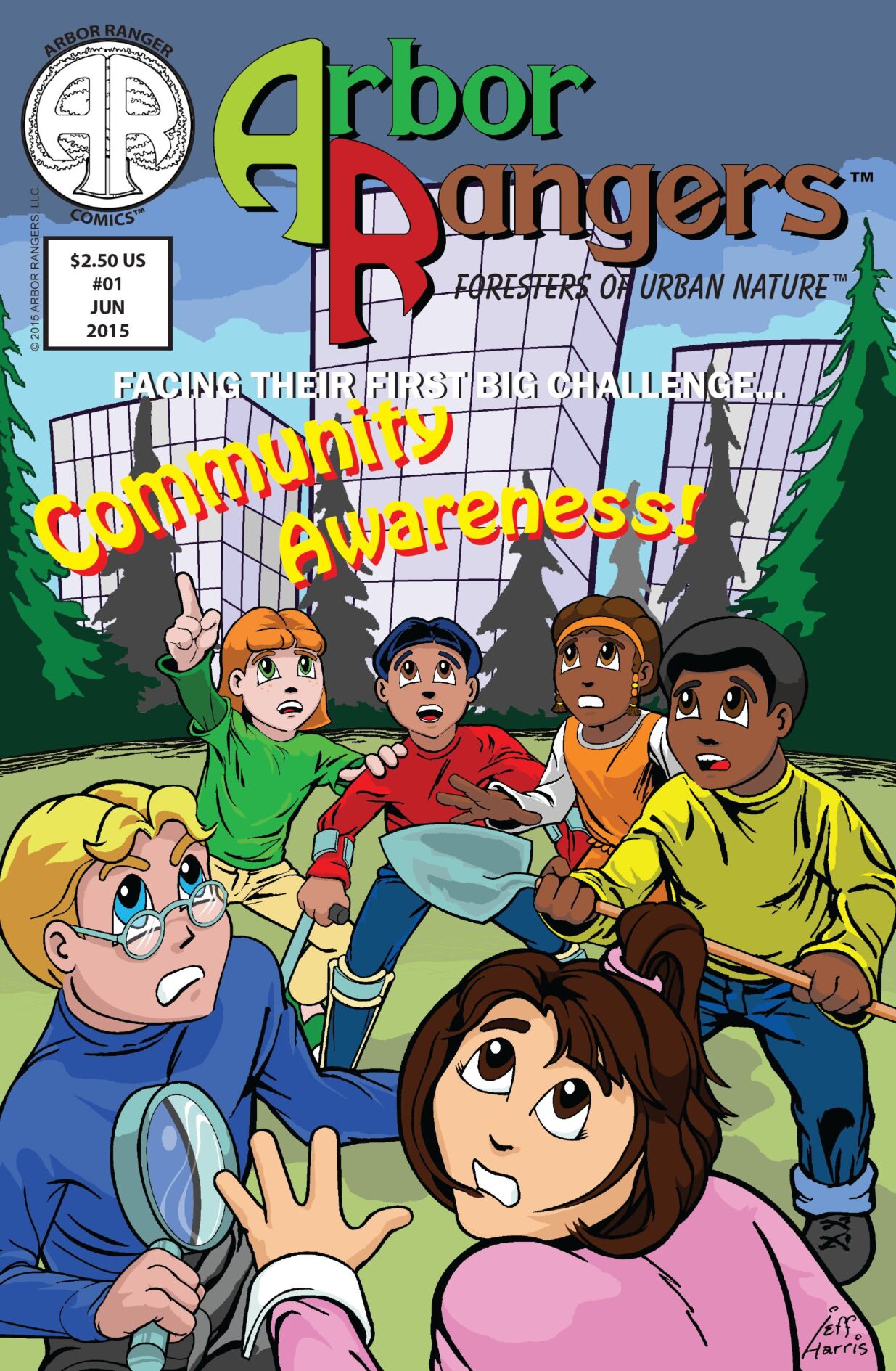
The Arbor Rangers™ is an educational outreach program created by Certified Arborist and Senior Art Director Jeff Harris that is primarily focused on fifth-graders, but can benefit most elementary school-age children and their grown-ups. The Arbor Rangers™ is presented as an entertaining adventure series to help kids learn basic knowledge in fun ways about trees in our urban environment and how to become good tree stewards.
The Power of Music in Learning
Jeff has always recognized the importance of music in education from growing up in the early 1970s through the 1980s, watching kids’ shows on PBS, like Sesame Street, Mister Rogers’ Neighborhood, The Electric Company, and Zoom, to name just a few. Weekdays after school and Saturday morning cartoons were filled with entertaining shows like Jonny Quest, The Super Friends, Scooby-Doo, Bugs Bunny, The Flintstones, and Schoolhouse Rock! What better way to help teach children about trees and their importance than through animation and music?
A Theme Song is Born
To accomplish this dream of making animations with music, the development of a theme song for the then-unnamed series was sparked back in April 2009. According to Jeff, “I just started humming some notes that were swirling around in my head out loud,” explaining how The Arbor Rangers™ theme song originated. “I knew I wanted something ‘catchy’ and fun that kids could be excited about and bob their heads to! I was imagining my childhood and the shows that my children were watching. I drew inspiration from newer cartoon shows from the 1990s. Eventually, through my humming and whistling, I started to formulate a melody I liked. I then was afraid I’d forget it, and so I purchased an MP3 digital recorder and began recording myself when the melody would return to my head, and I tried to hum or whistle the tune out loud again. Putting together some basic lyrics as I imagined a title sequence for a show helped me remember the tune easier. One thing was for sure: from that tune, I unmistakably found the name of my new series, The Arbor Rangers!™ It took a few tries and several rewrites to nail down the lyrics to where I like how they flowed, and finally, I had my theme song! Unfortunately, I am no musician. Writing sheet music for the song so that other musicians could play it was out of my area of expertise. I decided that my limited “hunt-n-peck” self-taught method of learning to play songs on my inexpensive piano keyboard would have to do. It didn’t take too long for me to learn to play the basic melody of my theme song, and after a bit of practice, I also managed to add a simple beat track and then recorded my performance.”
Delays and Setbacks
This endeavor has been one of passion for learning and teaching, but all of it is a self-funded outreach project. Inevitably, since those early days of development, progress in production has been slowed or indefinitely postponed due to other obligations or engagements in volunteer activities for non-profit organizations. In the meantime, Jeff has made efforts to define and refine the core Arbor Rangers™ team characters and is back to illustrating new elements for producing animations and publications (e.g., comic books). He still wants to produce a professionally arranged and recorded Official Theme track.
Arbor Rangers™ Theme Song (Lyrics & Basic Keys)
[Intro] (Brief drummer intro)
[Verse]
Ar-bor Ran-gers!

E  E   G   E

Bet-ter call on the dou-ble!

B   B   B    B  B   A   B

Ar-bor Ran-gers!

E  E   G   E

When your trees are in trou-ble!

B    B    C     C   C  B    C

Ar-bor Ran-gers!

E  E   G   E

E-ver rea-dy; re-source-ful!

B B   B   B   B  A      B
[Chorus]
For-e-sters of ur-ban na-ture,
C C B C D C B A
When threats put our trees in dan-ger,
C C B C D C B A
You can count on Ar-bor Ran-gers! Yah!
C C B C D C B A B
[Instrumental Break] (Energetic guitar solo with percussion)
B C C C A G F# G A B B B G F# E
B C C C A G F# G A B
B B B C C C C C D C B A B B B C D E
G G G G G A G F# G A G F# G B
(Repeat Main Verse and Chorus, skip Break, then Final Verse)
[Final Verse]
Ar-bor Ran-gers!
E E G E
[Outro]
Here is a sample of the basic Arbor Rangers Theme Song tune composed by Jeff Harris. Use the Up/Down Arrow keys on your computer keyboard to increase or decrease volume while playing the tune.
THEME SONG DEVELOPMENT
The decision on how to move forward in producing the theme music will ultimately define the spirit of the Arbor Rangers™ team and the adventures they will embark upon.
We are considering two, maybe three, possibilities:
- Conduct a contest (statewide, national, or even international) among grade school bands and choirs* to submit their performance of the theme song for a chance to have it used in future Arbor Rangers™ animated productions and live shows, be named in the credits, and receive a one-time cash prize; or Select and work in collaboration with a willing local school band and choir group in preparing instrumentals for the finished score, with acknowledgments in future productions that feature these works and a one-time cash donation to their music department/school.
- Put out an ad in various music vines to offer a chance for new or established bands looking for exposure of their talents to put together a finished song track using the established Arbor Ranger™ theme song melody and lyrics, which includes their name featured in the credits to future productions utilizing their work, and also a one-time cash bonus.
- Hire a music producer from a platform like Fiverr.
*The best renditions may be featured in a future Arbor Rangers™ music CD, with the top winning submission used as the official adaptation, which would be featured on the Arbor Rangers™ website and in future productions!
Check back in this MUSIC section for more songs about nature and trees, which are being written for future Arbor Rangers™ live and animated productions.
-
Native Trees of Indiana
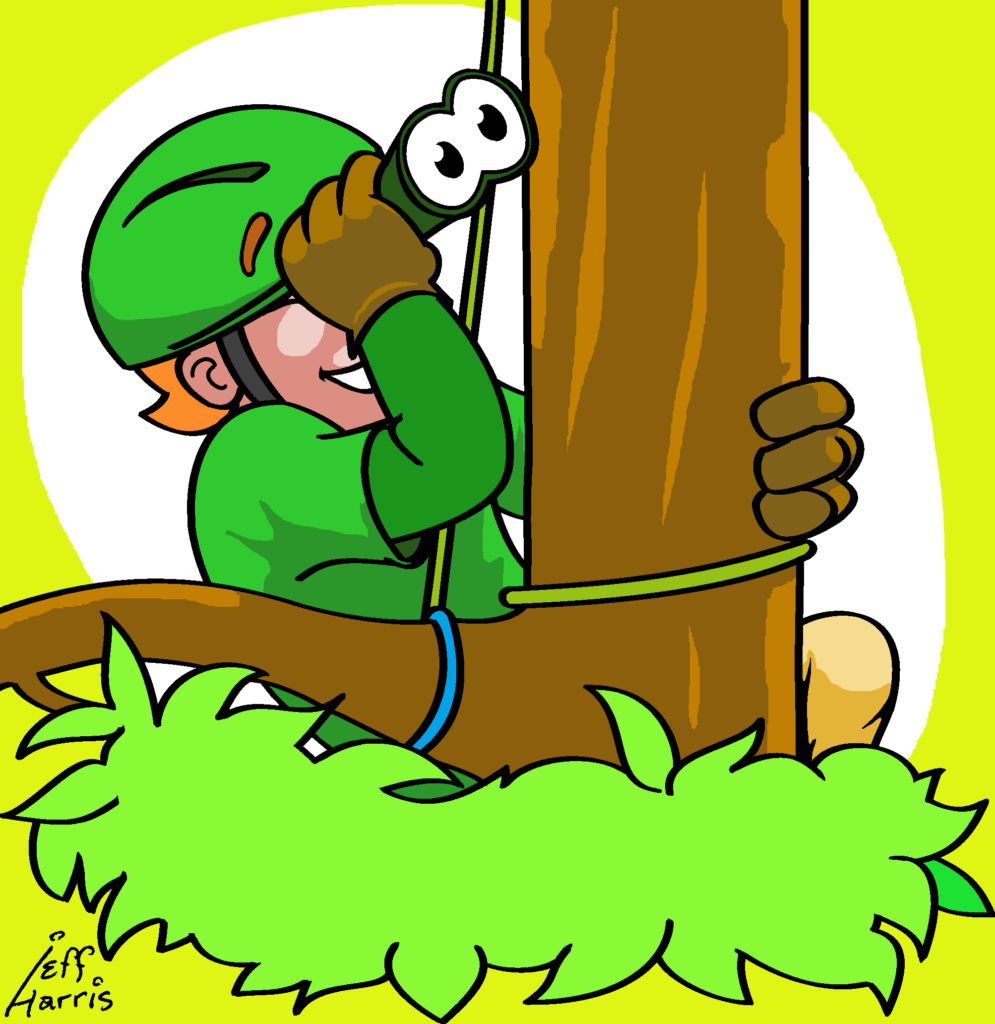
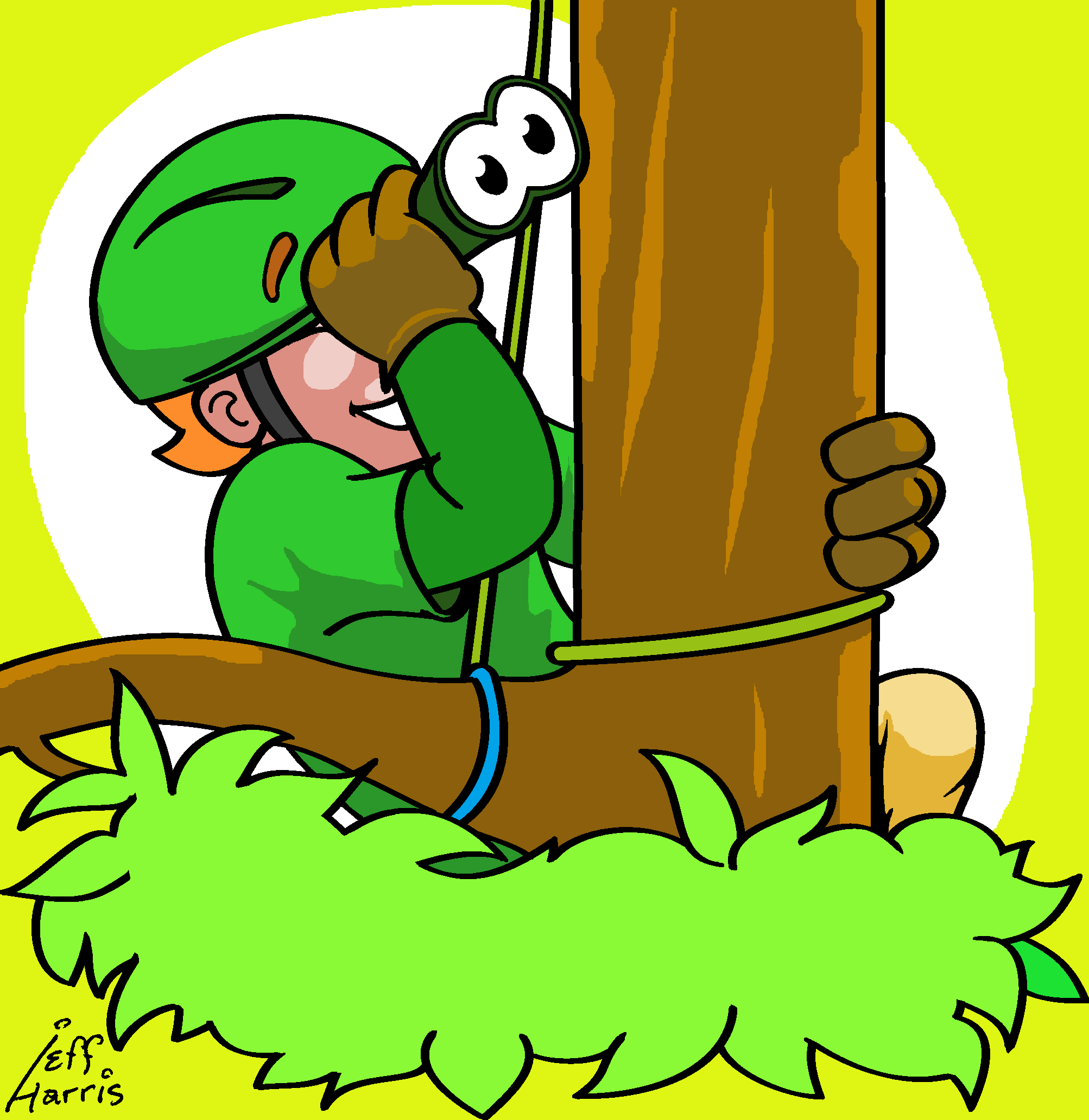
Sandy gets up close to view trees! Sandy loves the diversity of trees that are native to Indiana! Whenever she gets a chance, she puts on her safety equipment and goes out with her fellow Arbor Rangers ™ to view and climb trees.
Trees come in all shapes and sizes and Indiana, for example, has over 100 native species!
Did you know that some of these Indiana tree species are in common with nearby states?
For instance, the Indiana State Tree, the Tulip Tree (also known as Yellow Poplar; scientific name, Liriodendron tulipifera), is also the State Tree of Kentucky and Tennessee! It is native from Connecticut and southern New York, westward to southern Ontario and northern Ohio, and south to Louisiana and northern Florida.
The most common types of trees in Indiana range from:
- CONIFER (a.k.a. EVERGREEN or Softwood) trees bear cones with embedded seeds and have needle-like or scale-like leaves that remain “ever” green throughout the year. Because these plants do not produce flowers, they are among the group of plants known as “Gymnosperms“.
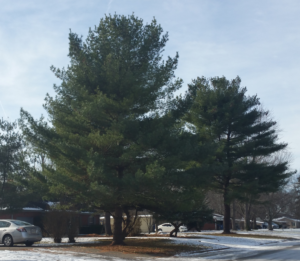
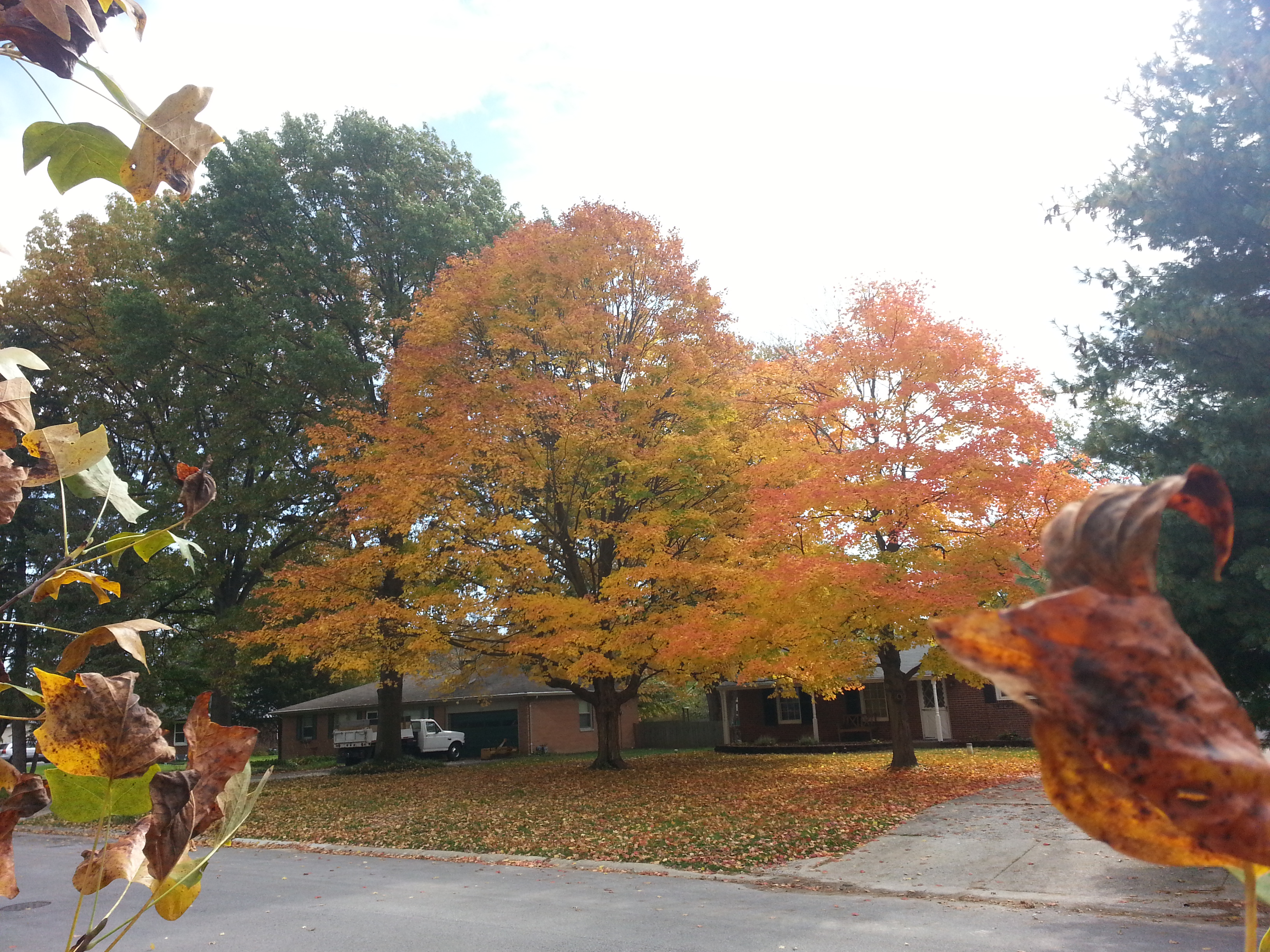
Eastern White Pines (Pinus strobus) adorn a front yard in this neighborhood. - DECIDUOUS HARDWOOD (a.k.a. Broadleafed) trees which are trees with broader, flattened, “fan-like” leaves (simple or compound of various shapes and sizes). These are seed-producing plants, like conifers, but they differ because they bear flowers (some more distinctly than others) and thereby are among a larger diverse group of plants called “Angiosperms“. Most species’ leaves will change color before dropping off in the fall season. This is true in other cooler climate states, but rarer in warmer or tropical climate states.
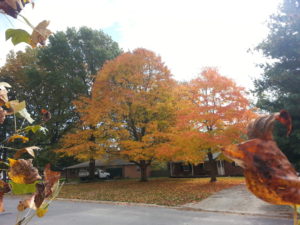
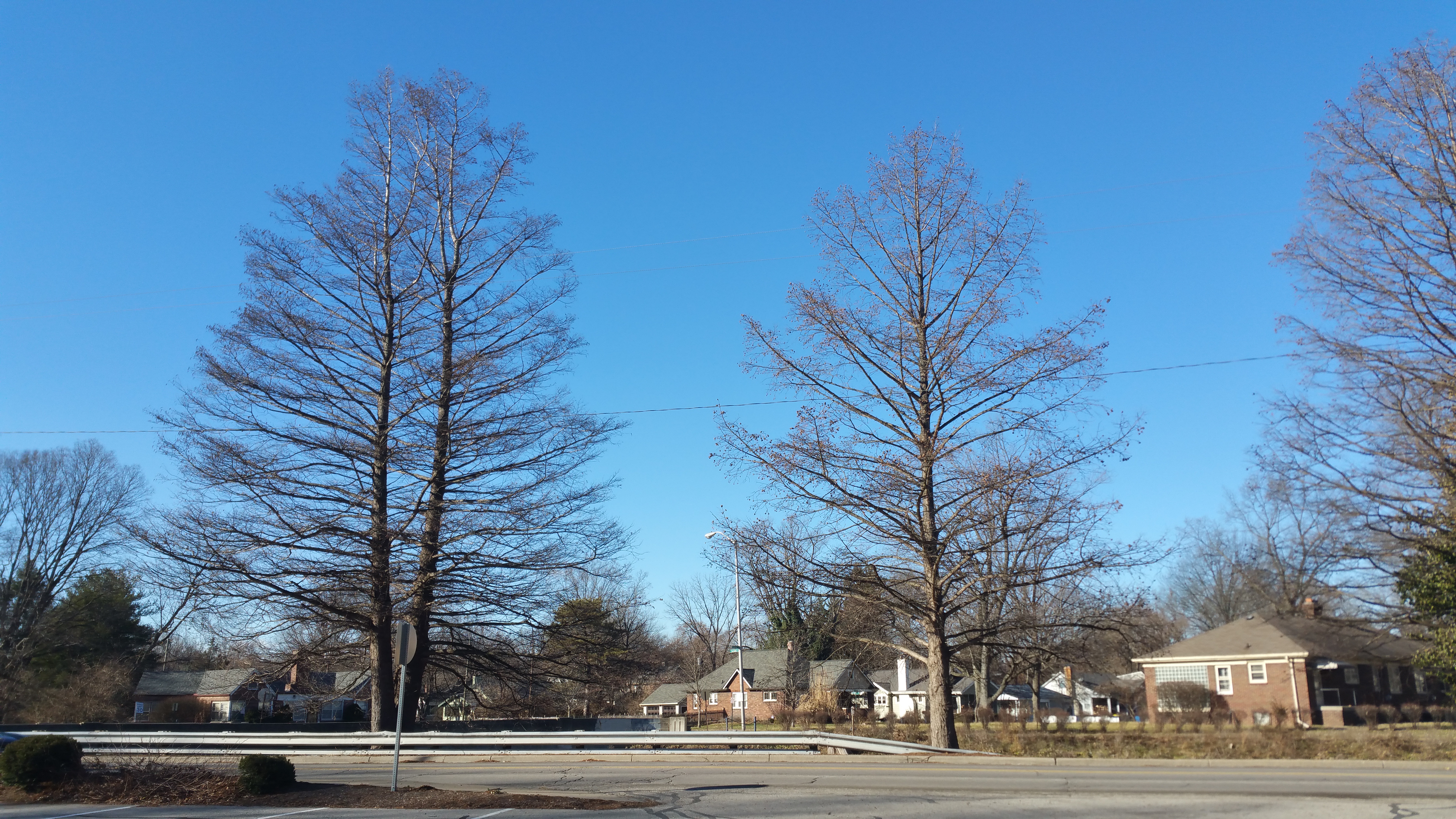
Sugar Maples (Acer saccharum) brighten up a neighborhood in fall! - DECIDUOUS EVERGREEN trees which look like typical conifers, but surprisingly lose their foliage in the fall just like deciduous hardwood trees! These are also among the group of plants known as “Gymnosperms“.
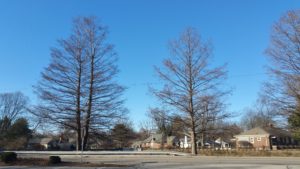
Baldcypress (Taxodium distichum) by the canal have lost their summer foliage. Do Your TREE-Search!
Sandy has helped put together the following list of trees that are native to Indiana. Included are non-native, INVASIVE SPECIES.* This is a searchable & sortable list of conifers and hardwood trees featuring their Scientific Names as well as Common Names by which they are generally known and includes links to more tree information** by clicking on their Scientific and Common Names.
DEFINITIONS The list also reflects some quick tree facts, such as:
- Type: One of the three tree types: Conifer, Deciduous Hardwood, or Deciduous Evergreen.
- Leaf: The general type of leaf form.
- Simple – a single leaf blade joined by its stalk (or petiole) to a woody stem.
- Compound – a leaf that is itself composed of more than one leaflet and these leaflets are attached to its single leaf stalk.
- Needle-like – slender, sharp-pointed leaf.
- Scale-like – leaves with short overlapping segments.
- Branching: Briefly describes the general, characteristic, growth structure of the plant’s stems/branches.
- Alternate – branching that is staggered or not directly across from one another.
- Opposite – branches that are directly across from each other.
- Height: The approximate average maximum height the tree species may obtain at maturity.
- Spread: The approximate average maximum width the tree species may obtain at maturity.
- Fall Color: The general color of the foliage during the fall/winter season; leaves detach and drop from deciduous tree types. Find out Why Leaves Change Color.
- Hardiness Zones: Range of USDA Plant Hardiness Zones each plant has been reported to grow and usually thrive in. To learn more about hardiness zones, see our USDA Plant Hardiness Zone Map – INDIANA page.
HINT: Viewing the list on a small screen mobile device in portrait position may not display all columns. Try viewing this page with your device in landscape orientation to broaden your view of all featured columns of the tree list.
Explore the Native Trees of Indiana
*An invasive species is defined as a species that is: 1) non-native (or alien) to the ecosystem under consideration and 2) whose introduction causes or is likely to cause economic or environmental harm or harm to human health. Invasive species that occur in urban forests should be removed, if and wherever possible, or at least avoid being planted or replanted.Scientific Name(s) Common Name(s) Type; Leaf; Branching Height Spread Fall Color Hardiness Zones PEST ALERT! Juniperus virginiana Redcedar, Eastern; Red Cedar, Eastern Conifer, Scale-like, Alternate 50′ 20′  Green
Green2-9 EGM (seldom attacked by EGM) Pinus banksiana Pine, Jack; Jack-pine Conifer, Needle-like, Alternate 40′ 18′ Green3-7 EGM, SLF (especially favored by EGM, SLF) Pinus strobus Pine, Eastern White; Pine, White Conifer, Needle-like, Alternate 100′ 50′ Green5-7 EGM, SLF (especially favored by EGM, SLF) Pinus virginiana Pine, Virginia; Virginia-pine; Scrub-pine Conifer, Needle-like, Alternate 50′ 20′ Green4-8 EGM, SLF (especially favored by EGM, SLF) Thuja occidentalis Arborvitae, Eastern; White Cedar, Northern; White Cedar; Tree of Life Conifer, Scale-like, Alternate; Endangered 50′ 15′ Green2-8 EGM (seldom attacked by EGM) Tsuga canadensis Hemlock, Eastern; Hemlock, Canadian Conifer, Needle-like, Alternate 90′ 40′ Green4-7 EGM (especially favored by EGM) Larix laricina Larch, American; Larch, Eastern; Tamarack Evergreen, Deciduous, Needle-like, Alternate 75′ 30′  Yellow
2-8 EGM Taxodium distichum Baldcypress; Bald Cypress Evergreen, Deciduous, Needle-like, Alternate; Threatened 120′ 45′  Red, Copper
5-9 Acer negundo Boxelder; Maple, Ash-leaved Hardwood, Deciduous, Compound, Opposite 60′ 40′  Red-orange
3-8 EGM, ALB, SLF (especially favored by ALB) Acer nigrum Maple, Black Hardwood, Deciduous, Simple, Opposite 80′ 60′ Yellow4-8 EGM, ALB, SLF (especially favored by EGM, ALB) Acer platanoides Maple, Norway, incl. cultivar: Maple, Crimson King INVASIVE SPECIES Hardwood, Deciduous, Simple, Opposite 80′ 40′ Yellow4-8 EGM, ALB, SLF (especially favored by EGM, ALB) Acer rubrum Maple, Red Hardwood, Deciduous, Simple, Opposite 90′ 50′ Red-orange4-8 EGM, ALB, SLF (especially favored by EGM, ALB) Acer saccharinum Maple, Silver; Silver-maple Hardwood, Deciduous, Simple, Opposite 80′ 60′ Yellow4-8 EGM, ALB, SLF (especially favored by EGM, ALB) Acer saccharum Maple, Sugar; Sugar-maple Hardwood, Deciduous, Simple, Opposite 80′ 60′  Yellow-orange
4-8 EGM, ALB, SLF (especially favored by EGM, ALB) Aesculus flava (A. octandra) Buckeye, Yellow; Buckeye, Sweet Hardwood, Deciduous, Compound, Opposite 90′ 50′  Yellow, Brown
3-8 EGM, ALB (especially favored by ALB) Aesculus glabra Buckeye, Ohio Hardwood, Deciduous, Compound, Opposite 50′ 35′  Red-brown
3-7 EGM, ALB (especially favored by ALB) Amelanchier arborea Serviceberrry, Downy; Serviceberry, Common Hardwood, Deciduous, Simple, Alternate 30′ 25′  Yellow-red
4-9 EGM, SLF (especially favored by EGM) Amelanchier laevis Serviceberry, Allegheny: Shadbush, Allegheny; Serviceberry, Smooth Hardwood, Deciduous, Simple, Alternate 30′ 10′ Yellow-red4-8 EGM, SLF (especially favored by EGM) Asimina triloba Pawpaw Hardwood, Deciduous, Simple, Alternate 30′ 30′ Yellow5-8 EGM (especially favored by EGM) Betula alleghaniensis Birch, Yellow Hardwood, Deciduous, Simple, Alternate 60′ 60′ Yellow3-9 EGM, ALB, SLF (especially favored by EGM) Betula nigra Birch, River; Birch, Red Hardwood, Deciduous, Simple, Alternate 80′ 60′ Yellow3-9 EGM, ALB, SLF (especially favored by EGM) Betula papyrifera Birch, Paper; Birch, White Hardwood, Deciduous, Simple, Alternate 50′ 60′ Yellow3-9 EGM, ALB, SLF (especially favored by EGM) Betula populifolia Birch, Gray; Birch, Grey Hardwood, Deciduous, Simple, Alternate; Presumed Extirpated 30′ 20′ Yellow4-6 EGM, ALB, SLF (especially favored by EGM) Carpinus caroliniana Hornbeam, American; Beech, Blue; Musclewood; Beech, Water Hardwood, Deciduous, Simple, Alternate 30′ 25′ Yellow-red3-9 EGM (especially favored by EGM) Carya cordiformis Hickory, Bitternut; Bitternut-hickory Hardwood, Deciduous, Compound, Alternate 80′ 50′ Yellow3-7 Carya glabra Hickory, Pignut; Pignut-hickory Hardwood, Deciduous, Compound, Alternate 60′ 40′ Yellow5-9 EGM, SLF (especially favored by EGM) Carya illinoinensis Pecan Hardwood, Deciduous, Compound, Alternate 100′ 75′ Yellow6-9 EGM, SLF (especially favored by EGM) Carya laciniosa Hickory, Shellbark; Shellbark-hickory Hardwood, Deciduous, Compound, Alternate 120′ 60′ Yellow5-8 EGM, SLF (especially favored by EGM) Carya ovalis Hickory, Red; Red-hickory; Hickory, Sweet Pignut; Sweet Pignut-hickory Hardwood, Deciduous, Compound, Alternate 80′ 80′ Yellow, Brown4-8 EGM, SLF (especially favored by EGM) Carya ovata Hickory, Shagbark; Shagbark-hickory Hardwood, Deciduous, Compound, Alternate 80′ 40′ Yellow4-8 EGM, SLF (especially favored by EGM) Carya pallida Hickory, Sand; Hickory, Pale Hardwood, Deciduous, Compound, Alternate; Threatened 40′ 43′  Yellow, Pale
5-9 EGM, SLF (especially favored by EGM) Carya texana Hickory, Black Hardwood, Deciduous, Compound, Alternate; Endangered 50′ 43′ Yellow, Brown5-9 EGM, SLF (especially favored by EGM) Carya tomentosa Hickory, Mockernut Hardwood, Deciduous, Compound, Alternate 60′ 30′ Yellow, Brown6-8 EGM, SLF (especially favored by EGM) Castenea dentata Chestnut, American Hardwood, Deciduous, Simple, Alternate; Endangered 75′ 75′ Yellow, Brown5-8 EGM, SLF (especially favored by EGM) Catalpa speciosa Catalpa, Northern; Catalpa Hardwood, Deciduous, Simple, Whorled 60′ 40′  Yellow-green
4-9 EGM (seldom attacked by EGM) Celtis laevigata Sugarberry; Hackberry, Southern Hardwood, Deciduous, Simple, Alternate 80′ 80′ Yellow6-9 Celtis occidentalis Hackberry, Common; Hackberry, Northern Hardwood, Deciduous, Simple, Alternate 90′ 60′ Yellow2-9 EGM, ALB (especially favored by EGM) Cercis canadensis Redbud; Redbud, Eastern Hardwood, Deciduous, Simple, Alternate 30′ 35′ Yellow4-9 EGM (especially favored by EGM) Cladrastis kentukea (C. lutea) Yellowwood; Yellowwood, American; Yellowwood, Kentucky Hardwood, Deciduous, Compound, Alternate; Threatened 60′ 55′ Yellow4-8 Cornus alternifolia Dogwood, Pagoda; Pagoda-dogwood; Dogwood, Alternate-leaved Hardwood, Deciduous (Shrubby), Simple, Alternate 30′ 30′  Red, Purple
4-7 EGM, SLF (especially favored by SLF) Cornus florida Dogwood, Flowering Hardwood, Deciduous, Simple, Opposite 40′ 20′  Red, Rust
5-8 EGM, SLF (especially favored by SLF) Crataegus crus-galli Hawthorn, Cockspur; Cockspur-thorn Hardwood, Deciduous, Simple, Alternate 25′ 25′  Orange-red
3-7 EGM (especially favored by EGM) Crataegus mollis Hawthorn, Downy Hardwood, Deciduous, Simple, Alternate 25′ 30′ Orange-red3-6 EGM (especially favored by EGM) Crataegus punctata Hawthorn, Dotted Hardwood, Deciduous, Simple, Alternate 30′ 30′ Orange-red4-8 EGM (especially favored by EGM) Crataegus viridis Hawthorn, Green Hardwood, Deciduous, Simple, Alternate; Threatened 25′ 25′  Red-orange
5-7 EGM (especially favored by EGM) Diospyros virginiana Persimmon; Persimmon, Common Hardwood, Deciduous, Simple, Alternate 60′ 35′ Orange-red4-8 EGM (especially favored by EGM) Fagus grandifolia Beech, American Hardwood, Deciduous, Simple, Alternate 80′ 80′ Orange-red4-8 EGM, SLF (especially favored by EGM, SLF) Fraxinus americana Ash, White; Purple Ash Hardwood, Deciduous, Compound, Opposite 100′ 70′ Red, Purple3-9 EAB, EGM, ALB, SLF (less preferred by EAB, ALB; seldom attacked by EGM;especially favored by SLF) Fraxinus nigra Ash, Black Hardwood, Deciduous, Compound, Opposite 60′ 70′ Yellow3-9 EAB, EGM, ALB, SLF (especially favored by EAB; less preferred by ALB; seldom attacked by EGM) Fraxinus pennsylvanica Ash, Green; Ash, Red Hardwood, Deciduous, Compound, Opposite 50′ 70′ Yellow3-9 EAB, EGM, ALB, SLF (especially favored by EAB, ALB; seldom attacked by EGM) Fraxinus profunda Ash, Pumpkin; Pumpkin-ash Hardwood, Deciduous, Compound, Opposite 60′ 70′ Red, Purple5-9 EAB, EGM, ALB, SLF (seldom attacked by EGM) Fraxinus quadrangulata Ash, Blue Hardwood, Deciduous, Compound, Opposite 70′ 70′ Yellow, Pale3-9 EAB, EGM, ALB, SLF (less preferred by EAB; seldom attacked by EGM) Gleditsia aquatica Waterlocust; Water-locust Hardwood, Deciduous, Compound, Alternate; Endangered 60′ 39′ Yellow6-9 Gleditsia triacanthos Honeylocust; Honey-locust Hardwood, Deciduous, Compound, Alternate 70′ 40′ Yellow, Brown4-9 EGM (seldom attacked by EGM) Gymnocladus dioicus Kentucky Coffeetree; Kentucky Coffee-tree Hardwood, Deciduous, Compound, Alternate 100′ 50′ Yellow3-8 Juglans cinerea Butternut; Walnut, White Hardwood, Deciduous, Compound, Alternate 60′ 50′ Yellow3-7 EGM, SLF (especially favored by EGM) Juglans nigra Walnut, Black Hardwood, Deciduous, Compound, Alternate 80′ 70′ Yellow4-9 EGM, SLF (especially favored by EGM, SLF) Liquidambar styraciflua Sweetgum; Gum, Sweet; Gum, Red Hardwood, Deciduous, Simple, Alternate 120′ 50′ Orange-red5-9 EGM (especially favored by EGM) Liriodendron tulipifera Tuliptree; Tulip-tree; Poplar, Tulip; Poplar, Yellow Hardwood, Deciduous, Simple, Alternate 175′ 50′ Yellow5-9 EGM, SLF (seldom attacked by EGM; especially favored by SLF) Magnolia acuminata Magnolia, Cucumber; Cucumber-tree; Cucumbertree Hardwood, Deciduous, Simple, Alternate; Endangered 100′ 35′  Yellow, Gold
3-8 EGM Magnolia tripetala Magnolia, Umbrella; Umbrella-tree Hardwood, Deciduous, Simple, Alternate; Endangered 20′ 30′ Yellow, Brown5-8 Malus coronaria
(Pyrus coronaria)Crabapple, American; Crabapple, Wild; Crabapple, Wild Sweet; Crabapple, Sweet Hardwood, Deciduous, Simple, Alternate 30′ 25′ Yellow-green4-8 Malus ioensis Crabapple, Prairie Hardwood, Deciduous, Simple, Alternate 25′ 25′ Red-orange4-8 Morus alba Mulberry, White; Mulberry, Silkworm INVASIVE SPECIES Hardwood, Deciduous, Simple, Alternate 30′ 50′ Yellow4-8 Morus rubra Mulberry, Red Hardwood, Deciduous, Simple, Alternate 70′ 35′ Yellow5-10 Nyssa sylvatica Gum, Black; Gum, Sour; Tupelo, Black Hardwood, Deciduous, Simple, Alternate 60′ 30′ Red, Copper3-9 Ostrya virginiana Hophornbeam; Hop-hornbeam, American; Hop-hornbeam, Eastern; Ironwood Hardwood, Deciduous, Simple, Alternate 30′ 30′ Yellow3-9 Oxydendrum arboreum Sourwood Hardwood, Deciduous, Simple, Alternate; Threatened 60′ 25′ Orange-red5-9 Platanus occidentalis Sycamore; Sycamore, American Hardwood, Deciduous, Simple, Alternate 100′ 100′ Yellow4-9 Populus balsamifera Poplar, Balsam; Balsam-poplar Hardwood, Deciduous, Simple, Alternate; Presumed Extirpated 70′ 10′ Yellow3-9 Populus deltoides Cottonwood; Cottonwood, Eastern Hardwood, Deciduous, Simple, Alternate 100′ 75′ Yellow2-9 Populus grandidentata Aspen, Bigtooth; Aspen, Big-toothed; Aspen, Large-toothed Hardwood, Deciduous, Simple, Alternate 50′ 28′ Yellow, Gold3-5 Populus heterophylla Cottonwood, Swamp Hardwood, Deciduous, Simple, Alternate 70′ 40′ Yellow3-8 Populus tremuloides Aspen, Quaking; Aspen, Trembling Hardwood, Deciduous, Simple, Alternate 50′ 30′ Yellow2-5 Prunus americana Plum, American; Plum, American Wild Hardwood, Deciduous, Simple, Alternate 25′ 25′ Orange-red3-10 Prunus hortulana Plum, Hortulan; Plum, Wild Goose Hardwood, Deciduous, Simple, Alternate 15′ 15′ Orange-red5-9 Prunus nigra Plum, Canada; Canada-plum Hardwood, Deciduous, Simple, Alternate 25′ 15′ Red, Purple3-6 Prunus pensylvanica Cherry, Pin; Pin-cherry; Cherry, Fire Hardwood, Deciduous, Simple, Alternate 40′ 30′ Orange-red3-8 Prunus serotina Cherry, Wild Black; Cherry, Black Hardwood, Deciduous, Simple, Alternate 80′ 25′ Yellow3-10 Pyrus calleryana Pear, Callery, incl. cultivar: Pear, Bradford INVASIVE SPECIES Hardwood, Deciduous, Simple, Alternate 50′ 35′ Red, Purple4-9 Quercus acutissima Oak, Sawtooth INVASIVE SPECIES Hardwood, Deciduous, Simple, Alternate 60′ 60′ Yellow, Brown5-9 Quercus alba Oak, White Hardwood, Deciduous, Simple, Alternate 150′ 70′ Red3-9 Quercus bicolor Oak, Swamp White Hardwood, Deciduous, Simple, Alternate 75′ 70′ Yellow, Brown3-9 Quercus coccinea Oak, Scarlet Hardwood, Deciduous, Simple, Alternate 80′ 50′  Red, Deep
4-8 Quercus ellipsoidalis Oak, Northern Pin; Pin-oak, Northern; Oak, Hill’s Hardwood, Deciduous, Simple, Alternate 60′ 70′ Red, Rust3-9 Quercus falcata Oak, Southern Red; Oak, Spanish Hardwood, Deciduous, Simple, Alternate 80′ 50′ Red, Copper7-9 Quercus imbricaria Oak, Shingle; Shingle-oak Hardwood, Deciduous, Simple, Alternate 60′ 70′ Orange-red3-9 Quercus lyrata Oak, Overcup; Overcup-oak Hardwood, Deciduous, Simple, Alternate 80′ 60′  Orange-brown
6-9 Quercus macrocarpa Oak, Bur; Bur-oak; Oak, Mossycup Hardwood, Deciduous, Simple, Alternate 80′ 70′ Red, Copper3-9 Quercus marilandica Oak, Blackjack; Oak, Black-jack Hardwood, Deciduous, Simple, Alternate 40′ 70′ Red3-9 Quercus michauxii Oak, Swamp Chestnut; Chestnut-oak, Swamp Hardwood, Deciduous, Simple, Alternate 80′ 50′ Red6-9 Quercus montana (Q. prinus) Oak, Chestnut; Oak, Rock Chestnut; Chestnut-oak, Rock; Oak, Rock; Oak, Mountain Hardwood, Deciduous, Simple, Alternate 75′ 60′ Yellow, Brown5-9 Quercus muehlenbergii Oak, Chinkapin; Oak, Chinquapin; Chinkapin-oak; Oak, Yellow Hardwood, Deciduous, Simple, Alternate; Endangered 80′ 70′ Orange-brown3-9 Quercus pagoda Oak, Cherrybark; Cherrybark-oak Hardwood, Deciduous, Simple, Alternate 120′ 48′ Red, Copper7-9 Quercus palustris Oak, Pin; Pin-oak Hardwood, Deciduous, Simple, Alternate 80′ 70′ Orange-red3-9 Quercus rubra Oak, Red; Oak, Northern Red Hardwood, Deciduous, Simple, Alternate 80′ 70′ Red, Deep3-9 Quercus shumardii Oak, Shumard Hardwood, Deciduous, Simple, Alternate 80′ 60′ Orange-red5-9 Quercus stellata Oak, Post; Post-oak Hardwood, Deciduous, Simple, Alternate 50′ 70′ Red, Copper3-9 Quercus velutina Oak, Black Hardwood, Deciduous, Simple, Alternate 60′ 60′ Orange-red3-9 Robinia pseudoacacia Locust, Black Hardwood, Deciduous, Compound, Alternate 80′ 35′ Yellow4-8 Sassafras albidum Sassafras Hardwood, Deciduous, Simple, Alternate 90′ 40′ Red, Deep5-9 Tilia americana Basswood, American; Linden, American Hardwood, Deciduous, Simple, Alternate 80′ 50′ Yellow3-8 Ulmus alata Elm, Winged Hardwood, Deciduous, Simple, Alternate 50′ 40′ Yellow6-9 Ulmus americana Elm, American Hardwood, Deciduous, Simple, Alternate 100′ 120′ Yellow2-9 Ulmus pumila Elm, Siberian INVASIVE SPECIES Hardwood, Deciduous, Simple, Alternate 60′ 50′ Yellow5-9 Ulmus rubra Elm, Slippery; Elm, American Slippery Hardwood, Deciduous, Simple, Alternate 60′ 35′ Yellow3-9 Ulmus thomasii Elm, Rock; Elm, Cork Hardwood, Deciduous, Simple, Alternate 90′ 90′ Yellow3-7 Salix amigdaloides Willow, Peachleaf; Willow, Peach-leaf Hardwood, Deciduous (Shrubby), Simple, Alternate 40′ 17′ Yellow2-8 Salix nigra Willow, Black Hardwood, Deciduous, Simple, Alternate 40′ 100′ Yellow2-8 Aralia spinosa Devil’s Walkingstick; Devil’s-walkingstick; Hercules’ Club Hardwood, Deciduous (Shrubby), Compound, Alternate 20′ 10′ Red-orange4-9 Hamamelis virginiana Witch-hazel Hardwood, Deciduous (Shrubby), Simple, Alternate 20′ 25′ Yellow3-8 Ptelea trifoliata Hoptree; Hoptree, Common; Hop-tree, Common; Wafer-ash Hardwood, Deciduous (Shrubby), Simple, Alternate 20′ 15′ Yellow3-9 Rhus typhina Sumac, Staghorn; Staghorn-sumac Hardwood, Deciduous (Shrubby), Compound, Alternate 25′ 25′ Red-orange4-8 Sorbus decora Showy Mountainash; Showy Mountain-ash Hardwood, Deciduous (Shrubby), Compound, Alternate; Presumed Extirpated 30′ 70′ Red-orange3-9 Ailanthus altissima Tree of Heaven INVASIVE SPECIES Hardwood, Deciduous, Compound, Alternate 70′ 50′ Yellow-green5-8 Alnus glutinosa Alder, European Black; Alder, Black; Alder, Common INVASIVE SPECIES Hardwood, Deciduous, Simple, Alternate 50′ 40′ Yellow-green3-7 Paulownia tomentosa Princess Tree; Royal Paulownia; Empress Tree; Princesstree INVASIVE SPECIES Hardwood, Deciduous, Simple, Opposite or Whorled 40′ 40′ Green5-8 Phellodendron amurense Amur Cork Tree; Amur Corktree INVASIVE SPECIES Hardwood, Deciduous, Compound, Opposite 45′ 60′ Yellow3-7
**Links for additional information include fact sheets from various federal and municipal entities and academic institutions. These fact sheets expand upon and feature a broader range of tree details, including identification photos. These factsheet links were specifically selected, based on the quality of their online content. We highly recommend the book “Native Trees of the Midwest“ by Sally Weeks (Purdue University). Please contact us regarding any broken web links.
[DISCLAIMER: Tree facts sometimes vary from source to source, and particularly from state to state. We conducted our research from multiple sources from within Indiana and then from states in our general region, with few exceptions. Arbor Rangers, LLC makes no guarantees, nor claims, as to fitness of the data represented other than that every attempt has been made to present such information as accurately as possible. After consulting the “101 Trees of Indiana” © 2003 publication as a basis for our tree list, we then cross-checked the information with other sources. Where sources differed in information, we gave preference to the data from the newer published book “Native Trees of the Midwest” (Revised and Expanded Second Edition) © 2010 and then, in the case where certain data was not cited in this publication, we used or averaged the data available from the other resources listed at the bottom of this page. This tree list is subject to modification without prior notification.]Native Trees of Indiana list compiled, created and copyright © 2017 Arbor Rangers, LLC.
Arbor Rangers, LLC would like to thank and acknowledge the following resources which made this compilation possible:
- Sally Weeks: “Native Trees of the Midwest“ (Second Edition) [ISBN 978-1-55753-572-6]
- Marion Jackson: “101 Trees of Indiana“ [ISBN 978-0-253-21694-6]
- Indiana University-Purdue University (Fort Wayne): Native Trees of Indiana River Walk website
- Elbert Little: “Field Guide to Trees: Eastern Region – North America“ [ISBN 0-394-50760-6]
- USDA Forest Service: “Silvics of North America“ (Agriculture Handbook 654) also their Natural Resources Conservation Service (NRCS) and Fire Effects Information System (FEIS) online databases
- Butler University: Indiana Plant Atlas
- University of Florida Environmental Horticulture: 680 Tree Fact Sheets
- Missouri Botanical Garden: Plant Finder
- Ohio DNR Forestry: Common Ohio Trees
- Virginia Tech: Dendrology factsheets (“vTree” database)
- Arbor Day Foundation: Tree Identification
- The Morton Arboretum: Tree and plant descriptions
- Indiana Invasive Species Council: Official IISC Invasive Plant List
- Rebecca Weller’s: Trees For Me website
- University of Texas at Austin/Lady Bird Johnson Wildflower Center: Native Plant Finder
- Illinois Wildflowers: Trees, Shrubs, and Woody Vines of Illinois
- Minnesota Wildflowers: Trees in Minnesota
- New England Wild Flower Society/Go Botany: Woody Plants
- Friends of the Louisiana State Arboretum: Featured Species
- Global Species website
- Dave’s Garden website
- With special THANKS to Lindsey Purcell, Urban Forest Specialist, Purdue University for his expert review!
Find additional resources here on our TEACHER and PARENT RESOURCES page.
-
POLLINATORS: Vital to Sustaining Life -What YOU Can Do
Arbor Rangers ™ Supports Pollinators #FeedABee
Arbor Rangers, LLC, through our educational outreach program, featuring The Arbor Rangers ™, is proud to be a supporter of the Bayer “Feed a Bee” program! We advocate good stewardship of our urban forests because disregard for these natural resources can significantly impact our economy and very existence. This is even truer concerning the effect we have on pollinators.
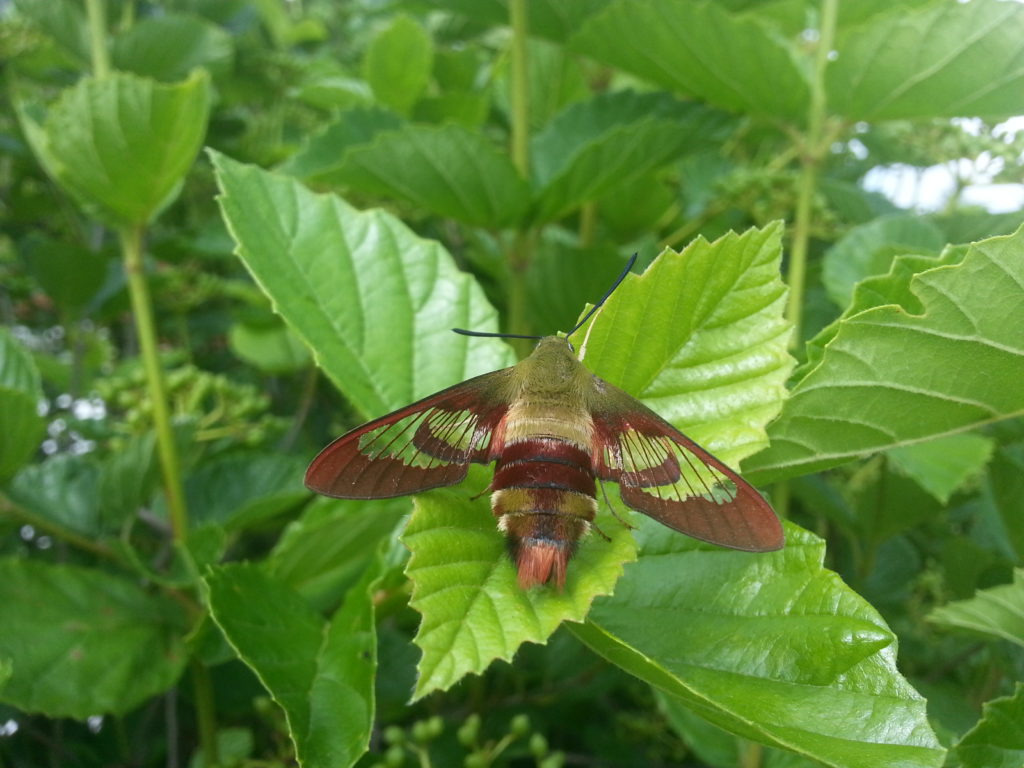
Pollinators are insects, birds and other small creatures that assist plants in reproducing by their normal activities. For example, some creatures feed on a flowering plant’s nectar, petals or leaves. As they feed, their bodies often collect and transport the genetic material of that plant, known as pollen. These tiny pollen grains (produced by a flower’s stamen) become attached to the unsuspecting pollinators as they feed or when they brush up against the plant. As they move about, the pollen is transferred to the flower’s pistil, thus completing the fertilization process. Once fertilized, food-producing plants become the source of multitudes of foods, such as nuts, fruits & vegetables. Many plants also provide natural oils, along with a host of other resources vital for the life and stability of our planet.
How can you help pollinators?
Responsible pesticide use is important. Often, the over-use or misuse of insecticides has contributed to the reduction in populations of pollinators. Another area of importance is FEEDING pollinators. They have to eat, too, so consider planting flower beds, home gardens, and yes, non-invasive flowering ornamental trees to brighten up your spring landscape! All of these contribute to our urban forest and help preserve our pollinators at the same time!
Arbor Rangers ™ supports Bayer’s “Feed a Bee” program by talking about it as part of our urban forest advocacy program and in helping to distribute packets of their Pollinator Wildflower Mix to raise awareness of the vital role of pollinators and encourage the participation in providing food for them.
Educational Resources:
- Bayer publications page hosts links to a tremendous amount of study and research into bee biology and in-depth explanations of their importance. Featured are amazing facts about them, including their vital role as pollinators and why they threats to their existence warrants our serious attention. You will also find the following learning materials to help children acquire a healthy appreciation and respect for bees:
- The Official Feed a Bee website where they promise that every time #FeedABee bee is shared, they’ll plant a wildflower! Clap along as you watch the “Feed a Bee” music video to learn more!
- Coloring pages:
- Children’s books:
- Sweet Virginia Foundation – Life is Honey Hive Alive! program has some really neat and free online lesson plans, such as:
- Bee Bodies – Honey Bee Anatomy: Structure and Function
- Everybody Has a Job! – The Fascinating Inside World of a Honey Bee Hive
- Tiny Bug Huge Role – How Honey Bees Collectively Affect Their Community, Ecosystem and the World
- Swarm – How Bees Manage Their Communities
- Honey – How it is Made and Used
- Vitamin Bee website features music, activities and videos, such as:
- Feed a Bee video
- How Honey is Made video
- and so much more for your school!
- National Honey Board educational materials:
- The Honey Files: A Bee’s Life – A Teaching Guide Grades 4-6
- The Pollinator Partnership
- List of pollinated foods
- US Forest Service – Bee Basics (PDF)
- National Wildlife Federation – Garden for Wildlife
- S. Fish & Wildlife Service – Pollinators
- Xerces Society for Invertebrate Conservation – Pollinator-Friendly Plant Lists
- Bayer publications page hosts links to a tremendous amount of study and research into bee biology and in-depth explanations of their importance. Featured are amazing facts about them, including their vital role as pollinators and why they threats to their existence warrants our serious attention. You will also find the following learning materials to help children acquire a healthy appreciation and respect for bees:
-
Are planting new trees in YOUR future? Great! But before you do…
DON’T TAKE CHANCES! Call 8-1-1 BEFORE you dig!
Knowing where underground utility lines are buried before each digging project begins helps to prevent injury, expense and penalties. The depth of utility lines may vary and multiple utility lines may exist in one area. Simple digging jobs can damage utility lines and can disrupt vital services to an entire neighborhood, harm those who dig and result in expensive fines and repair costs. Marked lines show those who dig the approximate location of underground lines and help prevent undesired consequences.
-
ANNOUNCEMENT: 2019 Arbor Day Poster Contest Suspended Indefinitely
Is Your Community Planning Ahead for Arbor Day 2019?
 Arbor Day is celebrated on the last Friday in the month of April in Indiana
ANNOUNCEMENT: 2019 Arbor Day Poster Contest Suspended Indefinitely
Sadly, it has come to our attention that Indiana’s DNR Community & Urban Forestry division will not be able to run the Arbor Day poster contest this year. Unfortunately, this news came too late for Arbor Rangers to pull together a plan and bolster enough resources and volunteers to be able to run the contest ourselves. We are looking into possibly organizing and managing the contest for 2020. We are sorry for any teachers, students, and their parents who looked forward to the regular contest this year and are disappointed by the cancellation. We strongly encourage you to still participate in an Arbor Day celebration in some way, like planting a tree, creating a poem, and volunteering in a related local event. Have a Happy Arbor Day!